
Removing water by boiling it off is one of the most energy-hungry jobs in any process plant. Whether a dairy is concentrating skim milk, a chemical unit is thickening a mother liquor, or a textile cluster is reducing reject brine ahead of a zero liquid discharge scheme, the evaporator is usually the largest single consumer of steam on site. That makes the choice of evaporator configuration much more than a technical detail. It sets the plant's fuel bill for the next fifteen to twenty years.
The most common decision engineers face is whether to install a simple single effect evaporator or a multiple effect evaporator (MEE). This article explains how each one works, why reusing vapor saves so much energy, where the extra effects stop paying for themselves, and how to decide which arrangement fits your capacity, product and budget. The guidance is drawn from AKSH Engineering's experience of designing evaporation and drying plants in Ahmedabad since 2013.
How a Single Effect Evaporator Works
A single effect evaporator is the simplest form of the technology. It consists of one heat exchanger (often called the calandria), one vapor-liquid separator and a condenser. Live steam from the boiler condenses on one side of the heat transfer surface, releasing its latent heat. That heat passes through the tube wall into the process liquid on the other side, which boils and releases water vapor. The concentrated liquid is drawn off, and the vapor is sent to a condenser where cooling water turns it back into liquid.
The weakness of this arrangement is easy to spot. The vapor leaving the separator carries almost as much latent heat as the steam that went in, and all of that energy is thrown away into the cooling water. As a result, a single effect unit typically evaporates a little less than one kilogram of water for every kilogram of steam it consumes. Engineers express this as steam economy, and for a single effect it is usually around 0.85 to 0.95.
Where Single Effect Units Still Make Sense
- Small duties: When evaporation rates are low, the steam saved by extra effects may not justify the extra equipment.
- Batch or campaign operation: Plants that run a few hours a day, or switch products frequently, benefit from the simple start-up and cleaning.
- Highly heat-sensitive products: A single effect under deep vacuum keeps the residence time and number of heating stages to a minimum.
How a Multiple Effect Evaporator Works
A multiple effect evaporator links two or more evaporator bodies in series so that the vapor boiled off in one effect becomes the heating medium for the next. Only the first effect receives live steam. Its vapor heats the second effect, the vapor from the second heats the third, and so on. Only the vapor from the last effect goes to the condenser.
For this cascade to work, each effect must boil at a lower temperature than the one before it, which means each operates at a progressively lower pressure. The first effect may run close to atmospheric pressure, while the last runs under a deep vacuum maintained by the condenser and a vacuum pump or steam ejector. The temperature difference between live steam and the final condenser is therefore shared among all the effects.
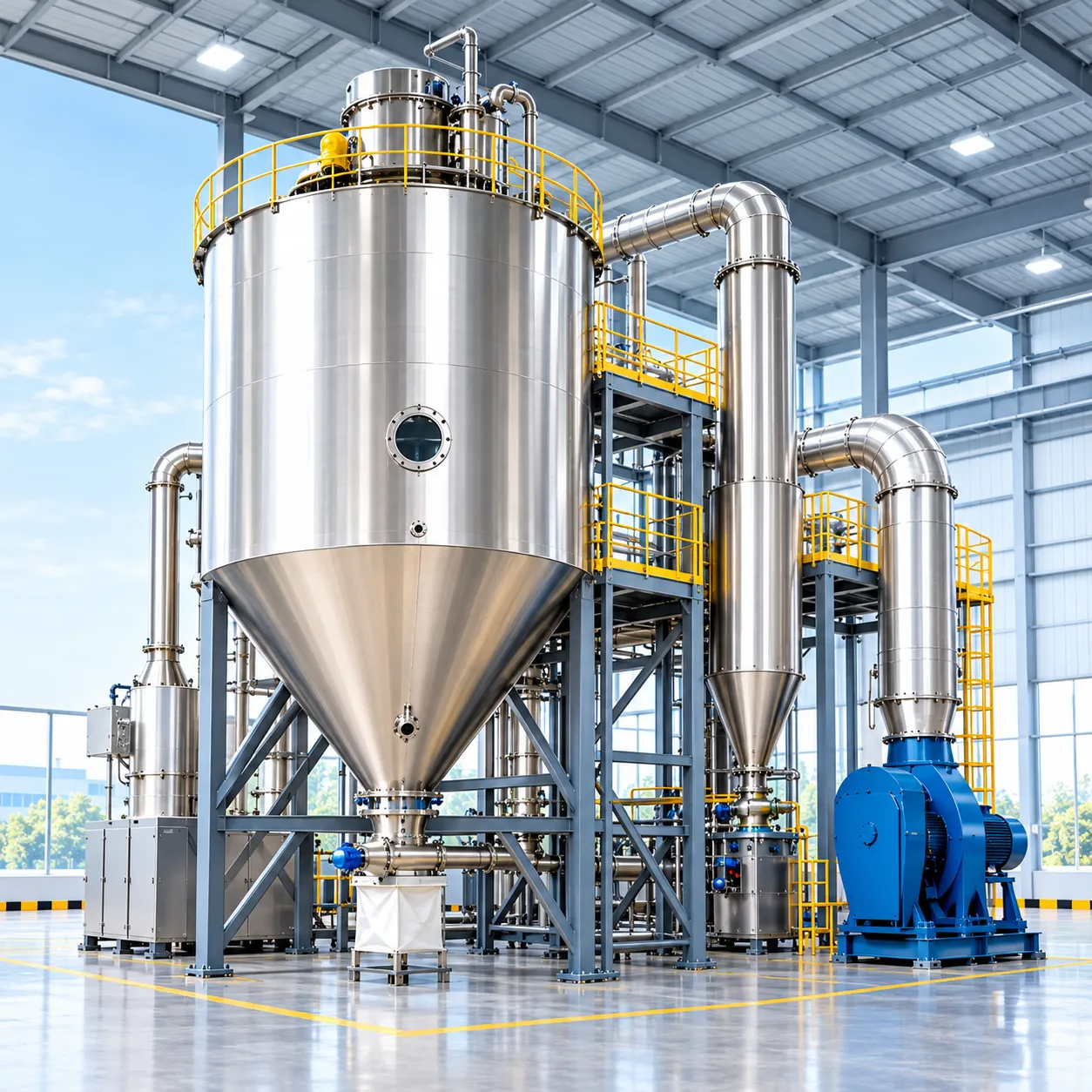
The result is that the same kilogram of live steam evaporates water several times over. A well-designed triple effect evaporator commonly achieves a steam economy of roughly 2.4 to 2.8, and larger plants with five or more effects can reach well above 4. AKSH's industrial evaporators are offered in double, triple and multi-effect configurations, along with falling film, forced circulation and MVR designs, so the arrangement can be matched to the duty rather than forced into a standard template.
Feed Arrangements in an MEE
The way liquid moves through the effects matters almost as much as the number of effects:
- Forward feed: Liquid flows in the same direction as the steam, from the hottest to the coldest effect. No pumps are needed between effects, but the most concentrated, viscous liquid ends up in the coldest effect, where heat transfer is weakest.
- Backward feed: Liquid enters the last, coldest effect and is pumped toward the first. The thickest liquid is handled at the highest temperature, which helps viscous products, at the cost of interstage pumps.
- Mixed feed: A combination of the two, chosen to balance viscosity, heat sensitivity and pumping.
- Parallel feed: Fresh feed enters every effect separately. This is common where crystals form in each body, as in salt production.
Single Effect vs Multiple Effect: Side-by-Side Comparison
The table below summarizes the practical differences. The steam economy figures are typical ranges for well-designed plants and will vary with product, boiling point elevation and feed temperature.
| Factor | Single Effect Evaporator | Multiple Effect Evaporator |
|---|---|---|
| Typical steam economy | About 0.85 to 0.95 kg water per kg steam | Roughly 1.7 to 1.9 (double), 2.4 to 2.8 (triple), above 4 for five or more effects |
| Live steam demand | Highest | Falls almost in proportion to the number of effects |
| Cooling water demand | Highest, since all vapor is condensed | Much lower, only last-effect vapor is condensed |
| Capital cost | Lowest | Higher, rising with each effect |
| Heat transfer area | Smallest total area | Larger total area, as each effect works on a smaller temperature difference |
| Control complexity | Simple | Needs level, pressure and flow control across effects |
| Best fit | Small, intermittent or very heat-sensitive duties | Continuous, medium to large duties such as effluent, dairy and chemical concentration |
Why Multiple Effects Save So Much Energy
The saving comes from reusing latent heat. Evaporating water requires roughly 2,200 to 2,400 kJ per kilogram depending on pressure, and that energy cannot be avoided. What can be avoided is supplying it fresh every time. In a single effect, each kilogram of steam does one job. In a triple effect, the same energy is used three times before it reaches the condenser.
An Illustrative Comparison
Consider a plant that needs to evaporate 10,000 kg of water per hour. The figures below are illustrative only and assume typical steam economies:
- Single effect at an economy of 0.9: about 10,000 / 0.9 = 11,111 kg/hr of live steam.
- Triple effect at an economy of 2.6: about 10,000 / 2.6 = 3,846 kg/hr of live steam.
- Five effect at an economy of 4.2: about 10,000 / 4.2 = 2,381 kg/hr of live steam.
Moving from one effect to three cuts steam demand by roughly 65 percent in this example. Moving from three effects to five saves a further 1,465 kg/hr, which is real but noticeably smaller. Over a year of continuous operation, these differences add up to thousands of tonnes of steam. To estimate the evaporation load for your own process, our guide on evaporator capacity calculation walks through the mass and energy balance step by step.
The Law of Diminishing Returns
Each added effect saves less than the one before. The first step from one to two effects roughly halves steam use. The step from five to six saves only a small fraction of the original consumption. Meanwhile, the cost of each extra body, its separator, piping, pumps and instruments is roughly constant. At some point the extra capital is no longer recovered by the steam saved.
Several physical limits also cap the number of effects:
- Available temperature difference: The total gap between live steam temperature and the condenser temperature is fixed by the boiler and cooling water. Dividing it across too many effects leaves each one with a small driving force, so the required heat transfer area grows.
- Boiling point elevation: Dissolved solids raise the boiling point of the liquid. In concentrated brines and sugar or salt solutions this elevation can be several degrees per effect, eating into the available temperature difference.
- Heat sensitivity: Products such as milk, fruit juices and herbal extracts cannot tolerate high first-effect temperatures, which limits the top of the temperature range.
- Fouling and scaling: More effects mean more surfaces to keep clean, and a low temperature difference can make fouling more troublesome.
Beyond Effects: TVR and MVR
Adding effects is not the only way to recycle vapor. Two vapor recompression methods are often combined with, or used instead of, extra effects.
Thermal Vapor Recompression (TVR)
A TVR uses a steam jet thermocompressor. High-pressure motive steam entrains part of the vapor from an effect and compresses it for reuse as heating steam. With no moving parts, it typically adds roughly the equivalent of one extra effect to the steam economy at modest cost.
Mechanical Vapor Recompression (MVR)
An MVR system uses an electrically driven fan or compressor to raise the pressure of the vapor so that it can heat the same evaporator body. Once running, it needs only a small amount of make-up steam, and its energy input is mainly electricity. Where power is reasonably priced and the plant runs continuously, MVR can reduce live steam demand far below even a large MEE. We explain the economics in detail in how MVR evaporators cut steam costs.
Choosing the Right Evaporator Type Within Each Effect
The number of effects is only half of the design. Each effect also needs the right type of heat exchanger for the liquid it handles:
- Falling film: Low residence time and high heat transfer at small temperature differences, ideal for multi-effect and MVR plants handling clean, low-viscosity or heat-sensitive feeds.
- Rising film: A simpler design for moderately viscous, foaming liquids, though it needs a larger temperature difference to drive circulation.
- Forced circulation: Pumped high-velocity flow that resists scaling and handles crystallizing or viscous liquids, often used as the final effect or finisher in effluent plants.
For a full breakdown of the first two designs, read falling film vs rising film evaporators. Many plants use a hybrid: falling film effects for bulk water removal and a forced circulation finisher.
Operating Factors That Decide Real-World Savings
Design steam economy is a promise made on paper. Actual savings depend on how the plant runs every day.
Feed Preheating
Cold feed must first be heated to its boiling point using steam that does no evaporation. Preheating it with hot condensate and vapor noticeably improves real steam economy.
Condensate Recovery
The condensate leaving each effect still carries useful sensible heat. Flashing it into the following effect, or using it to preheat feed, recovers energy that would otherwise be lost. Clean condensate from the steam side can also be returned to the boiler, saving treated water.
Fouling Control
A thin layer of scale can sharply cut the heat transfer coefficient, forcing operators to raise steam pressure to hold capacity. Regular cleaning, correct velocities and good pretreatment protect the economy the plant was designed for. Our article on common evaporator fouling problems covers prevention in depth.
Automation
Multiple effect plants have interacting levels, pressures and flows. Stable, automated control keeps every effect at its design point instead of drifting with operator adjustments. AKSH's instrumentation, automation and controls packages provide PLC and SCADA control with trend logging, alarms and interlocks, which makes it far easier to hold steady steam consumption.
Applications Where MEE Delivers the Biggest Payback
- Effluent treatment and ZLD: Concentrating RO reject and high-TDS streams before a crystallizer, ATFD or dryer. A ZLD plant typically relies on an MEE or MVR stage for most of its thermal water recovery.
- Dairy and food: Milk, whey, juices and extracts, often concentrated before spray drying to reduce drying costs.
- Chemicals and pharmaceuticals: Mother liquors, salt solutions, caustic and process intermediates.
- Agro and starch: Steep water, distillery spent wash and similar organic-rich streams.
Evaporation and drying often work as a pair. Water is far cheaper to remove in an MEE than in a dryer, so concentrating the feed before it reaches spray dryers can reduce overall energy use. Our article on reducing energy costs in industrial drying explores this concentration-first strategy further.
How to Decide: A Practical Checklist
- Quantify the evaporation load: Calculate kilograms of water to be removed per hour from feed and product concentrations.
- Check operating hours: Continuous, round-the-clock duty strongly favors more effects or MVR. Short, intermittent runs favor simplicity.
- Know your steam and power costs: High steam cost pushes toward more effects; favorable power cost may tip the balance toward MVR.
- Characterize the liquid: Boiling point elevation, viscosity, heat sensitivity and scaling tendency limit how many effects are practical.
- Compare lifecycle cost: Evaluate capital plus ten or more years of steam, power, cooling water and maintenance rather than purchase price alone.
Why Choose AKSH Engineering
AKSH Engineering Systems Pvt. Ltd. has designed and manufactured evaporation, drying and turnkey process plants since 2013, with more than 100 installations. Our team of technocrats brings over 100 years of combined experience, and every plant is designed and fabricated in-house at our facility in Ahmedabad, Gujarat. We size each evaporator from your actual feed data, select the number of effects and the heat exchanger type to suit your product, and integrate evaporation with downstream drying, automation and effluent systems. Our wider range of sustainability solutions helps plants reduce energy, water and waste together.
Conclusion
For almost any continuous duty of meaningful size, a multiple effect evaporator saves far more energy than a single effect unit, often cutting live steam demand by half or more. The single effect still has a place for small, intermittent and highly heat-sensitive applications. The real engineering task is finding the right number of effects, the right feed arrangement and the right heat exchanger type, and deciding whether TVR or MVR should be added to the mix.
If you are planning a new evaporation plant or looking to reduce the steam bill of an existing one, share your feed details with the AKSH Engineering team. We will help you compare options on a lifecycle basis and recommend a configuration that fits your process and your budget.