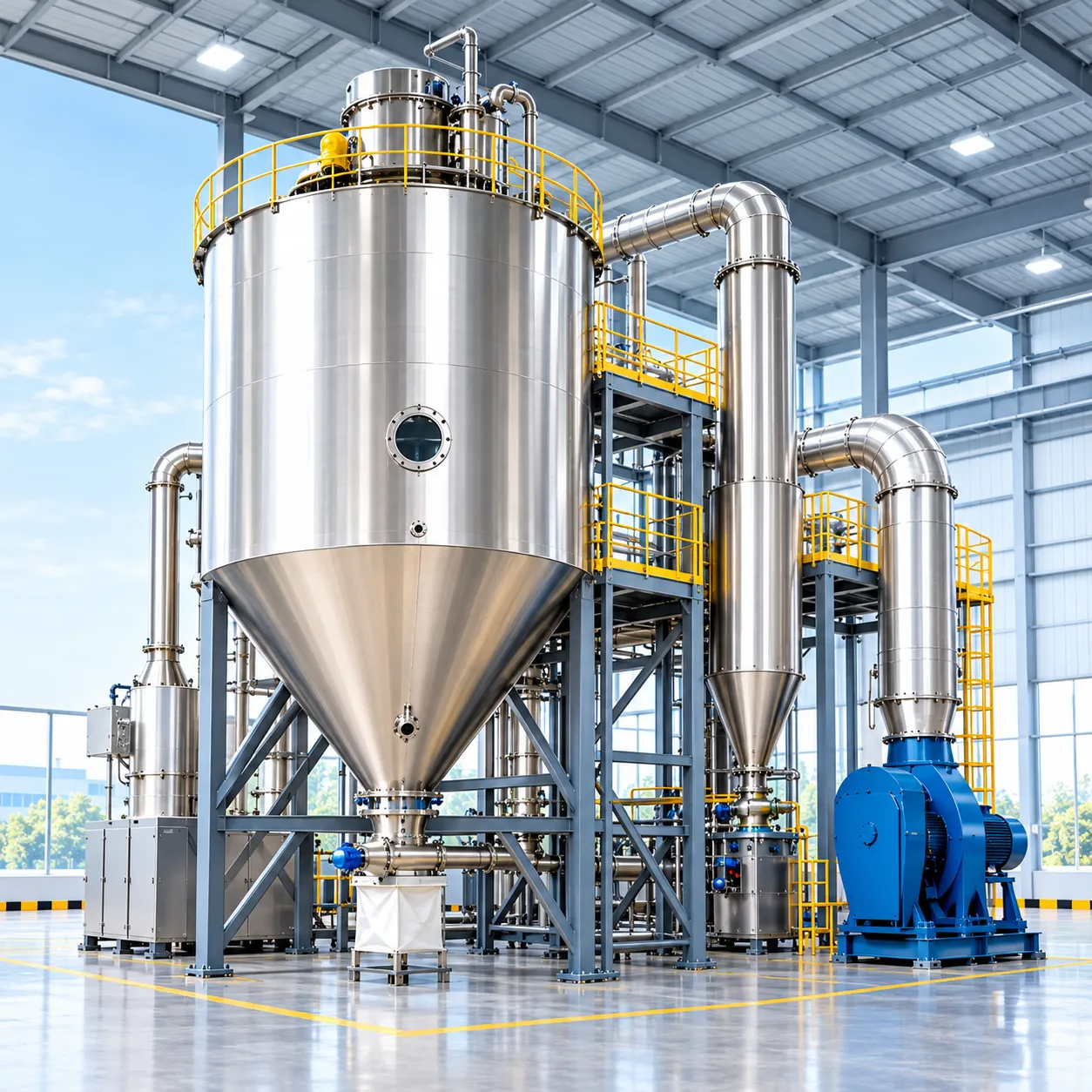

Film evaporators are the workhorses of liquid concentration. Instead of heating a deep pool of liquid, they spread the liquid as a thin layer over the inside of long vertical tubes, where it boils quickly and leaves the heated surface within seconds or minutes. That combination of fast heat transfer and short residence time is why film evaporators are found in dairies, juice plants, pharmaceutical units, chemical factories and effluent treatment systems across the world.
Two film designs dominate industrial practice: the falling film evaporator and the rising film evaporator. They look similar from the outside, and both use vertical shell-and-tube heat exchangers, yet they behave very differently in operation. This guide explains how each one works, compares them on the parameters that matter to process engineers, and shows how to decide which design suits your liquid.
Why Film Evaporation Works So Well
In a conventional pool-type evaporator, the liquid at the bottom of the vessel is under the pressure of the liquid above it. That hydrostatic head raises its boiling point, reduces the effective temperature difference and keeps the product in contact with hot surfaces for a long time. Film evaporators avoid most of these problems. A thin film offers little resistance to heat flow, there is almost no hydrostatic head, and the liquid passes through the heated zone quickly.
The practical benefits are high heat transfer coefficients, gentle treatment of heat-sensitive products and compact equipment. The two designs differ mainly in what drives the film: gravity in the falling film unit, and expanding vapor in the rising film unit.
How a Falling Film Evaporator Works
In a falling film evaporator, the liquid is fed to the top of a vertical tube bundle. A distribution system, typically a perforated plate, a set of distribution cups or a spray arrangement, spreads it evenly into every tube. The liquid then flows down the inner tube walls under gravity as a thin film, while steam condenses on the outside of the tubes.
As the film descends, part of the water evaporates. The vapor travels down the center of the tubes alongside the liquid and helps drag the film along, thinning it further and improving heat transfer. At the bottom, the concentrated liquid and vapor enter a separator, where the vapor is drawn off to the next effect, a compressor or a condenser, and the concentrate is pumped away or recirculated.
Key Characteristics of Falling Film Units
- Works at small temperature differences: Because gravity, not boiling, moves the film, the unit can operate efficiently with a small gap between steam and liquid temperature.
- Very short residence time: The product typically spends only seconds to a few minutes on the heated surface.
- High heat transfer coefficients: Thin, turbulent films transfer heat efficiently.
- Depends on good distribution: Every tube must be fully wetted. Dry patches cause local overheating, fouling and burning.
- Needs a minimum wetting rate: If the flow per tube falls too low, the film breaks. Recirculation is often used to keep tubes wet.
How a Rising Film Evaporator Works
In a rising film evaporator, often called a climbing film or long-tube vertical evaporator, the liquid enters at the bottom of the tube bundle. Steam heats the tubes from the outside. The liquid near the bottom warms up and begins to boil, forming vapor bubbles. As more vapor forms, the bubbles merge and expand rapidly, and the high-velocity vapor core pushes the liquid up the tube walls as a thin climbing film.
At the top, the vapor and concentrated liquid discharge into a separator. The design was historically popular because it needs no special distribution device and no circulation pump: the boiling itself provides the pumping action. The classic Kestner evaporator, used for many decades in sugar, chemical and pharmaceutical plants, is a well-known example of the rising film principle.
Key Characteristics of Rising Film Units
- Self-distributing: Liquid entering from the bottom naturally fills each tube, so no distribution plate is needed.
- Needs a larger temperature difference: Vigorous boiling is required to generate enough vapor to lift the film, so the unit typically needs a noticeably bigger gap between steam and liquid temperatures than a falling film design.
- Handles foaming well: The high-velocity vapor tends to break foam as it travels up the tube.
- Tolerates moderate viscosity: The vapor shear can move moderately viscous liquids.
- Limited turndown: At low heat loads the film may not climb properly, which can lead to unstable operation.
Falling Film vs Rising Film: Side-by-Side Comparison
The table below summarizes the main differences. The descriptions are general and the actual behavior of any plant depends on product properties and design details.
| Parameter | Falling Film Evaporator | Rising Film Evaporator |
|---|---|---|
| Feed entry | Top of tube bundle | Bottom of tube bundle |
| Film driving force | Gravity, assisted by vapor drag | Expanding vapor generated by boiling |
| Temperature difference needed | Small | Comparatively large |
| Residence time | Very short | Short, but generally longer than falling film |
| Liquid distribution | Requires a carefully designed distributor | Self-distributing |
| Suitability for multiple effects and MVR | Excellent | Limited, because of the larger temperature difference needed |
| Heat-sensitive products | Very good | Good |
| Foaming liquids | Manageable with proper design | Good |
| Viscous liquids | Low to moderate viscosity | Moderate viscosity |
| Scaling or crystallizing liquids | Poor, risk of dry spots | Poor to fair |
| Typical uses | Dairy, juices, extracts, effluent pre-concentration | Smaller chemical and pharmaceutical duties, foaming liquids |
The Differences That Matter Most
1. Temperature Difference and Energy Efficiency
This is usually the deciding factor. A falling film evaporator can run on a small temperature difference, so it fits naturally into plants that split the available temperature across several stages. In a multiple effect evaporator, more effects can be used when each one needs only a small driving force, which directly improves steam economy.
The same logic applies to vapor recompression. A mechanical compressor or fan can only raise vapor temperature by a limited amount, so the evaporator it serves must work with a small temperature difference. That is why falling film tubes are the standard choice for MVR plants. Our article on how MVR evaporators cut steam costs explains this link in more detail. A rising film unit, needing vigorous boiling, is far less suited to these energy-saving arrangements.
2. Product Quality and Heat Sensitivity
Both designs are gentler than pool boiling, but the falling film evaporator usually gives the shortest contact time and can operate at lower temperatures under vacuum. For milk, whey, fruit juices, coffee extract, gelatin, enzymes and herbal extracts, that matters for color, flavor and biological activity. Rising film units are still used for some heat-sensitive pharmaceutical duties, particularly at smaller scale.
3. Distribution and Operating Discipline
The falling film evaporator's strength is also its main vulnerability. If the distributor is poorly designed, partially blocked or the tube bundle is not vertical, some tubes will run dry. Dry spots overheat, product burns on, and fouling spreads. Good design uses carefully sized distribution devices, adequate recirculation and stable feed flow. Rising film units avoid this problem because the liquid fills each tube from below.
4. Fouling, Scaling and Cleaning
Neither film design is ideal for liquids that deposit heavy scale or form crystals. In those cases, a forced circulation evaporator, in which a large pump drives liquid through the tubes at high velocity, is normally the safer choice. For moderately fouling liquids, falling film plants need reliable wetting and a well-planned cleaning regime. You can read about the causes and remedies in our guide to common evaporator fouling problems.
For food, dairy and pharmaceutical duties, cleaning is usually automated. AKSH's automatic cleaning-in-place systems circulate caustic, acid and rinse water through evaporators and piping at controlled temperatures and flow rates, without dismantling the equipment. The principles behind effective cleaning are covered in our article on the fundamentals of clean-in-place technology.
5. Flexibility and Turndown
Falling film plants handle changes in capacity reasonably well, especially when recirculation keeps the tubes wet at reduced feed rates. Rising film units depend on a minimum boiling intensity to lift the film, so they can become unstable when run well below design capacity.
Applications for Each Design
Where Falling Film Evaporators Excel
- Dairy: Concentrating whole milk, skim milk and whey before spray drying.
- Food and beverages: Fruit juices, tomato products at lower concentrations, coffee and tea extracts, sugar solutions and glucose syrups.
- Pharmaceuticals and nutraceuticals: Herbal extracts, fermentation broths and heat-sensitive solutions.
- Effluent treatment: Pre-concentration of relatively clean, low-scaling streams in multiple effect or MVR plants ahead of a forced circulation finisher.
- Chemicals: Caustic soda, solvent recovery and other clean, low-viscosity duties.
Where Rising Film Evaporators Still Fit
- Foaming liquids: Where vapor velocity helps control foam.
- Smaller standalone units: Where simplicity and the absence of a distributor or circulation pump are attractive.
- Moderately viscous solutions: In chemical and pharmaceutical concentration where the larger temperature difference is acceptable.
- Climbing-falling combinations: Some designs use a rising film section followed by a falling film section in the same unit to combine self-distribution with good final concentration.
Concentration Before Drying
In many plants, the evaporator does not produce the final product. It concentrates the liquid so that the following dryer has less water to remove. Because evaporation uses far less energy per kilogram of water than spray drying, a falling film evaporator in front of industrial spray dryers is a standard arrangement in dairy, food and many chemical plants. The final concentration is chosen to balance evaporator efficiency against the viscosity the atomizer can handle.
How to Choose Between Falling Film and Rising Film
The following sequence helps narrow the choice for a new project:
- Characterize the liquid: Measure solids content, viscosity at different concentrations, boiling point elevation, heat sensitivity, foaming behavior and scaling tendency.
- Rule out forced circulation needs: If the liquid crystallizes or scales heavily, a forced circulation stage will likely be required for at least part of the duty.
- Define the energy strategy: If you plan multiple effects, TVR or MVR, a falling film design is almost always the better fit.
- Check capacity and turndown: Consider normal, minimum and future capacities and how the evaporator will run at each.
- Plan cleaning: Decide on cleaning frequency, chemicals and whether automated CIP is required.
- Size the plant: Use a proper mass and energy balance to establish evaporation load and heat transfer area. Our evaporator capacity calculation guide explains the method.
- Confirm with trials or reference data: For unfamiliar products, laboratory boiling tests or pilot runs reduce design risk.
Controls Make the Difference
Film evaporators respond quickly to changes, which is good for product quality but means they need stable control. Feed flow, steam pressure, vacuum, recirculation flow and concentrate density all interact. Automated control loops hold these variables steady, trip the plant safely on abnormal conditions and record trends for troubleshooting. AKSH's instrumentation, automation and controls packages integrate PLC and SCADA systems with field instruments such as flow meters, pressure transmitters and temperature sensors to keep evaporators running at their design point.
Why Choose AKSH Engineering
AKSH Engineering Systems Pvt. Ltd. has been designing and manufacturing evaporation and drying plants in Ahmedabad, Gujarat, since 2013, with more than 100 installations. Our team of technocrats brings over 100 years of combined experience. We design and fabricate in-house, which lets us tailor tube length, distributor design, materials and effect arrangement to each liquid. Our industrial evaporators are available in falling film, forced circulation, multiple effect and MVR configurations, in materials ranging from SS304 and SS316L to duplex steel, titanium and Hastelloy. You can explore related equipment in our supporting equipment and accessories range.
Conclusion
Falling film and rising film evaporators both use thin films to concentrate liquids efficiently, but they suit different situations. Falling film evaporators work at small temperature differences, offer very short residence times and fit naturally into multiple effect and MVR plants, which makes them the dominant choice for modern energy-efficient evaporation. Rising film evaporators remain useful for foaming and moderately viscous liquids in smaller, simpler installations. For scaling or crystallizing liquids, forced circulation is often the better answer.
If you are unsure which design suits your process, send your liquid properties and capacity requirements to the AKSH Engineering team. We will review your duty and recommend an evaporator configuration that balances product quality, energy use and long-term reliability.