
Lithium-ion battery performance is decided long before a cell is assembled. Energy density, rate capability, cycle life and safety all trace back to the powders that make up the cathode, the anode and, increasingly, the solid electrolyte. Two batches of the same chemistry can behave very differently in a cell if their particle size, shape, porosity or impurity levels are not the same. That is why battery material producers pay so much attention to the drying and particle-forming steps in their process.
Spray drying for lithium battery materials has become one of the most widely discussed tools for building well-defined particles at industrial scale. It can turn a slurry of precursors or nano-sized primary particles into spherical, free-flowing granules in a single continuous step. It also brings real challenges: abrasive and sometimes hazardous feeds, very tight contamination limits, moisture-sensitive products and the difficulty of scaling a lab recipe to tonnage. This article explains where spray drying fits, what typically goes wrong and how engineers approach each problem.
Where Spray Drying Fits in Battery Material Production
Battery material processes differ from one producer to another, and many details are proprietary. In general terms, however, spray drying is used in a few recurring roles:
- Granulating fine primary particles: Many active materials perform best as spherical secondary particles built from much smaller primary crystals. Spray drying a well-dispersed slurry can produce these agglomerates with a controlled size distribution.
- Mixing precursors at the droplet level: When a solution or slurry contains all the required elements, each droplet becomes a small, well-mixed reactor. After drying and calcination, this can help achieve uniform composition throughout the powder.
- Preparing carbon-coated materials: For some chemistries, such as lithium iron phosphate (LFP), a carbon source is often added to the feed so that a thin conductive carbon layer forms on each particle during later heat treatment under an inert atmosphere.
- Building composite anode particles: Research and industrial work on silicon-carbon and other composite anodes frequently uses spray drying to combine active particles, binders and carbon into engineered granules.
- Processing solid electrolyte and specialty materials: Some oxide-based solid electrolyte precursors and additive powders are also reported to be spray dried, although sulfide-based materials generally require strictly moisture-free and inert handling.
In most of these routes, spray drying is one step in a longer chain that also includes milling, mixing, calcination, classification and coating. The dryer does not create the final crystal structure on its own, but it strongly influences how well the later steps work.
Why Spray Drying Is Attractive for Battery Powders
Spherical Morphology and Tap Density
Spherical particles pack more efficiently than irregular ones, which can raise tap density and, in turn, the amount of active material that fits into an electrode. Spray drying naturally forms near-spherical granules because each droplet shrinks into a rounded particle as it dries.
Controlled Particle Size Distribution
Particle size affects electrode coating, calendering, ion diffusion paths and side reactions with the electrolyte. In spray drying, the size of the dried granule depends mainly on droplet size and feed solids, both of which can be adjusted. A narrow distribution with few fines and few oversize particles is usually the target.
Homogeneity
Because drying happens in seconds, components in a well-mixed feed have little time to separate. This helps keep dopants, coatings and carbon sources evenly distributed, which is difficult to achieve with slow drying methods where dissolved species can migrate to the surface.
Continuous, Scalable Operation
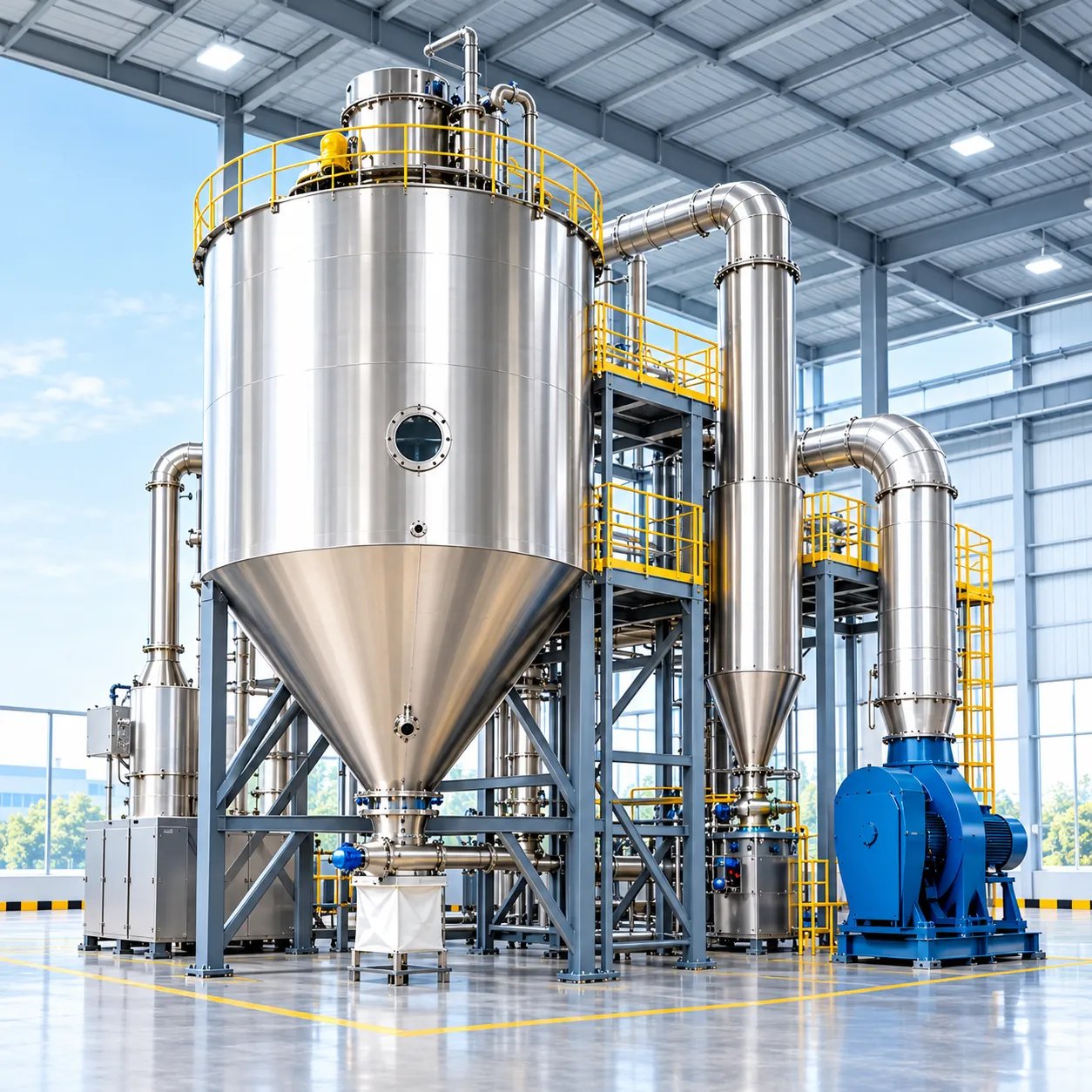
Spray drying is a continuous process that has been scaled to very large capacities in other industries. AKSH's industrial spray dryers, for example, are custom-sized with capacities up to 15,000 kg/hr of evaporation for suitable products. This makes the technology a practical option when a battery material moves from development quantities to commercial volumes.
Key Challenges in Spray Drying Battery Materials
1. Metallic Contamination
Battery manufacturers generally specify very low levels of magnetic and metallic impurities, because stray particles of iron, chromium, nickel, copper or zinc can contribute to self-discharge or internal short circuits in a finished cell. Any wear of pumps, atomizers, ducts or cyclones can introduce such particles. This makes contamination control one of the central design issues, not a detail to be handled later.
2. Abrasion
Many cathode and anode materials, and their precursors, are hard and abrasive. High-speed atomizer wheels, nozzles and cyclone inlets are especially exposed. Wear not only shortens component life but also adds metallic contamination to the product, so the two problems are linked.
3. Moisture Sensitivity and Reactivity
Several lithium compounds are hygroscopic, and some react with moisture or carbon dioxide in air. Lithium hydroxide, for instance, can pick up carbon dioxide and form lithium carbonate on particle surfaces. Nickel-rich cathode materials are commonly described as sensitive to ambient humidity. For these products, the humidity of the drying air and the conditions during powder handling and packing matter a great deal.
4. Hollow or Collapsed Particles
If a droplet dries too quickly, a hard shell can form while water is still inside. The trapped vapor may inflate the particle into a hollow sphere or cause it to crack or collapse. Hollow particles often have low tap density and can break during calendering. The balance between inlet temperature, feed solids and droplet size controls this behavior.
5. Difficult Feed Rheology
Slurries of nano-sized particles often have high viscosity at relatively low solids, and they may be shear-thinning or prone to settling. Dispersants, binders and pH control can help, but these additives may affect later calcination or electrochemical performance, so they have to be chosen together with the material scientists.
6. Organic Solvents and Inert Atmospheres
Some formulations use organic solvents, or contain components that must not be exposed to oxygen at drying temperatures. These cases call for nitrogen-based, closed-cycle drying with solvent recovery and explosion protection rather than conventional open-air spray drying.
7. Hazardous Dust
Powders containing nickel, cobalt and certain other compounds can pose health risks if inhaled. Containment, efficient filtration, sealed discharge and careful maintenance procedures are needed to protect operators and the environment.
8. Scale-Up Uncertainty
A recipe that works on a laboratory unit with a small two-fluid nozzle may behave differently in a production chamber with a rotary atomizer, longer residence time and different air flow. Without representative trial data, scale-up can lead to changes in morphology or yield that are expensive to correct after the plant is built.
Engineering Solutions
The table below summarizes common challenges and the engineering responses typically considered. The right combination always depends on the specific chemistry and specification.
| Challenge | Typical Engineering Responses |
|---|---|
| Metallic contamination | Careful selection of contact materials, wear-resistant or non-metallic contact parts where specified, smooth weld finishes, magnetic separation of feed and product |
| Abrasion | Carbide or ceramic inserts in atomizers, reduced velocities at wear points, replaceable liners in cyclone inlets |
| Moisture sensitivity | Dehumidified process air, inert gas drying, sealed and conditioned powder handling |
| Hollow particles | Optimized feed solids, moderated inlet temperature, adjusted droplet size |
| Viscous nano slurries | Dispersant and binder optimization, suitable atomizer choice, steady low-pulsation feed pumps |
| Solvent-based feeds | Nitrogen closed-loop design with condensation and solvent recovery |
| Hazardous dust | Contained discharge, high-efficiency bag filters, controlled maintenance access |
| Scale-up risk | Pilot trials on representative equipment to define the operating window |
Choosing the Atomizer
Atomizer choice shapes the size, density and shape of the granules. A rotary disk atomizer handles high-solids and abrasive slurries without a fine orifice to block, and droplet size can be adjusted by changing wheel speed. AKSH's rotary atomizers use dynamically balanced wheels with wear-resistant carbide inserts and VFD speed control. Nozzle atomization, including pressure and two-fluid nozzles, is often chosen for very fine particles, narrow distributions or smaller pilot-scale units. Our article explaining pressure nozzle and two-fluid nozzle atomization describes how the two nozzle types differ.
For abrasive battery materials, the question is not only which atomizer gives the right droplet, but also which one will hold that droplet size without wearing and contaminating the product over long runs.
Managing Temperature and Particle Formation
The way a droplet dries determines whether it becomes a dense sphere, a hollow shell or a cracked fragment. In general, lower drying rates and higher feed solids favor denser particles, while very high inlet temperatures and dilute feeds favor hollow ones. The relationship between air temperature, humidity, droplet size and evaporation rate is explained in our guide to the physics of spray drying, heat and mass transfer. For battery materials, the outlet temperature and the residence time in the chamber are usually tuned through trials rather than set purely by calculation.
Closed-Loop and Inert Gas Drying
When a feed contains flammable solvents or oxidation-sensitive components, a nitrogen closed-loop system is the standard answer. In an AKSH closed-loop spray dryer, nitrogen is recirculated as the drying gas, oxygen is monitored, and evaporated solvent is condensed for reuse. AKSH lists battery chemicals among the specialty chemical applications for these systems. The same inert environment can also help limit unwanted surface reactions on reactive powders during drying.
Powder Handling After the Dryer
Many quality problems arise after drying, during conveying, storage and packing. Sealed transfer, dry or inert blanketing where needed, and minimal exposure to ambient air all help to preserve the properties built in the dryer. Product collected from cyclones and filters may also need to be blended to keep the particle size distribution consistent.
A Typical Development and Scale-Up Path
Because battery materials are expensive and specifications are strict, most producers follow a staged path:
- Define targets: Agree on particle size distribution, tap density, morphology, moisture and impurity limits with the cell or material customer.
- Characterize the feed: Measure solids, viscosity, particle size, pH and sensitivity to air, moisture and temperature.
- Screen on laboratory equipment: Confirm that the feed can be spray dried and that the basic morphology is achievable.
- Run pilot trials: Use a pilot spray dryer with industrial-style atomization to map the effect of temperature, feed rate and atomizer settings on particle properties.
- Test downstream steps: Calcine, classify and test pilot powder in cells to confirm that the dried granules lead to the required electrochemical performance.
- Compile design data: Record evaporation rate, yield, energy use and the validated operating window.
- Design the production plant: Size the chamber, atomizer, air system and powder handling, and specify contamination and safety measures.
Our article on moving from lab to line with pilot spray dryers covers this scale-up process in more detail.
Lessons From Other Abrasive Powder Industries
Battery materials are new compared with many spray dried products, but several of their problems have long been solved in other sectors. Ceramic, catalyst and pigment producers have decades of experience handling abrasive, high-solids slurries, controlling granule density and preventing contamination between products. Many of the same principles apply. Our article on spray drying ceramic pigments and frit discusses wear protection, slurry rheology and granule control in a related context.
Spray drying is also not the only drying option in a battery material plant. Filter cakes, precursors and by-product streams may be better suited to flash, rotary or fluid bed equipment. AKSH's full range of drying systems can help match each stream to the most suitable technology.
Why AKSH Engineering
AKSH Engineering Systems Pvt. Ltd., based in Ahmedabad, Gujarat, has been designing and manufacturing spray dryers, evaporators and turnkey drying plants since 2013, with more than 100 installations. Our team of technocrats brings over 100 years of combined experience, and we design and manufacture in-house. For advanced materials, we work through feed characteristics, contamination limits, atomization, inert gas requirements and scale-up data with your process team, and build both pilot and production systems with the same engineering approach. We serve customers in India and export markets.
Conclusion
Spray drying offers battery material producers a continuous, scalable way to build spherical, uniform particles with controlled size and composition. The difficulties are real: contamination limits, abrasive feeds, moisture-sensitive chemistries, hollow particles, solvent safety and scale-up uncertainty. None of them can be fixed by temperature settings alone; they have to be addressed in the design of the atomizer, contact materials, gas system and powder handling, and confirmed through representative trials.
If you are developing a cathode, anode or solid electrolyte material and are considering spray drying, contact the AKSH Engineering team. We can discuss your feed, your particle targets and your contamination requirements, and help you plan a pilot program and a production system that fits them.