
Scale-up is where many promising powder products stall. A formulation dries beautifully in the laboratory, the samples impress customers, and then the first production run delivers powder that is wetter, coarser, stickier or simply different. The chemistry has not changed. What changed is the physics: larger droplets, longer flight paths, different air patterns and different heat losses. Bridging that gap reliably is an engineering exercise, and the pilot spray dryer is the instrument that makes it possible.
This guide is a practical playbook for that exercise. It explains which process variables can be carried from pilot to production and which must be recalculated, how to structure a scale-up program in clear stages, what data the production designer needs, and how to avoid the classic surprises at start-up. If you would like a refresher on the equipment itself, see our overview of what a pilot spray dryer is and why it matters.
Why Spray Drying Does Not Scale Linearly
It is tempting to think of a production dryer as a pilot unit multiplied by a factor. In reality, the variables that determine powder quality do not all grow at the same rate.
- Droplet size: production atomizers handle far higher feed rates, and droplets are often larger than on smaller equipment, which affects drying time and final particle size.
- Residence time: large chambers give particles more time in the hot gas, which changes final moisture and can increase agglomeration.
- Surface-to-volume ratio: small chambers lose proportionally more heat through their walls and give droplets more opportunity to strike a wall.
- Air flow pattern: the way hot gas enters and circulates in a large tower differs from a small one, changing temperature and humidity profiles along the drying path.
The physics behind these effects is explained in the physics of spray drying: heat and mass transfer. For scale-up, the practical lesson is that you must decide in advance which conditions to hold constant and which to recalculate.
What to Keep Constant and What to Recalculate
| Parameter | Scale-Up Approach | Why |
|---|---|---|
| Outlet air temperature | Usually kept close to the pilot value | Strongly linked to residual moisture and stickiness |
| Inlet air temperature | Kept similar, within product limits | Sets the drying driving force and thermal exposure |
| Feed formulation and solids | Kept identical | Changes alter droplet formation, shrinkage and powder properties |
| Atomization principle | Kept the same (rotary stays rotary, nozzle stays nozzle) | Different atomizers produce different particle populations |
| Atomizer setting | Recalculated, for example matching wheel peripheral speed | Larger wheels reach the same rim speed at lower RPM |
| Air flow and heater duty | Recalculated from the heat and mass balance | Scale with the required evaporation rate |
| Chamber dimensions | Recalculated from droplet drying time and spray pattern | Must allow droplets to dry before reaching the wall |
| Powder recovery system | Recalculated from measured particle size and loading | Fines behavior determines cyclone and filter design |
The Heat and Mass Balance at the Core
For a given product, the water to be evaporated per hour is fixed by the production rate and the feed solids. The air flow required follows from how much heat each kilogram of air can give up between the inlet and outlet temperatures. Because the outlet temperature is anchored by the pilot results, and the inlet temperature is chosen within the product's limits, the pilot data effectively sets the air flow, heater duty and fan size for production. This is why accurate pilot measurement of temperatures, feed rate and evaporation is so valuable: errors here propagate straight into the production design.
A Stage-Gate Scale-Up Program
Successful scale-up projects tend to move through clearly defined stages, each ending with a decision. A typical program looks like this:
- Gate 1, Feasibility: laboratory or early pilot runs confirm the feed can be spray dried and give a first view of yield and powder properties. Decision: is spray drying the right technology?
- Gate 2, Process definition: pilot trials with the atomization type intended for production map the operating window for temperatures, feed rate and atomizer settings. Decision: is there a robust window that meets specification?
- Gate 3, Robustness and samples: repeat runs on different days with fresh feed demonstrate repeatability, and kilogram quantities go to customers, stability studies and packaging trials. Decision: is the product commercially acceptable?
- Gate 4, Design basis: pilot data is compiled into a design basis covering capacity, heat and mass balance, powder characteristics and hygiene or safety requirements. Decision: approve production plant design.
- Gate 5, Commissioning and transfer: the production plant is started at the pilot-derived conditions and fine-tuned. Decision: release for commercial production.
Not every project needs every gate in full. A reformulation of an existing product may move quickly through the first two, while a new active ingredient may need several loops between Gate 2 and Gate 3 before the window is stable. What matters is that each gate ends with an explicit decision and the evidence behind it.
Stage gates prevent a common trap: moving to production design while key questions, such as whether the product needs a fluid bed after the chamber, are still open.
Choosing a Pilot Unit That Scales
Not every small dryer produces data that transfers. The differences between benchtop and pilot hardware are covered in our comparison of pilot and lab spray dryers; for scale-up specifically, look for four things:
- Industrial atomization: a rotary disk or industrial nozzle, matching the planned production atomizer. AKSH pilot spray dryers offer interchangeable rotary disk and two-fluid nozzle atomization.
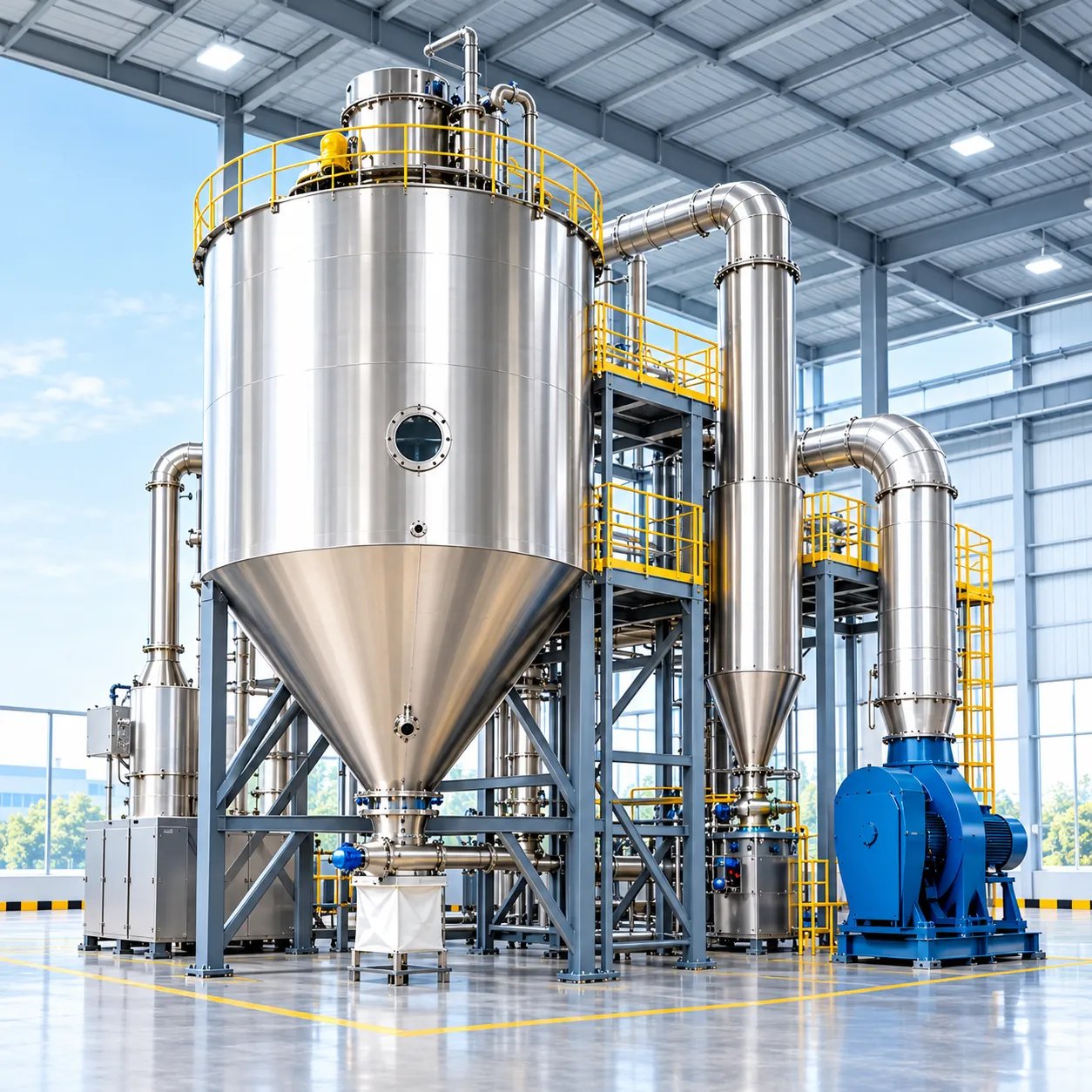
- Representative chamber geometry: a stainless steel cylinder-and-cone chamber that reflects production design principles.
- Adequate capacity: AKSH pilot units are custom sized from 1 to 50 kg/hr water evaporation, enough to run for long periods and generate meaningful quantities.
- Reliable data logging: PLC and HMI control that records inlet and outlet temperatures, feed rate and atomizer settings throughout every run.
The Data Package Your Production Designer Needs
The output of a pilot program should be a document, not just a bag of powder. A complete scale-up data package normally includes:
- Feed specification: solids content, viscosity at operating temperature, density, pH and preparation method.
- Validated operating window: inlet and outlet temperatures, feed rate, atomizer speed or pressure.
- Measured evaporation rate and heat consumption per kilogram of water evaporated.
- Powder properties: moisture, particle size distribution, bulk and tapped density, flowability, solubility and any product-specific quality attributes.
- Yield and the split between chamber and cyclone product.
- Observations on wall deposits, stickiness, hygroscopicity and thermal sensitivity.
- Any requirement for agglomeration, cooling or conditioning after the chamber.
- Safety data for solvent-based or combustible products.
With this package, the designer of the commercial industrial spray dryer can size the chamber, air system, atomizer and powder handling on measured data. For an inside view of what happens next, read our complete guide to spray dryer construction from design to commissioning.
When the Pilot Reveals a Need for More Stages
Sometimes the most important scale-up finding is that a single-stage dryer will not deliver the required powder. If pilot trials show that the product becomes sticky at the outlet temperature needed for low moisture, or that customers need an instant, non-dusty powder, the production design may need a fluid bed after the chamber. A multistage spray dryer leaves some residual moisture in the main chamber and finishes drying gently on an integrated fluid bed, with an external fluid bed for cooling and conditioning. Identifying this at pilot scale is far cheaper than adding a fluid bed to an operating plant.
Scaling Hygiene and Safety Requirements
Scale-up is not only about powder properties. Requirements that seem minor on a pilot unit become major design drivers at production scale.
Hygienic Products
For food, dairy, nutraceutical and pharmaceutical powders, the pilot campaign should record how easily deposits form and how they are removed. That information shapes the cleaning strategy for production, including the number and position of cleaning devices, surface finish requirements and the time allowed for changeovers. Testing cleaning procedures on a sanitary pilot unit gives a realistic starting point for cleaning validation later.
Solvent-Based and Combustible Products
When the feed contains an organic solvent, or the dry powder is combustible, the pilot stage should confirm the inert gas requirement, solvent recovery behavior and the dust characteristics needed for explosion protection design. A pilot unit configured as a closed-loop nitrogen system lets these questions be answered safely before the production plant is specified.
Building the Right Scale-Up Team
Scale-up fails most often at the handover points between groups. The most effective programs bring the right people together from the start:
- Formulation scientists, who understand what the recipe can and cannot tolerate.
- Process engineers, who run the pilot trials and translate results into a heat and mass balance.
- Quality and analytical staff, who define the critical powder attributes and test methods.
- Production and maintenance teams, who will run the plant and can flag practical concerns early.
- The equipment supplier, whose designers need to see the pilot data directly rather than through a summary.
Documenting Technology Transfer
In regulated industries, scale-up must also be traceable. Pilot batch records, logged process trends, analytical results and the reasoning behind each chosen set point together form a development history that supports later qualification of the production plant. Even outside regulated sectors, a clear transfer document reduces dependence on individual memory and makes it far easier to troubleshoot or expand the plant years later.
Commissioning: Closing the Loop
Commissioning is where pilot predictions meet reality. A disciplined approach keeps it short:
- Start conservatively: begin with water, then product at reduced feed rate and slightly higher outlet temperature, approaching the target window step by step.
- Compare with pilot benchmarks: check outlet temperature, moisture and particle size against the pilot data package at each step.
- Adjust the right lever: if particle size differs, adjust atomizer speed or pressure first; if moisture differs, adjust outlet temperature through feed rate.
- Lock in the recipe: once in specification, record the settings as a recipe in the control system and set alarm limits around the validated window.
Plant automation is what keeps the transferred window in place. AKSH instrumentation, automation and controls provide closed-loop temperature control, feed synchronization with exhaust temperature and SCADA trend archiving, so production can be compared directly with pilot records.
Classic Scale-Up Surprises and How to Avoid Them
- Wetter powder in production: usually a heat balance or outlet temperature issue; verify the outlet temperature matches pilot conditions before changing anything else.
- Coarser particles: larger production atomizers and longer residence times can increase size; adjust atomizer settings using the cause-and-effect map from pilot trials, as described in our guide to achieving consistent particle size.
- Unexpected wall deposits: often linked to spray pattern and air distribution; check atomizer condition and air disperser settings.
- Lower yield than expected: review cyclone performance and fines loading; the pilot split between chamber and cyclone product is a useful guide.
- Feed variation: production feed preparation may differ from careful pilot batches; enforce the same solids and temperature specification.
Why AKSH Engineering
AKSH Engineering Systems Pvt. Ltd. has designed and manufactured spray drying plants in Ahmedabad, Gujarat, since 2013, with more than 100 installations completed. Our team of technocrats, with over 100 years of combined experience, designs pilot units, atomizers and production plants in-house, so scale-up stays within one engineering team from the first trial to commissioning. Our pilot spray dryers are offered in SS304, SS316 and SS316L, with inlet air temperatures up to 350°C, open-loop or closed-loop nitrogen configurations and PLC-based data logging. Explore the wider range in our drying systems category.
Conclusion
Seamless scale-up is not luck. It is the result of keeping the right variables constant, recalculating the rest from a sound heat and mass balance, moving through clear decision gates and handing the production designer a complete data package. A pilot spray dryer with industrial atomization and reliable data logging is the tool that makes each of those steps possible, turning a laboratory success into a production line that performs from the first week.
If you are preparing to scale up a spray-dried product, contact the AKSH Engineering team. We will help you plan the pilot program, build the data package and design a production plant that delivers the powder your laboratory promised.