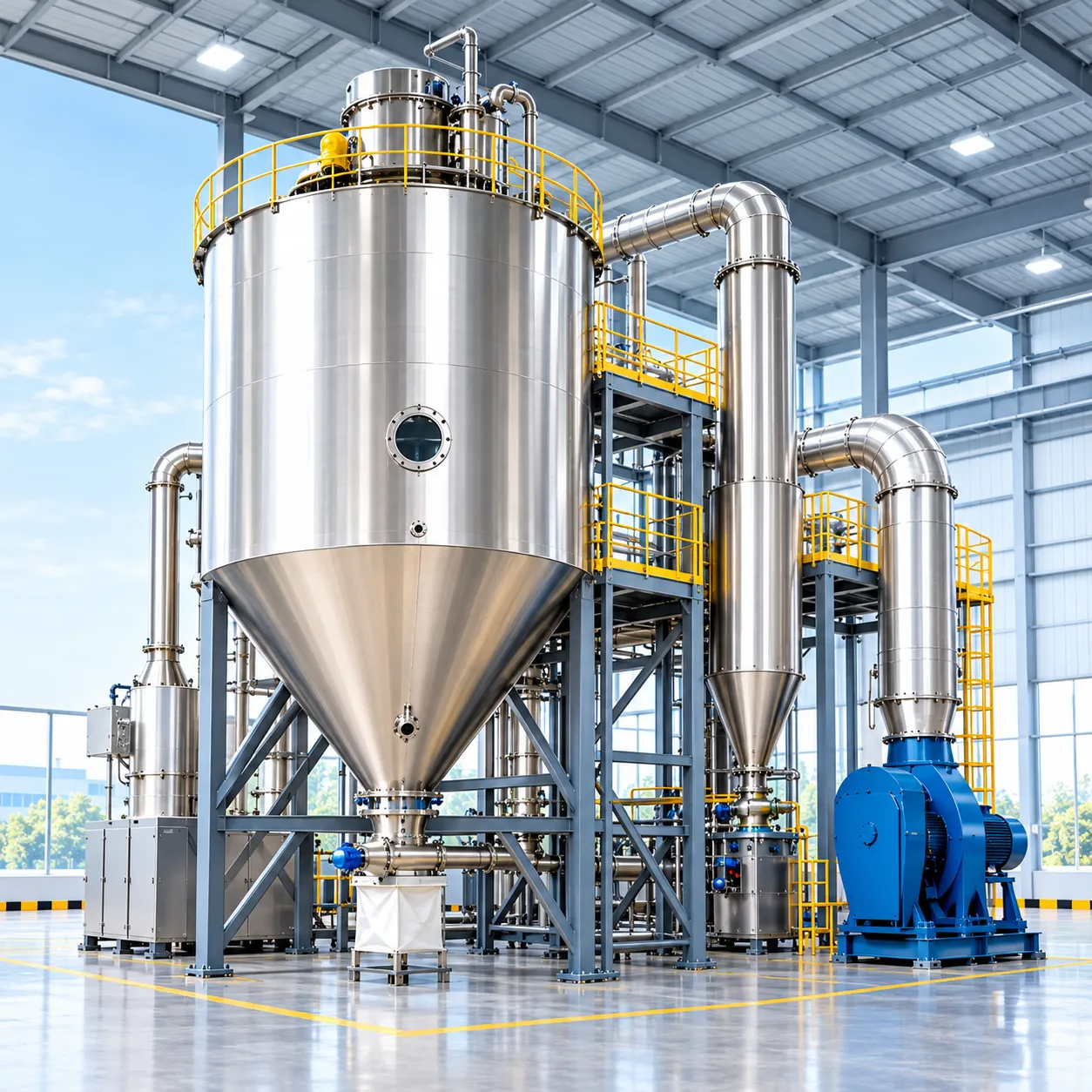

From the outside, a spray dryer looks like a large, quiet steel vessel. Inside, millions of droplets are each running a tiny race against time: they must shed most of their water before they touch a wall or leave the chamber, and they must do it without overheating. Whether that race is won depends on two coupled physical processes, heat transfer from the gas to the droplet and mass transfer of vapor from the droplet to the gas.
This article is written for process engineers, R&D scientists and operators who want to understand why a spray dryer behaves the way it does. We look at the gas side through psychrometrics, the droplet side through convection and diffusion, the distinct drying periods, how particle morphology forms, and how a simple energy balance predicts evaporation capacity. For a non-mathematical overview of the equipment itself, see our introduction to what an industrial spray dryer is and its components.
Two Coupled Processes
Evaporating water requires energy, roughly 2,260 kJ per kilogram at 100°C and somewhat more at lower temperatures. In a spray dryer, that energy is carried by the hot drying gas and delivered to the droplet surface by convection. At the same time, the vapor produced must diffuse away from the surface into the bulk gas, or evaporation slows down.
The two processes are locked together. Heat drives evaporation; evaporation consumes heat and cools the droplet. When they balance, the droplet surface settles at a steady temperature, which, for a freely evaporating water surface, is the wet-bulb temperature of the gas. Understanding this balance explains most of what engineers observe in practice, from why heat-sensitive products survive to why outlet temperature predicts powder moisture.
The Gas Side: Psychrometrics Made Practical
The drying gas is described by a few linked properties:
- Dry-bulb temperature: the ordinary gas temperature measured at inlet and outlet.
- Absolute humidity: kilograms of water vapor per kilogram of dry air.
- Relative humidity: how close the gas is to saturation at its current temperature.
- Wet-bulb temperature: the temperature a wet surface reaches when evaporating into the gas.
As gas passes through the chamber, it follows a path of roughly constant wet-bulb temperature (an adiabatic saturation line): its dry-bulb temperature falls and its humidity rises as it gives up heat and picks up vapor. For typical inlet conditions of 180 to 220°C, the wet-bulb temperature is often somewhere around 45 to 55°C, depending on inlet humidity. That is why a wet droplet in a 200°C gas stream can remain at a temperature closer to that of warm bath water.
Outlet humidity matters, too. Each kilogram of air can only carry so much vapor before the relative humidity at the outlet becomes too high to dry the powder to the required residual moisture. In practice, the outlet temperature and outlet relative humidity together define the equilibrium moisture the powder can reach, which is why outlet temperature is the standard control variable.
The Droplet Side: Heat Transfer
Heat reaches the droplet mainly by convection. The rate is described by the familiar relationship:
Q = h × A × (Tgas − Tsurface)
where h is the convective heat transfer coefficient, A the droplet surface area, and the bracket is the temperature difference between the gas and the droplet surface.
Why Small Droplets Dry So Fast
For spherical particles, h is usually estimated through the Ranz-Marshall correlation, Nu = 2 + 0.6 Re^0.5 Pr^0.33, where Nu is the Nusselt number (h × d / k). Spray droplets quickly decelerate to near the gas velocity, so the Reynolds term becomes small and Nu approaches 2. That gives a simple, powerful result: h ≈ 2k / d. The heat transfer coefficient rises as droplet diameter falls.
Combine that with the surface-to-volume ratio of a sphere, which also scales as 1/d, and the time to evaporate a droplet scales roughly with the square of its diameter. Halving droplet size cuts evaporation time to about a quarter. This is the physics behind the critical role of atomization, and why atomizer settings, such as wheel speed on a rotary disk atomizer, are among the most powerful levers available to an engineer.
Radiation and Conduction
Radiation from chamber walls and conduction within the droplet exist but play secondary roles in most aqueous spray drying. Internal conduction does matter once a solid crust forms, because the crust insulates the wet core and changes the temperature profile inside the particle.
The Droplet Side: Mass Transfer
Vapor leaves the droplet surface by diffusion and convection into the gas. The driving force is the difference between the vapor concentration (or partial pressure) at the droplet surface and in the bulk gas:
N = km × A × (Csurface − Cgas)
Mass transfer is described by an analogous correlation using the Sherwood number, Sh = 2 + 0.6 Re^0.5 Sc^0.33. The analogy between heat and mass transfer is close, which is why the wet-bulb temperature can be calculated reliably and why the same small-droplet advantages apply to both processes.
Mass transfer weakens in two situations. First, as the gas becomes more humid toward the outlet, the concentration difference shrinks. Second, once a crust forms on the droplet, vapor must diffuse through the solid layer, which adds a large internal resistance.
The Drying Periods of a Single Droplet
A droplet does not dry at a steady rate. Its history is usually described in stages:
- Initial adjustment: Immediately after atomization, the droplet heats up or cools down to the wet-bulb temperature. This takes a tiny fraction of a second.
- Constant-rate period: The surface behaves like free water. Moisture reaches the surface as fast as it evaporates, the surface stays near wet-bulb temperature, and the droplet shrinks. Most of the water is removed here.
- Critical point: Solids concentration at the surface reaches a level where a skin or crust begins to form. The droplet stops shrinking freely.
- Falling-rate period: Moisture must diffuse from the interior through the crust. The evaporation rate drops, cooling weakens, and the particle temperature rises toward the gas temperature.
- Final equilibrium: The particle approaches the equilibrium moisture set by the local gas temperature and humidity.
The falling-rate period is where thermal damage becomes possible, because the particle is no longer protected by evaporative cooling. In a co-current dryer, the gas has cooled substantially by the time particles reach this stage, which is why co-current flow is preferred for heat-sensitive products. The same moisture-movement principles apply to other dryers too, as discussed in our article on moisture reduction strategies for bulk solids.
How Particle Morphology Forms
The competition between evaporation at the surface and diffusion of solutes inside the droplet determines particle shape. Engineers often express this with a Péclet number: the ratio of how fast the surface recedes to how fast dissolved solids can diffuse back toward the center.
- Low Péclet number (slow drying, fast-diffusing solutes): solids stay evenly distributed and the particle shrinks into a dense, solid sphere.
- High Péclet number (fast drying, large molecules such as proteins or polymers): solids accumulate at the surface, an early shell forms, and the result is a hollow, often thin-walled particle.
- Shell under pressure: if vapor generated inside a rigid shell cannot escape, the particle can puff, crack or form blowholes; flexible shells may buckle into wrinkled or "raisin" shapes.
These mechanisms explain why higher inlet temperatures often lower bulk density, and why feed solids, inlet temperature and droplet size together govern properties such as flowability and dissolution.
Stickiness and the Glass Transition
Many food and pharmaceutical products contain sugars, organic acids or polymers that are amorphous after drying. Amorphous materials soften above their glass transition temperature, which falls sharply as moisture content rises. When a particle's temperature exceeds its glass transition by more than roughly 10 to 20°C, its surface becomes sticky and it adheres to walls or other particles.
This is why fruit powders, honey and some extracts are notoriously difficult to spray dry. Typical remedies include adding drying aids such as maltodextrin, lowering the outlet temperature, cooling chamber walls or using a multistage spray dryer, where the main chamber leaves some residual moisture and a fluid bed completes drying at a gentler temperature.
The Energy Balance: Predicting Evaporation Capacity
An overall heat balance turns the physics into a sizing tool. For an adiabatic chamber, the heat released by the air as it cools from inlet to outlet supplies the evaporation:
Water evaporated ≈ (air flow × cp × (Tin − Tout)) / heat required per kg of water
Consider an illustrative case: 10,000 kg/hr of dry air, specific heat around 1.0 kJ/kg·K, inlet 200°C, outlet 90°C. The air releases about 1.1 million kJ/hr. Allowing roughly 2,500 kJ per kg of water evaporated, including sensible heating of the feed, the dryer evaporates in the order of 400 to 450 kg/hr before heat losses. Real plants then subtract wall losses and the heat carried away by the powder.
A useful rule-of-thumb indicator of thermal efficiency is (Tin − Tout) / (Tin − Tambient). With the numbers above and 30°C ambient, that ratio is about 65 percent. It shows clearly that raising inlet temperature or lowering outlet temperature, where the product allows, improves efficiency. Our guide to energy-saving tips for industrial spray dryers builds on this, covering heat recovery and feed concentration.
How Operating Variables Affect the Physics
| Change | Effect on Heat and Mass Transfer | Typical Result in the Powder |
|---|---|---|
| Higher inlet temperature | Larger driving force, faster evaporation, more capacity per kg of air | Earlier crust formation, often lower bulk density |
| Higher outlet temperature | Lower outlet relative humidity, more thermal exposure | Lower moisture, higher risk of degradation and stickiness |
| Smaller droplets | Higher h and surface area, much shorter drying time | Finer particles, more fines to recover |
| Higher feed solids | Less water to evaporate, earlier critical point | Larger, denser particles, better energy use |
| Higher feed rate at fixed inlet | More evaporative cooling, gas cools faster | Lower outlet temperature, higher moisture |
Residence Time and Chamber Design
Gas residence time in a typical industrial chamber is often in the range of 20 to 40 seconds, while individual particles may spend anywhere from a few seconds to longer, depending on flow patterns and recirculation. The chamber must provide enough time and space for the largest droplets in the size distribution to pass their critical point before reaching a wall. This is why chamber diameter is linked to atomizer type, and why recirculation zones that carry partly dry particles back toward hot gas need careful design.
Fine particles that do not settle in the chamber go on to the cyclone and filters, so the physics of drying also affects collection efficiency. Our article on improving powder recovery in industrial spray dryers explores that link. Increasingly, engineers model these flows with computational fluid dynamics and process models; see how digital twin technology can optimize spray drying for where this is heading.
From Physics to Practice: Pilot Trials
Correlations and balances provide the framework, but real feeds are complex: viscosity, solids interactions, film-forming behavior and glass transition data are rarely known well enough to predict performance from first principles alone. Running the product on a pilot spray dryer provides measured evaporation rates, outlet temperature windows and powder properties that can then be scaled with the energy and mass balances described above.
Why AKSH Engineering
AKSH Engineering Systems Pvt. Ltd., based in Ahmedabad, Gujarat, has designed and built spray drying and evaporation plants since 2013, with more than 100 installations. Our technocrats, with over 100 years of combined experience, size each air system, chamber and atomizer from heat and mass balances matched to the customer's feed, and we design and manufacture in-house. Our industrial spray dryers sit alongside flash, rotary and fluid bed systems in our wider drying systems range, so we can recommend the right technology rather than forcing every product into one.
Conclusion
Spray drying works because of a delicate balance: hot gas delivers heat, evaporation removes vapor and cools the droplet, and the whole process finishes in seconds. Understanding psychrometrics, the small-droplet advantage, drying periods, morphology and the energy balance helps engineers set sensible operating windows, troubleshoot sticky or wet powder, and size equipment with confidence.
If you would like help applying these principles to your product, from estimating evaporation capacity to planning pilot trials, get in touch with the AKSH Engineering team. Our engineers will review your feed data and suggest a practical way forward.