
Ceramic pigments and frits rarely get the attention that pharmaceutical or dairy powders do, yet they are some of the most demanding materials a spray dryer will ever handle. The slurries are heavy, abrasive and often loaded with 60 percent solids or more. The finished powder is judged not only on moisture but on how it flows into a press die, how evenly it carries color into a glaze and how it behaves in a kiln at well over 1,000°C. A small drift in granule size or residual moisture can show up weeks later as shade variation, pinholes or pressing defects on a tile line.
This article looks at the engineering decisions behind spray drying ceramic pigments and frit: how the slurry should be prepared, which atomization route suits which product, how to set temperatures, what to do about wear and color contamination, and how to handle the dust and exhaust that come with every ceramic drying plant. It is written for plant heads, process engineers and purchase teams who are planning a new line or trying to improve an existing one.
Why Spray Drying Suits Ceramic Pigments and Frit
Frit is a glass that has been melted, quenched and then wet-milled into a fine slurry. Ceramic pigments are inorganic colorants, such as zircon-based stains, spinel structures and doped metal oxides, that are calcined and then milled. Both end up as water-based suspensions that must be turned into a dry, granulated powder before they can be used in glazes, inks, engobes or colored tile bodies.
Older routes relied on filter pressing, tray or rotary drying and then a separate crushing and granulation step. Each handling stage added labor, dust and a chance for contamination. A spray dryer does drying and granulation in one continuous pass, and it does so in a way that can be repeated precisely. Three properties make it the standard choice:
- Controlled granule shape: Spray drying produces near-spherical granules that pour evenly into press dies and fill them to a consistent density.
- Uniform composition: Because each droplet carries a small, representative portion of a well-mixed slurry, every granule contains the same ratio of colorant, frit and additives.
- Repeatability: Once the operating window is defined, a well-instrumented plant can deliver the same bulk density and moisture from shift to shift, which is what ceramic customers value most.
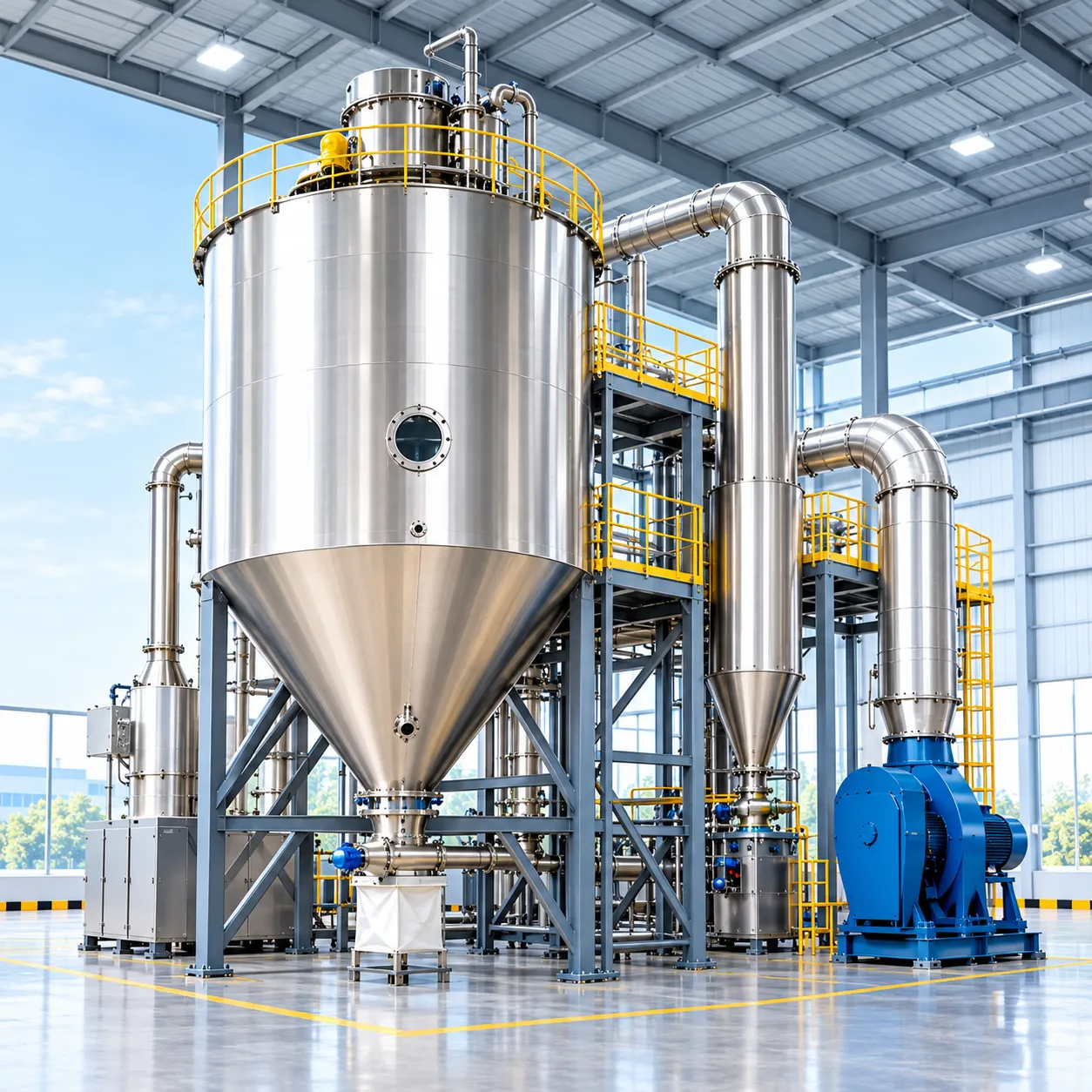
The basic machine is the same as any industrial spray dryer, but the details of feed handling, atomization, wear protection and exhaust treatment change considerably when the product is a ceramic material.
Slurry Preparation: Where Granule Quality Begins
Most problems that appear at the dryer outlet start in the slurry tank. Before discussing the dryer itself, it is worth fixing the feed.
Solids Content and Rheology
Every kilogram of water in the feed has to be evaporated, so ceramic plants push solids content as high as rheology allows. For tile body slips this is often in the range of 60 to 70 percent by weight; for pigment and frit slurries it depends heavily on particle size and chemistry. The limiting factor is viscosity. If the slurry is too thick, it will not pump steadily or atomize cleanly; if it is too thin, energy cost rises and granules become hollow and fragile.
Deflocculants such as sodium silicate or sodium tripolyphosphate are commonly used to lower viscosity at high solids. The dosage needs careful control, because over-deflocculation can cause settling in tanks and lines, while under-dosing leaves the slurry too stiff. Many plants measure viscosity and density on every batch before release to the dryer feed tank.
Particle Size After Milling
The milling step sets the size of the primary particles inside each granule. Finer milling generally improves color development and surface finish after firing, but it also raises slurry viscosity and can make granules denser and harder to press. Residue on a standard sieve is the usual control parameter, and it should be agreed between the milling and drying teams, because a change on one side shifts the result on the other.
Binders and Additives
Small additions of organic binders such as polyvinyl alcohol or carboxymethyl cellulose give dried granules enough green strength to survive conveying without breaking down into fines. Plasticizers may be used to help granules deform and knit together under pressing. These additives must burn out cleanly in the kiln, so their type and dosage are part of the product formulation, not just a drying decision.
Screening and Iron Removal
Before the slurry reaches the atomizer, it should pass through vibrating screens and magnetic filters. Oversize particles can block nozzles or unbalance an atomizer wheel, and stray iron from mills, pipes or pumps creates dark specks in light-colored glazes. For white and pastel pigments, iron control is often the single most important quality step on the wet side.
Choosing the Atomization Method
Atomization determines droplet size, and droplet size largely determines granule size, bulk density and flow. Ceramic plants use two main routes, and the right choice depends on the target granule and the nature of the slurry. Both are covered within AKSH's atomization technologies range.
Pressure Nozzles for Coarse Pressing Granules
Tile body and many pressing powders need relatively coarse granules, often in the region of a few hundred microns. High-pressure nozzle atomization is widely used for this, frequently in a fountain or mixed-flow arrangement where the spray is directed upward and the droplets travel a long path through the hot air before falling. This produces dense, free-flowing granules with relatively little fine dust. Nozzle atomization systems for ceramic duty need wear-resistant orifice inserts, typically tungsten carbide or similar hard materials, because abrasive slurries erode standard stainless steel quickly.
Rotary Disk Atomizers for Fine Pigments and Glaze Powders
When the goal is a finer powder, for example a pigment destined for digital ink or a glaze component that will be redispersed in water, a rotary atomizer is often the better fit. Because there is no small orifice to block, a rotary disk atomizer handles high-solids and slightly variable slurries well. AKSH rotary atomizers use dynamically balanced wheels with wear-resistant carbide inserts and VFD speed control, which suits abrasive ceramic feeds. The trade-off is that rotary atomization produces a wider spray pattern, so the chamber must be large enough in diameter to keep wet droplets off the wall.
For a more detailed comparison of the two routes, see our article on rotary disc atomizers versus nozzle atomizers.
| Factor | Pressure Nozzle | Rotary Disk Atomizer |
|---|---|---|
| Typical granule size | Coarser, suited to pressing powders | Finer, suited to pigments and redispersible powders |
| Granule density | Generally higher | Generally lower, more open structure |
| Tolerance to viscosity changes | Lower; pressure and flow are linked | Higher; speed can be adjusted independently |
| Wear points | Orifice inserts and swirl chambers | Wheel vanes and inserts |
| Chamber shape | Taller, narrower | Wider, shorter |
| Blockage risk | Higher with oversize particles | Low, no fine orifice |
Thermal Settings and Moisture Control
Unlike food or pharmaceutical powders, ceramic pigments and frits are not usually heat sensitive in the drying range. This allows high inlet air temperatures, which improve thermal efficiency and capacity for a given chamber size. In ceramic tile plants, inlet temperatures of several hundred degrees Celsius are common, often supplied by direct gas-fired hot air generators. Organic binders and some special pigments may set a lower ceiling, so the inlet limit should be confirmed for each product.
The outlet temperature is the main control variable. It is closely linked to final moisture, and the plant controller normally holds it steady by trimming the feed rate. For pressing powders, residual moisture is not something to minimize at all costs; a small, controlled amount of moisture, often around a few percent, acts as a lubricant and binder during pressing. Over-dried granules can be brittle and produce weak green tiles, while under-dried granules can cake in silos and stick to dies.
Because product moisture affects pressing behavior so directly, many ceramic plants install online moisture measurement after the dryer and feed the result back to the control system. The broader physics of how droplet temperature, airflow and humidity interact is explained in our guide to choosing the right spray dryer for chemical slurries, which applies equally to ceramic feeds.
Wear, Materials of Construction and Color Contamination
Ceramic slurries are abrasive. Zircon, alumina, quartz and frit glass will scour any surface they move across at speed. A plant designed for food powders will wear rapidly if put on ceramic duty, so wear protection should be specified from the start.
- Feed pumps and lines: Piston or diaphragm pumps with hardened wetted parts are commonly used for high-pressure nozzle feeds. Bends should have generous radii to slow erosion.
- Atomizer parts: Carbide inserts in nozzles and wheels extend service life and keep droplet size stable as the plant ages.
- Chamber and cone: Mild steel with suitable protection is often acceptable for tile body powders, while stainless steel is preferred for pigments, light-colored frits and anything where rust or iron pickup would be visible after firing.
- Cyclones and ducts: Inlet zones of cyclones see the highest particle velocities and may need wear liners or thicker plate.
Material choice is a balance between cost, wear resistance and cleanliness. Our article on choosing the right stainless steel grade for spray dryer construction covers the differences between SS304, SS316 and SS316L in more depth.
Managing Color Changeovers
Pigment plants often dry several shades on the same equipment. Any residue left in the chamber, cyclone or ductwork can contaminate the next color, which is especially costly when moving from a dark stain to a white or pastel. Good practice includes smooth internal welds, minimal ledges and dead zones, adequate access doors, and a cleaning routine that is planned into the production schedule. Some producers sequence colors from light to dark to reduce the cleaning effort between campaigns, and dedicate separate dryers to very strong colorants such as cobalt-based blues.
Powder Recovery, Dust and Exhaust Treatment
Spray drying ceramic materials produces a fine fraction that is carried out with the exhaust air. Recovering it is important for yield, for the working environment and for meeting emission limits.
A typical arrangement uses cyclones to collect the bulk of the fines, followed by a bag filter or wet scrubber to clean the exhaust before discharge. Fines from the cyclone are often returned to the slurry tank so that nothing is wasted. The choice between dry and wet final cleaning depends on the product, the emission norms at the site and whether the plant can reuse scrubber water in its slurry preparation. Our guide to cyclone separators, bag filters and scrubbers compares these options.
For larger installations, a properly engineered pollution control system should be designed together with the dryer, not added later. Exhaust volumes from ceramic spray dryers are large, and the sizing of fans, ducts and filters has a direct effect on both energy use and compliance.
A Practical Process Flow for Ceramic Spray Drying
The sequence below summarizes how a typical ceramic pigment or frit spray drying line is organized:
- Batching and wet milling: Raw materials or calcined pigment are milled in water with deflocculants to the target residue.
- Slurry conditioning: Density and viscosity are checked and adjusted; binders and additives are added.
- Screening and iron removal: Vibrating screens and magnetic filters remove oversize particles and tramp iron.
- Feed pumping: A wear-resistant pump delivers slurry to the atomizer at a steady rate and pressure.
- Atomization and drying: Droplets meet hot air in the chamber and dry into granules within seconds.
- Granule discharge: Dry granules leave the cone, often through a screen to remove lumps.
- Fines recovery: Cyclones and filters capture fines, which are often recycled to the slurry.
- Conditioning and storage: Granules are cooled, stored in silos and allowed to homogenize in moisture before pressing or dispatch.
Controlling Energy Cost
Ceramic spray dryers evaporate large quantities of water, and fuel is usually the largest operating cost. The most effective levers are:
- Raising slurry solids as far as rheology allows, since every percentage point removes water from the evaporation load.
- Running the highest safe inlet temperature for the product.
- Keeping outlet temperature as low as moisture targets permit.
- Recovering heat from exhaust air to preheat combustion or drying air where the plant layout allows.
- Maintaining insulation, seals and burner tuning so that heat is not lost before it reaches the product.
Many of these measures apply to every type of drying plant. Our article on energy-saving tips for industrial spray dryers explains them in more detail with practical examples.
Why AKSH Engineering
AKSH Engineering Systems Pvt. Ltd. has been designing and manufacturing spray drying and evaporation plants in Ahmedabad, Gujarat, since 2013, with more than 100 installations. Our team of technocrats brings over 100 years of combined experience, and every plant is designed and built in-house. For ceramic and mineral applications, we size the chamber, atomization and air system around your slurry and granule targets, specify wear-resistant components where abrasion is expected, and integrate powder recovery and exhaust treatment as part of one engineered system. We supply plants in India and for export.
Conclusion
Spray drying ceramic pigments and frit is less about evaporating water and more about building a granule with exactly the right size, density and moisture, every time. That outcome depends on a chain of decisions: slurry rheology and milling, atomization route, thermal settings, wear protection, contamination control and dust recovery. Getting each link right at the design stage saves years of operating cost and quality complaints.
If you are planning a new ceramic pigment or frit drying line, or want to improve the consistency of an existing one, contact the AKSH Engineering team. We will review your slurry, your granule specification and your plant constraints and recommend a spray drying configuration that fits them.