
Ask ten spray drying engineers which nozzle is best and you will hear the same reply ten times: it depends on the feed, the powder you need and the utilities you are willing to pay for. Pressure nozzles and two-fluid nozzles both turn a pumped liquid into a spray, both fit through a small port in the roof of a drying chamber, and both are sold under the broad label of nozzle atomization. Yet they get their atomizing energy from completely different sources, and that single difference shapes particle size, energy bills, maintenance routines and even the height of the tower that surrounds them.
This article looks inside both nozzle types. We explain how each one breaks up liquid, which process variables really control the droplet size, how they compare on energy, wear and turndown, and how to decide between them for a new plant or a retrofit. If you are still deciding whether a nozzle or a spinning wheel is the right starting point at all, our companion article on rotary disc atomizers vs nozzle atomizers covers that broader choice. Here, we focus on the two nozzle families themselves.
Where the Atomizing Energy Comes From
Every atomizer has the same job: add enough energy to a liquid stream to overcome its surface tension and viscosity, so that it tears into droplets. The two nozzle families differ in where that energy is introduced.
- Pressure nozzle (single-fluid, hydraulic): the energy is put into the liquid itself by a high-pressure pump. The nozzle converts pressure into velocity, and the fast-moving liquid sheet breaks up on its own as it leaves the orifice.
- Two-fluid nozzle (pneumatic, air-assisted): the liquid arrives at low pressure, and the energy is supplied by a second stream, usually compressed air or nitrogen, which shears the liquid into droplets at high relative velocity.
This means a pressure nozzle couples throughput and droplet size together through one variable (pump pressure), while a two-fluid nozzle separates them: liquid flow is set by the feed pump, and droplet size is set mainly by the gas flow. Almost every practical difference between the two flows from this point.
Inside a Pressure Nozzle
A typical spray drying pressure nozzle has three working parts: a swirl insert (or swirl chamber), a core, and a hardened orifice disc. The feed is pumped, usually by a high-pressure piston or plunger pump, into the swirl insert, where tangential slots force it to spin. The spinning liquid exits the orifice as a thin, rotating conical sheet. Within a few millimeters, the sheet thins, becomes unstable and breaks into ligaments and then droplets, forming a hollow-cone spray.
What Controls Droplet Size
Three variables dominate. First, pressure: raising it thins the liquid sheet and produces finer droplets, although the effect is gradual rather than dramatic. Second, orifice and swirl geometry: a larger orifice or a weaker swirl gives a thicker sheet and coarser droplets, and this is how engineers make big changes in particle size. Third, feed properties: higher viscosity damps sheet breakup and pushes droplets larger.
Because flow through a fixed orifice rises roughly with the square root of pressure, you cannot change pressure much without also changing the feed rate. In practice, a pressure nozzle is selected for a target throughput and particle size, and it runs well inside a fairly narrow band around that design point. Larger capacity is achieved by installing several nozzles on separate lances rather than by pushing one nozzle harder.
Typical Performance
Industrial pressure nozzles for spray drying often operate somewhere between about 50 and 300 bar, depending on the product and the particle size required. AKSH Engineering's nozzle atomization systems are specified for hydraulic pressures of up to 250+ bar, with orifice and wear parts available in tungsten carbide and technical ceramics. Pressure nozzles are known for a relatively narrow droplet size distribution and coarser, often spherical particles; on AKSH nozzle spray dryers, the typical target range for nozzle-produced powders is about 80 to 250 microns.
Inside a Two-Fluid Nozzle
A two-fluid nozzle brings liquid and gas together through separate passages. The liquid leaves a central channel at low pressure, and the gas, typically supplied at around 2 to 7 bar on industrial units, flows through a surrounding annulus at high velocity. Where the two streams meet, friction between the fast gas and the slow liquid strips the liquid into fine droplets.
Internal Mix and External Mix
- External mix: gas and liquid meet just outside the nozzle tip. Liquid flow and gas flow can be adjusted independently, there is no back-pressure interaction, and the design tolerates viscous or particle-laden feeds well. This is the most common layout in spray drying.
- Internal mix: gas and liquid mix in a chamber inside the nozzle before leaving a common orifice. It can atomize with less gas, but the two streams influence each other's pressure, which makes independent control harder.
What Controls Droplet Size
The key lever is the gas-to-liquid ratio, the mass of atomizing gas per unit mass of feed. More gas per kilogram of liquid means more shear and finer droplets. Gas pressure, nozzle geometry and feed viscosity also matter, but the gas-to-liquid ratio is what operators actually adjust. Two-fluid nozzles generally produce the finest droplets of any common spray drying atomizer, which is why they dominate laboratory spray dryers and are popular for fine pharmaceutical powders, encapsulated actives and other products that need particles of a few microns to a few tens of microns.
Side-by-Side Comparison
| Criterion | Pressure Nozzle | Two-Fluid Nozzle |
|---|---|---|
| Atomizing energy | High liquid pressure from the feed pump | Compressed air or nitrogen |
| Typical operating pressure | About 50 to 300 bar on the liquid | Low liquid pressure; gas at about 2 to 7 bar |
| Particle size tendency | Coarser, often around 80 to 250 microns in dried powder | Fine, often a few microns to a few tens of microns |
| Droplet size control | Mainly by orifice and swirl insert selection | Continuously adjustable via gas-to-liquid ratio |
| Turndown | Limited; flow and droplet size are linked | Wide; liquid and gas flows set independently |
| Energy use | Pump energy only; efficient per kg of feed | Compressor energy can be significant at scale |
| Viscous feeds | Struggles as viscosity rises | Handles viscous feeds better |
| Clogging risk | Higher; small orifice and swirl slots | Lower with wide liquid passages |
| Wear | Orifice erosion with abrasive slurries | Lower liquid velocity means less erosion |
| Typical capacity | Large production towers with multiple lances | Lab, pilot and fine-powder production |
Energy and Operating Cost
On energy, the pressure nozzle usually wins at production scale. Its only atomization energy is the pump work needed to raise the feed to pressure, which is modest per kilogram of liquid. A two-fluid nozzle, by contrast, may need a quantity of compressed gas comparable to or greater than the mass of feed it atomizes, and generating compressed air is one of the more expensive utilities in any plant. For a few liters per hour on a laboratory or pilot unit, that cost is negligible. For several tonnes of feed per hour, it can become a major line item.
There is a second, less obvious cost. Atomizing gas enters the drying chamber cold and adds to the volume of air passing through the system, so it slightly affects the heat balance and the size of the fan, cyclone and filter. When plants evaluate total drying cost, it helps to include atomization energy alongside heater and fan power.
Feed Properties That Push the Decision
Viscosity
As viscosity climbs, a pressure nozzle needs ever-higher pressure to form a sheet that breaks up cleanly, and at some point the pump or the nozzle reaches its limit, leaving coarse droplets or stringy, filament-like sprays. Two-fluid nozzles cope better because the gas does the work of tearing the liquid apart. For highly concentrated feeds, this is often decisive.
Suspended Solids and Abrasion
Pressure nozzles push liquid through tiny swirl slots and orifices at very high velocity. Slurries containing crystals, fibers or hard mineral particles can block those passages or erode the orifice, gradually widening it and coarsening the spray. Hardened inserts help considerably. Two-fluid nozzles with wide liquid passages are less prone to blockage, although very abrasive feeds may still steer engineers toward a rotary wheel. For the special case of mineral and chemical slurries, see our guide on how to choose the right spray dryer for chemical slurries.
Heat and Shear Sensitivity
Evaporative cooling protects heat-sensitive feeds with either nozzle. Shear is the bigger question: both the high-velocity pressure nozzle and the gas jet of a two-fluid nozzle apply significant shear, so sensitive biologicals should be checked by trial.
Solvent-Based Feeds
With organic solvents, a two-fluid nozzle must use nitrogen rather than air to keep a closed-loop system inert. Pressure nozzles need no atomizing gas at all.
How the Nozzle Shapes the Dryer Around It
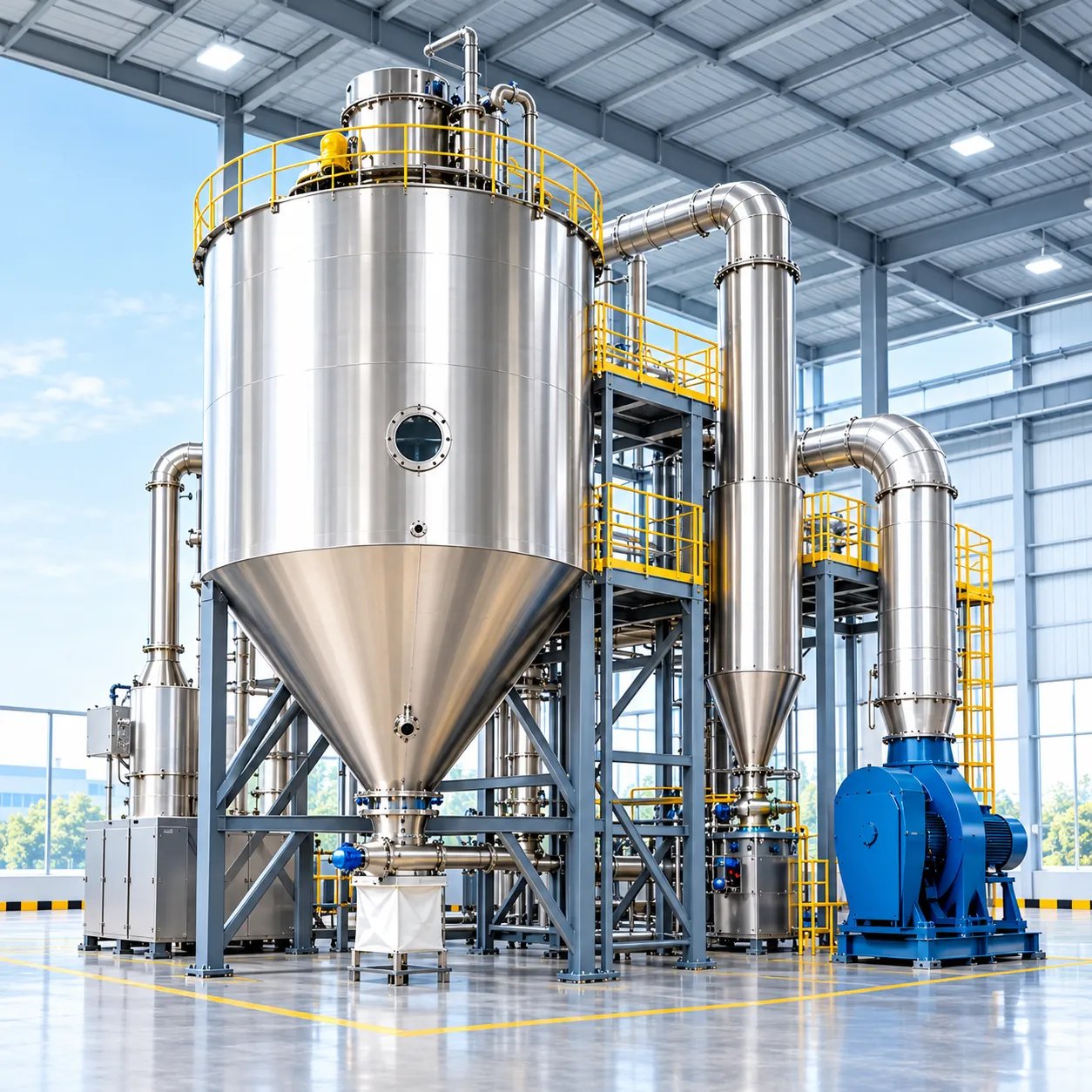
Atomizer choice influences the whole tower, not just the spray. Pressure nozzles produce a narrow, fast, downward-pointing spray cone with large droplets that need a long fall to dry fully, so pressure-nozzle dryers are typically tall and relatively slim. Some designs spray upward in a fountain arrangement to extend the flight path. Two-fluid nozzles produce fine droplets that dry quickly, so the chamber can be more compact, but fine powders place higher demands on the separation system. A clear understanding of droplet drying time, covered in the physics of spray drying, makes it easier to see why chamber geometry and atomizer selection must be designed together.
Fine two-fluid powders also tend to carry more product into the exhaust stream, so cyclone efficiency and secondary collection deserve attention. For practical ways to keep yield high, read our guide to improving powder recovery in industrial spray dryers.
A Practical Selection Process
When AKSH engineers help a client choose between the two nozzle types, the reasoning usually follows this order:
- Define the powder: target particle size range, bulk density, flowability, residual moisture and morphology. If the specification calls for coarse, dense, free-flowing particles, the pressure nozzle moves to the front. If it calls for very fine particles, the two-fluid nozzle does.
- Characterize the feed: solids content, viscosity at operating temperature, presence of suspended or abrasive solids, and whether it contains solvents.
- Fix the throughput: at high production rates, the compressed-gas demand of two-fluid atomization weighs heavily; at small and medium rates it matters far less.
- Check utilities: confirm whether a high-pressure feed pump, or a reliable supply of clean compressed air or nitrogen, fits the site.
- Consider flexibility: if one dryer will process many products or grades, the wide, independent control of a two-fluid nozzle can outweigh its energy penalty.
- Trial before committing: spray a sample of real feed on a pilot dryer to confirm particle size, yield and nozzle behavior.
That final step is often the most valuable. A pilot spray dryer lets you see how your actual feed atomizes, instead of relying on correlations developed for water or standard test liquids.
Typical Applications
Pressure nozzles are common in food and dairy powders, detergents and ceramic granules, where dense, free-flowing particles and low atomization energy matter. Two-fluid nozzles dominate laboratory and pilot dryers, fine pharmaceutical and specialty chemical powders, viscous feeds and nitrogen-blanketed solvent systems.
Many processes that suit neither nozzle well, for example very high-capacity plants handling abrasive or fibrous feeds, are better served by a spinning wheel. AKSH also builds rotary disk atomization systems for exactly those cases, and an overview of all three routes is available in our article on types of industrial spray dryers and their ideal applications.
Maintenance Tips for Both Nozzle Types
- Filter the feed: an inline strainer upstream of the nozzle is the cheapest protection against blockages.
- Inspect orifices regularly: on pressure nozzles, measure the orifice or watch for rising flow at constant pressure, a sign of wear that will coarsen the powder.
- Keep spare inserts: swirl inserts and orifice discs are wear parts; a set of spares avoids long stoppages.
- Flush at shutdown: run water or solvent through the nozzle before stopping the feed so product does not dry inside the passages.
- Dry the atomizing air: for two-fluid nozzles, oil- and moisture-free compressed air protects both the nozzle and the product.
Why AKSH Engineering
AKSH Engineering Systems Pvt. Ltd., based in Ahmedabad, Gujarat, has designed and manufactured spray drying equipment since 2013 and has delivered more than 100 installations. Our team of technocrats, with over 100 years of combined experience, designs atomization in-house as part of the complete dryer, rather than treating the nozzle as a bought-in accessory. We manufacture both single-fluid pressure and two-fluid pneumatic nozzle systems in SS304, SS316, SS316L, Hastelloy, tungsten carbide and technical ceramics, with electropolished sanitary options for food and pharmaceutical lines. We can also supply dimensionally compatible replacement nozzles for existing dryers. Because we build the entire industrial spray dryer, we can match the nozzle, chamber, air system and powder recovery to one another, and you can explore the full range of options in our atomization technologies category.
Conclusion
Pressure nozzles and two-fluid nozzles are not competing versions of the same tool. The pressure nozzle is an efficient, high-throughput atomizer that produces coarser, dense particles at low energy cost, but it asks for a stable, filterable feed and accepts limited turndown. The two-fluid nozzle is a flexible, fine-spray atomizer that handles viscous feeds and wide operating ranges, at the price of compressed-gas consumption. Matching the right one to your powder specification, feed and scale is what turns a good spray dryer into a reliable one.
If you are planning a new spray drying line or struggling with particle size, clogging or yield on an existing nozzle system, contact the AKSH Engineering team. Share your feed details and powder targets, and we will help you identify the atomization approach that fits your process.