
Rotary Dryer Working Principle: How a Rotary Drum Dryer Works, Step by Step
Some materials are too coarse, too heavy, too abrasive or too variable to dry in a spray or flash dryer. Sand, minerals, fertilizer granules, biomass, sludge, agricultural products and many bulk chemicals need a dryer that can handle large volumes, tolerate lumps and still deliver consistent moisture. For these materials, the most widely used solution is the rotary dryer, also called a rotary drum dryer.
Rotary dryers have been used in industry for more than a century because they are rugged, flexible and able to process huge tonnages continuously. In this guide, Aksh Engineering Systems Pvt. Ltd. explains the rotary dryer working principle step by step: how the drum moves material, how heat is transferred, which components make the system work and which variables decide the final product quality.
The Basic Principle of a Rotary Dryer
The core idea is straightforward:
Wet material is fed into one end of a long, slowly rotating cylinder that is slightly inclined. As the drum turns, internal flights lift the material and shower it through a stream of hot gas. Heat dries the material while gravity and the drum's slope move it gradually toward the discharge end.
Three actions work together inside the drum:
- Rotation keeps the material moving and continuously turns it over, exposing fresh surfaces.
- Lifting flights carry material up the drum wall and drop it as a falling curtain through the hot gas, which creates strong contact between gas and solids.
- Inclination of the drum, together with gas flow, pushes the material slowly from the feed end to the discharge end.
The result is a continuous drying process with a much longer residence time than flash or spray drying, usually measured in minutes rather than seconds. That longer time allows rotary dryers to remove both surface moisture and moisture held deeper inside larger particles.
Aksh Engineering designs and manufactures industrial rotary dryers built on this principle for minerals, chemicals, fertilizers, food, agriculture and waste processing.
Step-by-Step: How a Rotary Dryer Works
Let us follow the material from wet feed to dry product.
Step 1: Generating the Hot Gas
Drying energy comes from a heat source at one end of the dryer. Depending on the design, this may be:
- A burner and combustion chamber firing gas, oil, coal or biomass.
- A hot air generator that heats air indirectly, keeping combustion gases separate from the product.
- Steam or thermic fluid heat exchangers for lower-temperature or sensitive products.
- Waste heat from kilns, furnaces, engines or other process equipment, a good option for reducing fuel cost.
In a direct rotary dryer, the hot gas flows straight through the drum. In an indirect dryer, the heat is applied through the drum shell or internal tubes, and the product does not touch the combustion gas.
Step 2: Feeding the Material
Wet material is delivered into the feed end of the drum through a chute, screw conveyor or belt conveyor. A feed breeching or inlet hood connects the stationary feed system to the rotating drum, with a seal to limit air leakage.
Steady feeding is important. Large swings in feed rate or feed moisture cause swings in outlet temperature and final moisture. Very sticky materials may need backmixing with dry product or a special feed section to stop them sticking to the drum wall.
Step 3: Movement Through the Rotating Drum
The drum is mounted on rollers at a slight angle, typically a few degrees from horizontal, and is rotated slowly by a motor and gear drive, commonly in the range of a few revolutions per minute.
As the drum turns, three effects move the material:
- Gravity and slope move it forward each time it is lifted and dropped.
- Gas flow pushes fine particles forward in co-current dryers or holds them back in counter-current dryers.
- Flight design can be arranged to speed up or slow down material movement in different zones.
Residence time typically ranges from several minutes to an hour or more, depending on the material and the moisture to be removed. This is controlled mainly by drum length, slope, rotational speed and flight design.
Step 4: Lifting, Cascading and Drying
This is the heart of the rotary dryer. Inside the drum, lifting flights are welded or bolted to the shell. As the drum rotates, the flights scoop up material and carry it toward the top, where it falls off in a continuous curtain across the drum cross-section.
As the material cascades through the hot gas:
- Heat is transferred from the gas to the particle surfaces.
- Moisture evaporates and is carried away by the gas.
- The particles are mixed and turned over repeatedly, so drying is even.
Drum designs often use different flight types in different zones:
- Spiral or screw flights at the feed end to move wet material quickly away from the inlet and prevent build-up.
- Lifting flights in the main drying zone to create a dense, even curtain of material.
- Shallower flights or knockers near the discharge, or for sticky products, to reduce adhesion.
Just like other convective dryers, drying happens in two phases: a fast constant rate period when surface moisture evaporates, followed by a slower falling rate period when moisture must travel from inside the particle to the surface. The long residence time of a rotary dryer makes it well suited to the falling rate phase.
Step 5: Discharge of Dry Product
At the discharge end, dried material falls into a discharge breeching or hood and leaves through a chute, rotary valve or conveyor. Larger installations may follow the dryer with a rotary cooler or other cooling equipment, a screen to remove oversize, and conveyors to storage or packing.
Step 6: Exhaust Gas Cleaning
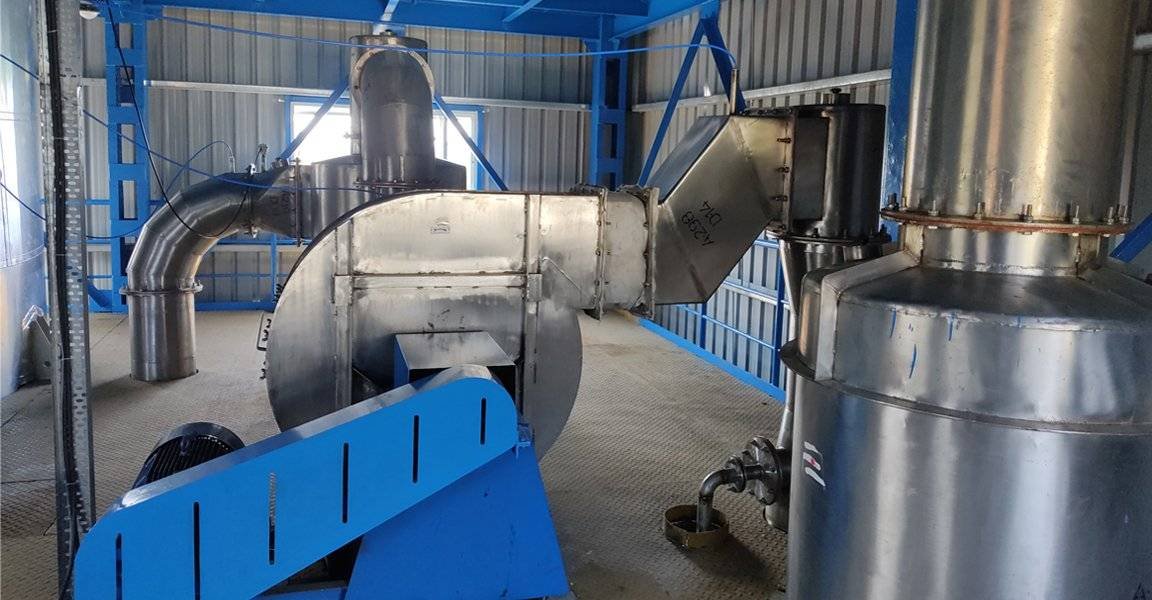
The moist exhaust gas leaves the drum carrying fine dust. It is drawn by an induced draft (ID) fan through dust collection equipment such as cyclones, bag filters or wet scrubbers before release through a stack. Keeping the drum under slight negative pressure prevents dust from escaping through seals.
Effective dust collection protects the environment, meets emission norms and recovers fine product. Aksh Engineering supplies complete pollution control systems for rotary drying plants.
Main Components of a Rotary Dryer
| Component | Function |
|---|---|
| Burner / hot air generator | Supplies heat for drying |
| Combustion chamber or inlet hood | Mixes and delivers hot gas to the drum |
| Feed system | Delivers wet material into the drum |
| Rotary drum (shell) | Long inclined cylinder where drying takes place |
| Lifting flights | Lift and cascade material through the hot gas |
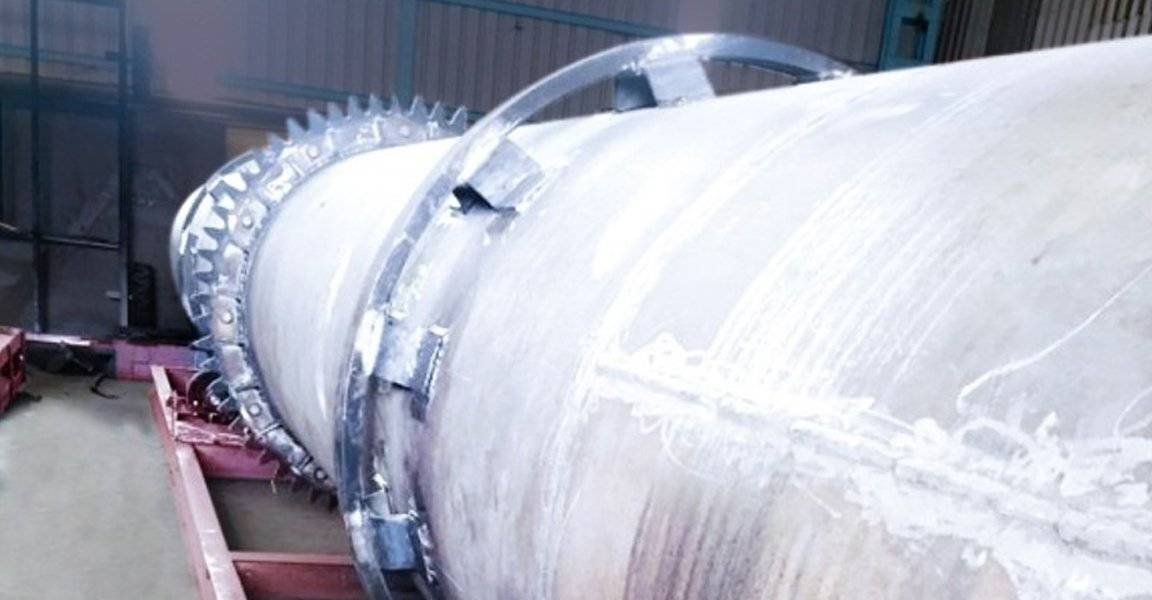
| Riding rings (tyres) | Steel rings around the drum that rest on rollers |
| Trunnion rollers | Support the drum and allow it to rotate |
| Thrust rollers | Prevent the drum from sliding along its axis |
| Girth gear and pinion / chain drive | Rotate the drum |
| Drive motor and gearbox | Provide power and control drum speed |
| Inlet and outlet seals | Limit air leakage at the rotating joints |
| Discharge breeching | Collects dry product and directs gas to the exhaust duct |
| Cyclone, bag filter or scrubber | Remove dust from exhaust gas |
| ID fan and stack | Draw gas through the system and release it |
| Control panel | Controls temperatures, drum speed, feed rate and interlocks |
Direct vs Indirect Rotary Dryers
One of the biggest design choices is how heat reaches the material.
Direct rotary dryers pass hot gas through the drum, in direct contact with the material. They offer high thermal efficiency and high capacity, and are the most common choice for minerals, sand, fertilizers, aggregates and many chemicals.
Indirect rotary dryers heat the material through the drum wall or through steam tubes inside the drum. The product never touches combustion gases. This is preferred for products that must not be contaminated, fine powders that would be carried away by high gas flow, materials that release vapours or odours, and products that need a controlled or inert atmosphere.
For a detailed comparison, read our article on direct vs indirect heating in rotary dryers.
Co-Current vs Counter-Current Flow
In a direct rotary dryer, the gas and material can move in the same or opposite directions.
Co-current (parallel) flow. Hot gas and wet material enter at the same end. The hottest gas meets the wettest material, where evaporative cooling protects it. By the time the material is nearly dry, the gas has cooled. This is best for heat-sensitive products such as food, biomass, fertilizers and organic materials, and helps reduce sticking at the feed end.
Counter-current flow. Gas enters at the discharge end and flows against the material. The driest material meets the hottest gas. This gives high thermal efficiency and very low final moisture, but the product reaches higher temperatures, so it suits heat-tolerant materials like minerals, sand and some inorganic salts.
Key Process Variables in Rotary Drying
Inlet gas temperature. Sets the drying capacity. Higher temperatures increase evaporation but must stay within the product's tolerance.
Outlet gas temperature. A key indicator of final moisture and dryer efficiency. Too high means wasted energy; too low may lead to condensation in ducts and filters.
Drum speed. Faster rotation increases cascading and moves material through more quickly; slower rotation increases residence time.
Drum slope. A steeper slope moves material faster and reduces residence time.
Flight design. Determines how much material is in the falling curtain and how evenly it is spread through the gas.
Gas velocity. Must be high enough for good heat transfer but low enough to avoid excessive dust carry-over.
Feed rate and feed moisture. Directly affect the load on the dryer and the final moisture.
Drum filling. Rotary dryers typically operate with only a modest fraction of the drum volume filled with material, which allows room for an effective falling curtain.
Types of Rotary Dryers
- Single-pass direct rotary dryer: The standard design for most bulk solids.
- Triple-pass rotary dryer: Three concentric drums inside one shell, so material travels back and forth three times. This saves floor space and suits lighter materials such as biomass and agricultural products.
- Indirect-fired rotary dryer: Heat is applied to the outside of the drum shell.
- Steam tube rotary dryer: Steam-heated tubes run through the drum, giving indirect heating with high efficiency.
- Rotary cooler: Same mechanical design, but uses ambient air or water to cool hot product after drying.
Applications of Rotary Dryers
Rotary dryers handle a wide variety of materials, including:
- Minerals and aggregates: Sand, limestone, clay, gypsum, silica, ores and slag.
- Fertilizers: Granular NPK, urea, ammonium sulphate, single superphosphate and organic fertilizers.
- Chemicals: Salts, sodium sulphate, calcium carbonate and other bulk chemicals.
- Agriculture and food: Grains, cattle feed, distillers' grains, fruit and vegetable waste, spices and pulses. Learn more in how rotary dryers improve efficiency in agriculture and food processing.
- Biomass: Wood chips, sawdust, bagasse and agricultural residues.
- Waste and sludge: Municipal and industrial sludge, and food waste. See our article on using rotary dryers to convert food waste into valuable products.
For a broader overview, read the top applications of rotary dryers across industries.
Advantages of Rotary Dryers
- Very high capacity for bulk solids, from a few tonnes to hundreds of tonnes per hour.
- Handles a wide range of materials, including coarse, abrasive, lumpy and variable feeds.
- Long residence time suitable for removing internal moisture.
- Rugged, reliable construction with long service life.
- Flexible heating options, including fuels, steam, thermic fluid and waste heat.
- Continuous operation with simple controls.
- Tolerant of feed variations compared with many other dryer types.
Limitations to Keep in Mind
- Large footprint and heavy foundations compared with flash or fluid bed dryers.
- Higher heat losses through the large shell surface if not properly insulated.
- Longer residence time can be a disadvantage for very heat-sensitive products.
- Sticky materials can build up on the drum wall without backmixing or special flights.
- Mechanical maintenance of tyres, rollers, gears and seals is required.
For fine, free-flowing materials with mostly surface moisture, a flash dryer may be a better fit. Our comparison of flash dryer vs rotary dryer explains how to choose between them.
Improving Rotary Dryer Efficiency
Energy is often the largest operating cost of a rotary dryer. Proven ways to improve efficiency include insulating the drum and ducts, optimizing flight design, reducing air leakage at seals, recovering heat from exhaust gas, using waste heat from other processes and automating temperature and feed control. Our article on innovations boosting energy efficiency in rotary drying systems explores these options in detail.
Why Choose Aksh Engineering for Rotary Drying?
Aksh Engineering Systems Pvt. Ltd., based in Ahmedabad, Gujarat, offers rotary dryers as part of our wider drying systems range. We design each rotary dryer around your material's moisture, particle size, stickiness, heat sensitivity and required capacity.
Our support includes:
- Material evaluation to confirm the right dryer type and configuration.
- Custom drum sizing, flight design and drive selection.
- Choice of direct, indirect, co-current or counter-current design.
- Heating systems matched to your fuel or utility availability.
- Dust collection and emission control.
- Automation, installation, commissioning and after-sales service.
Conclusion
The rotary dryer working principle combines three simple actions: a slowly rotating drum, lifting flights that shower material through hot gas, and a slight slope that moves material toward the discharge. This combination gives long, controlled residence time, thorough mixing and the ability to handle large volumes of difficult bulk solids.
By understanding how heating method, flow direction, drum speed, slope and flights affect the process, you can choose the right rotary dryer and run it efficiently. Contact Aksh Engineering Systems to discuss a rotary drying solution for your material.