
Every rotary dryer specification begins with one deceptively simple question: should the hot gas touch the product or not? The answer splits rotary drying into two families. In a direct-heated rotary dryer, hot air or combustion gas flows through the drum and contacts the wet solids. In an indirect-heated rotary dryer, the heat source stays on the other side of a metal wall, and the product is dried by heat conducted through the shell or through internal tubes.
Both designs use the same rotating, inclined drum, yet they behave very differently in terms of efficiency, product purity, emissions, safety and cost. Choosing the wrong one can mean a contaminated product, an oversized exhaust system or a dryer that simply cannot reach the target moisture. This guide explains how each type works, where each one excels, and how to decide which is right for your material.
A Quick Refresher on Rotary Dryer Basics
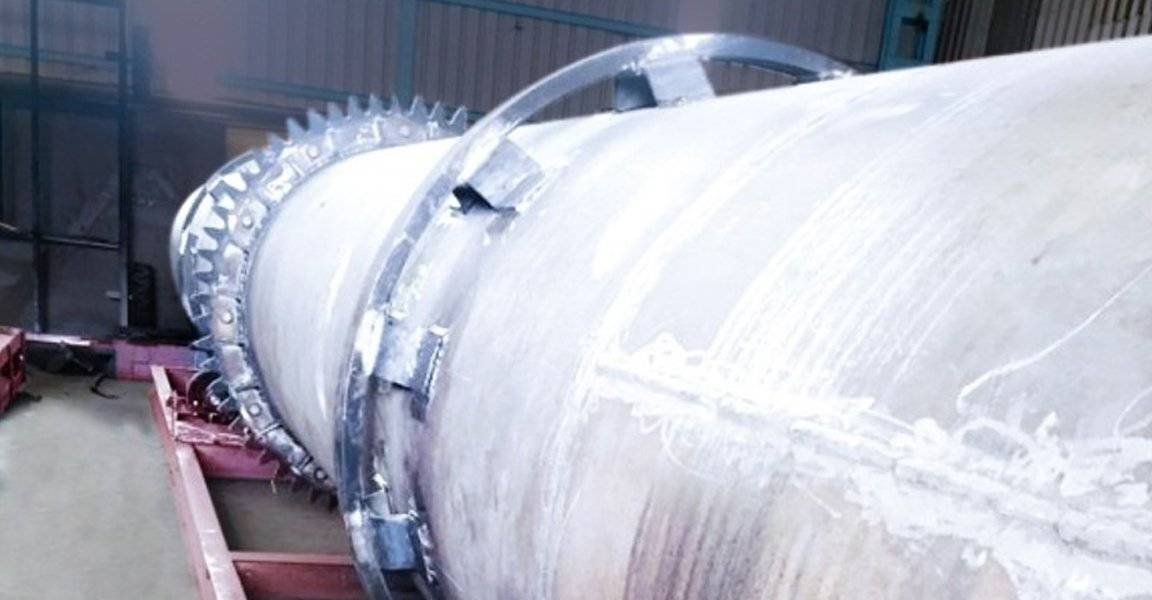
A rotary dryer is a long cylinder, slightly inclined from the feed end to the discharge end, that turns slowly on riding rings and trunnion rollers. Internal flights lift the material and let it fall, so each particle is repeatedly exposed to the drying environment while the slope carries it forward. Residence time is set by drum length, slope, rotational speed and flight design. Our article on the rotary dryer working principle walks through these elements in more depth.
The heating method is the next layer of design. It decides how heat reaches the particles, how much gas passes through the drum, and what has to be cleaned before it leaves the stack.
How Direct-Heated Rotary Dryers Work
In a direct dryer, a burner or air heater produces hot gas that enters the drum and passes over and through the curtain of falling solids. Heat transfer is mainly by convection: the gas gives up its sensible heat to the particles, the water on and in the particles evaporates, and the cooled, humid gas leaves through an exhaust duct to a dust collector and fan.
Co-current and counter-current flow
Direct dryers are arranged in one of two flow patterns:
- Co-current (parallel flow): Gas and solids enter at the same end. The hottest gas meets the wettest material, whose evaporative cooling keeps it relatively cool. By the time the product is nearly dry, the gas has cooled down. This arrangement protects moderately heat-sensitive products and is common for organics, fertilizers and biomass.
- Counter-current flow: Gas enters at the discharge end and flows against the material. The driest product meets the hottest gas, which helps reach very low final moisture and gives high thermal efficiency, but it also heats the product more. It suits robust minerals and materials that need a hot discharge.
Strengths of direct heating
- High heat-transfer rates, because the gas contacts every particle surface directly.
- Very high inlet temperatures are possible for non-sensitive materials, which keeps the drum compact for a given evaporation load.
- Simple construction with no internal heating surfaces to foul or leak.
- Typically the lowest capital cost per ton of water evaporated for large mineral and aggregate duties.
Limitations of direct heating
- The product is exposed to combustion products, which may be unacceptable for food, pharmaceutical or high-purity chemical grades.
- Large volumes of exhaust gas must be moved and cleaned, so fans and dust collectors are bigger.
- Fine or light particles are easily entrained, which raises dust load and product loss.
- Oxygen in the gas stream raises the fire and explosion risk for combustible dusts and solvent-wet products.
How Indirect-Heated Rotary Dryers Work
In an indirect dryer, the heat source never touches the product. There are several common arrangements:
- Externally fired shell: The rotating drum passes through a stationary furnace or jacket. Burners heat the outside of the shell, and the heat conducts through the steel to the tumbling bed inside.
- Steam tube dryers: Bundles of steam-filled tubes run along the inside of the drum and rotate with it. The product contacts the hot tube surfaces as it tumbles.
- Thermic fluid or hot oil heating: A heat-transfer fluid circulates through internal tubes or jackets, allowing higher temperatures than low-pressure steam.
Heat transfer is mainly by conduction from the hot metal surface into the bed of solids, with some radiation in high-temperature designs. A small flow of sweep gas, often air at low velocity or nitrogen, carries away the evaporated moisture.
Strengths of indirect heating
- No contamination from flue gas, ash or combustion byproducts.
- Much lower exhaust gas volume, so dust collection, odor treatment and vapor condensation are smaller and simpler.
- The drum atmosphere can be controlled, including inert gas operation, which is important for flammable, oxidizable or toxic materials.
- Evaporated solvents or valuable volatiles can be condensed and recovered from the concentrated vapor stream.
- Fine powders are less likely to be blown out of the drum.
Limitations of indirect heating
- Conductive heat transfer through a wall is slower than direct convection, so a larger heated surface, and often a larger drum, is needed for the same evaporation.
- Higher capital cost per unit of capacity in most cases.
- Maximum temperature is limited by the shell material and the heating medium.
- Sticky materials can coat heating surfaces and reduce performance, so internal scrapers, knockers or product recycle may be needed.
Direct vs Indirect Rotary Dryers: Side-by-Side Comparison
| Factor | Direct-heated | Indirect-heated |
|---|---|---|
| Main heat transfer mode | Convection from hot gas | Conduction through shell or tubes |
| Product contact with combustion gas | Yes (unless a clean air heater is used) | No |
| Exhaust gas volume | High | Low |
| Typical heating media | Gas or oil burners, hot flue gas, steam air heaters | External burners, steam, thermic fluid |
| Heat-transfer rate per drum size | Higher | Lower |
| Atmosphere control | Limited | Good, inert operation possible |
| Dust entrainment | Higher | Lower |
| Solvent or volatile recovery | Difficult, diluted in large gas flow | Practical, concentrated vapor stream |
| Typical capital cost per ton evaporated | Lower | Higher |
| Best for | Minerals, sand, ores, fertilizers, biomass, coal | Fine chemicals, flammable or toxic products, purity-critical or dusty materials |
Matching the Heating Method to Your Material
The right choice comes from the material, not from a general preference. Work through the following questions in order.
- Can the product tolerate contact with combustion gas? If even trace contamination from flue gas would harm quality or compliance, either use indirect heating or a direct dryer supplied with clean air from a steam or thermic fluid air heater.
- Is the product or its vapor flammable, explosive or toxic? If yes, the low-oxygen, low-gas-volume environment of an indirect dryer is usually safer and easier to contain.
- How heat-sensitive is it? Robust minerals can see very hot gas. Organic materials need lower temperatures, which favors co-current direct designs or indirect drying with moderate surface temperatures.
- How fine and dusty is it? Very fine powders lose less product and create smaller dust collection duties in an indirect dryer.
- What energy is available on site? Plants with spare steam or thermic fluid capacity may favor indirect heating or steam air heaters, while plants with natural gas or hot flue gas from a kiln may favor direct firing.
- What are the emission and odor requirements? Sludges and waste streams that smell or release volatiles are often easier to treat when the vapor stream is small and concentrated.
Typical direct-heating applications
Silica sand, limestone, gypsum, clays, ore concentrates, coal, NPK and SSP fertilizers, wood chips, sawdust and bagasse are classic direct-dryer duties. These materials tolerate high temperatures, are not compromised by flue gas contact and are produced in large tonnages where capital cost per ton matters. Our overview of the top applications of rotary dryers across industries shows how widely this approach is used.
Typical indirect-heating applications
Indirect drums are chosen for specialty chemicals and pigments that must stay clean, solvent-wet products where vapors must be recovered, combustible organic powders, some food and feed ingredients where flue gas contact is undesirable, and municipal or industrial sludges where odor and emission control are priorities.
Energy Efficiency: Which Is Better?
This is one of the most common questions, and the honest answer is that it depends on how efficiency is measured and how the system is designed.
Direct dryers usually achieve high heat utilization in the drum itself, because the gas transfers its heat straight to the product. However, they exhaust a large volume of warm, humid gas, and the sensible heat in that exhaust is lost unless it is recovered or partly recirculated.
Indirect dryers lose less heat through exhaust because the gas volume is small, but they have losses through the furnace flue (for externally fired drums), the steam or thermic fluid system and the larger shell surface. With good insulation and condensate return, indirect steam-heated systems can be very competitive, especially where low-cost steam is available.
In both cases, the biggest gains usually come from good insulation, tight seals at the feed and discharge ends, variable speed drives, accurate temperature control and heat recovery. We cover these in detail in our article on innovations boosting energy efficiency in rotary drying systems.
Emission Control for Each Design
Whatever the heating method, exhaust gas must be cleaned before it leaves the plant. Direct dryers typically need a primary cyclone followed by a bag filter or wet scrubber, sized for the full gas flow. Indirect dryers need smaller units, but the vapor may be hot, humid and sometimes corrosive, so material selection matters. AKSH designs matching pollution control systems for both configurations, and our comparison of cyclone separators, bag filters and scrubbers explains how to choose between them.
Control and Automation Considerations
Both dryer types benefit from automated control, but the key variables differ. In a direct dryer, the outlet gas temperature is the main indicator of final moisture, and the burner or heater is modulated to hold it. In an indirect dryer, the heating medium temperature or pressure and the product discharge temperature are the main control points. In both, feed rate, drum speed and exhaust draft must be coordinated. A PLC-based system with properly placed sensors, such as the packages offered in our instrumentation, automation and controls range, keeps moisture consistent as feed conditions change and provides safety interlocks for burners, fans and drives.
Hybrid Arrangements Worth Considering
The choice is not always strictly one or the other. A direct dryer can be supplied with clean hot air from a steam or thermic fluid air heater, so the product sees convective drying without contacting flue gas. Some plants also run a direct dryer for bulk moisture removal followed by an indirect or fluid bed stage for gentle finishing. Partial exhaust recirculation in a direct dryer lowers oxygen content and recovers heat. These hybrids often combine the speed of direct drying with much of the purity and safety of indirect drying, and they are worth evaluating whenever neither pure option fits perfectly.
Do You Need a Rotary Dryer at All?
Sometimes the heating debate reveals that a rotary drum is not the best fit. Fine, free-flowing wet powders with mostly surface moisture are often better dried in a flash dryer, where residence time is only a few seconds. Our guide to the flash dryer vs rotary dryer decision compares the two. You can also browse all available options in our drying systems range.
Why AKSH Engineering
AKSH Engineering Systems Pvt. Ltd. has designed and manufactured industrial drying systems in Ahmedabad, Gujarat, since 2013, with more than 100 installations. We build both direct-fired and indirect-fired rotary dryers in-house, with custom flight designs, heavy-duty drives, insulated shells and sealed feed and discharge housings. Heating options include direct gas or oil firing, steam air heaters, thermic fluid and hot flue gas, and drums are available in carbon steel, stainless steel grades SS304, SS316 and SS316L, and alloy steels. Our team of technocrats, with over 100 years of combined experience, helps you choose the heating method on the basis of your material data rather than habit.
Conclusion
Direct-heated rotary dryers deliver high heat-transfer rates and low capital cost for robust, high-tonnage materials such as minerals, fertilizers and biomass. Indirect-heated rotary dryers protect product purity, reduce exhaust volume and offer a controlled atmosphere for sensitive, flammable, dusty or volatile-bearing materials. The right answer depends on contamination tolerance, heat sensitivity, safety, available energy and emission requirements.
If you are weighing direct against indirect heating for a new or existing process, send your material details to the AKSH Engineering team. We will review the feed, recommend a configuration and help you build a rotary drying system that delivers the moisture, quality and efficiency your plant needs.