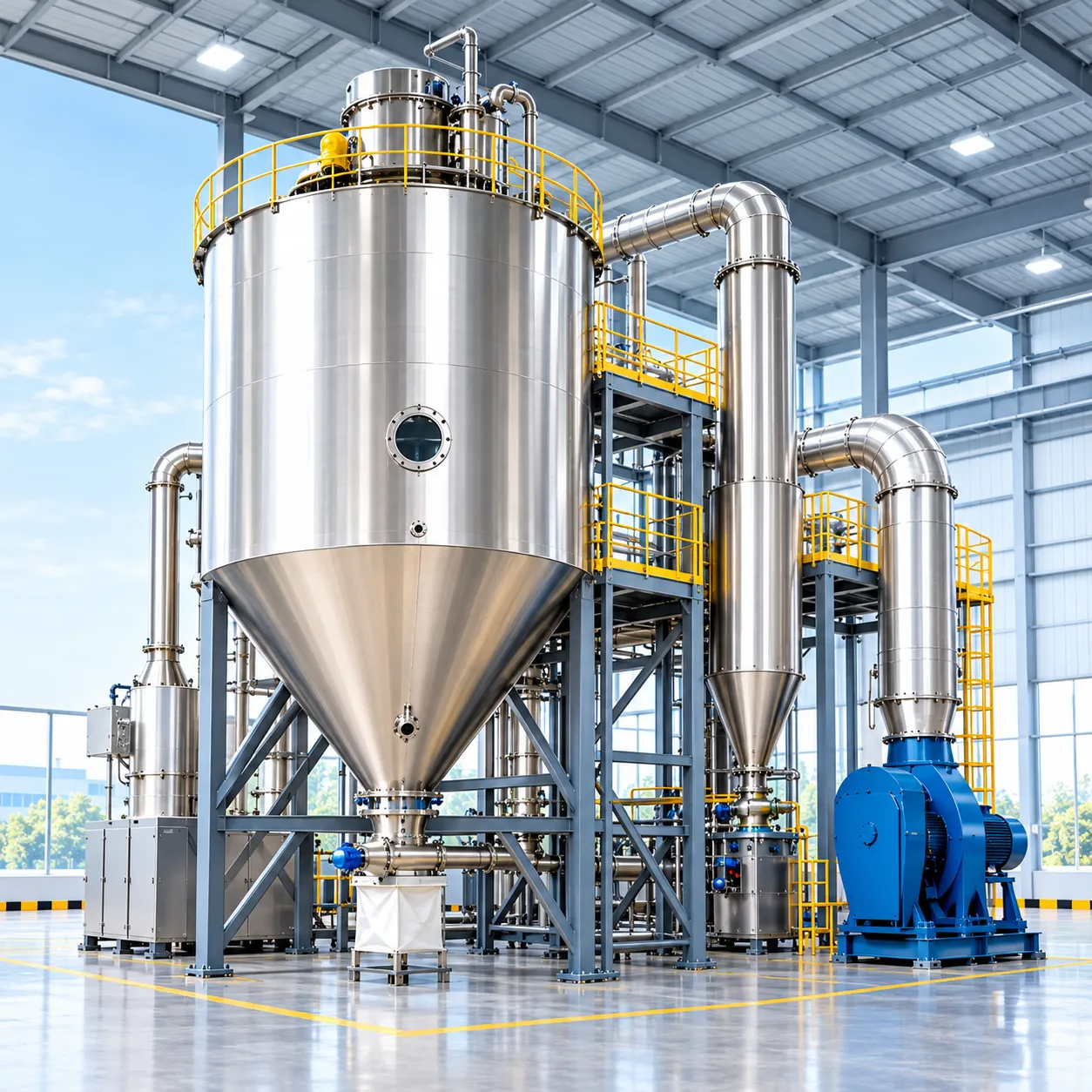

Every kilogram of powder that sticks to a chamber wall, escapes through the exhaust stack or ends up as off-specification product is a kilogram of raw material, energy and labor that earns nothing. In spray drying, these losses can be easy to overlook because they are spread across many small points in the plant. Yet for high-value products such as dairy proteins, herbal extracts, enzymes, dyes or specialty chemicals, even a small improvement in yield can make a meaningful difference to the cost per kilogram and to the return on the plant.
This guide looks at powder recovery in industrial spray dryers from a practical engineering point of view. We explain where powder is lost, how to measure recovery properly, and which process, equipment and operating changes typically deliver the largest improvements. The ideas apply to new plants at the design stage and to existing dryers where operators suspect they are losing more product than they should.
What Powder Recovery Really Means
Powder recovery, or yield, is the share of the dry solids fed to the dryer that leaves the plant as saleable product. A simple calculation compares the dry solids in the feed with the dry mass of powder collected over the same period:
Recovery (%) = (powder collected x (1 - powder moisture)) / (feed mass x feed solids fraction) x 100
Accurate figures need reliable data: calibrated feed flow measurement, a representative solids content, and careful weighing of the product. Plants that track recovery only at the end of a campaign often miss short-term losses during start-up, upsets and shutdown. Measuring by shift, or even by hour on critical products, reveals patterns that a monthly figure hides.
It is also useful to separate total recovery (all powder captured anywhere) from saleable recovery (powder that meets specification). A plant may capture almost all its product but still downgrade a portion because it is scorched, too wet or too fine.
Where Powder Is Lost in a Spray Dryer
Losses usually fall into a handful of categories. The table below summarizes them and the most common causes.
| Loss Point | What Happens | Typical Causes |
|---|---|---|
| Chamber walls and cone | Powder sticks, builds up and may scorch | Wet droplets reaching walls, sticky product, poor air distribution, cold spots |
| Exhaust air | Fines escape the separation system | Undersized or worn cyclone, damaged filter bags, very fine particles |
| Off-spec product | Powder collected but rejected | Unstable outlet temperature, moisture swings, scorched deposits falling into product |
| Start-up and shutdown | Wet or overheated material produced | Switching to feed too early, uncontrolled transitions |
| Ducts and transfer points | Powder settles or leaks | Low duct velocities, poor seals, worn rotary valves |
| Cleaning | Product washed away | Frequent wet cleaning because of heavy deposits |
The largest losses often come from just one or two of these points. A short audit, combining mass balance data with inspection of the chamber, cyclone and filters, usually shows where to focus first.
Strategy 1: Prepare the Feed for Better Drying
Optimize Solids and Viscosity
Feed solids influence droplet size, drying time and particle density. Higher solids generally produce larger, denser particles that separate more easily in a cyclone, while very dilute feeds tend to create fine, light powder that is harder to capture. The limit is viscosity: if the feed becomes too thick, atomization suffers and droplet size becomes uneven. Pilot trials help find the best compromise for each product.
Manage Stickiness
Many food and pharmaceutical products contain sugars, organic acids or low-molecular-weight compounds that become sticky when warm and moist. Stickiness is closely linked to the glass transition temperature of the material: when particle temperature rises well above it, the surface turns rubbery and adheres to walls and to other particles. Common remedies include adding drying aids or carriers such as maltodextrin where the formulation allows, lowering outlet temperature, using dehumidified inlet air, and cooling the chamber wall or cone. Our article on common challenges in food industry spray drying discusses stickiness and wall build-up with further examples.
Strategy 2: Control the Droplet Size Distribution
The atomizer determines how many very fine droplets are produced, and fine droplets become fine particles, which are the hardest to recover. A narrow droplet size distribution is therefore one of the most effective tools for improving yield.
- Rotary atomizers: wheel speed is the main control. Running faster than necessary creates excess fines; running too slowly can produce large droplets that hit the walls before they are dry. A dynamically balanced wheel with suitable vane design helps keep the spray even. AKSH's rotary disk atomization systems use VFD speed control so operators can tune droplet size precisely.
- Pressure nozzles: worn orifices change the spray angle and droplet size. Regular inspection and replacement keeps the spray consistent.
- Two-fluid nozzles: the air-to-liquid ratio controls droplet size. Excessive atomizing air produces very fine droplets and more fines in the exhaust.
Pilot work is the most reliable way to set these parameters. Our guide on how pilot spray dryers help achieve consistent particle size explains how trials are used to lock in the right atomization settings before scale-up.
Strategy 3: Get the Air Distribution Right
Wall deposits are frequently an air distribution problem rather than a product problem. If hot air enters unevenly, some zones of the spray dry too slowly and wet droplets are carried to the walls. Other zones may overheat, scorching the product. The air disperser sets the swirl and velocity of the incoming air, and even small damage or misalignment can change the flow pattern significantly.
Practical checks include inspecting guide vanes for distortion, confirming that the atomizer is centered in the disperser, and comparing deposit patterns with the expected spray zone. A characteristic ring of deposits at one height often indicates that the spray and air pattern are not matched. Upgrading or replacing a worn disperser is often a relatively low-cost improvement; AKSH supplies spray dryer accessories including air disperser assemblies with adjustable guide vanes and replacement cyclones.
Strategy 4: Keep the Walls Clean During Operation
Even with good design, some products tend to coat the walls. Several devices help keep deposits under control without stopping production:
- Pneumatic hammers or vibrators on the cone dislodge loose deposits at timed intervals.
- Air sweeps or air brooms blow a stream of air along the cone or walls to move powder toward the outlet.
- Wall or cone cooling lowers surface temperature so sticky products are less likely to adhere.
- Insulation and tracing prevent cold spots where moisture can condense and glue powder to the wall.
- Smooth, polished internal surfaces reduce the grip that powder has on the metal.
Material that is dislodged regularly is usually still within specification. Deposits left for hours can scorch, break off and contaminate good product, which turns a recovery problem into a quality problem.
Strategy 5: Improve the Powder Separation System
The separation system decides how much of the airborne powder is captured. Most spray dryers use one or more of three technologies.
Cyclones
Cyclones use centrifugal force to throw particles to the wall, where they spiral down to the outlet. They have no moving parts in the separation zone and handle high powder loads well. Their efficiency is high for coarser particles but falls for very fine material; AKSH's high-efficiency cyclones are rated at 98%+ collection efficiency for particles over 10 microns. Efficiency depends strongly on inlet velocity, so a cyclone running well below its design airflow, or with a worn inlet or leaking outlet valve, may lose much more powder than expected.
Bag Filters
Pulse-jet bag filters capture the fines that pass through the cyclone. With the right filter media, they can achieve very high efficiency on fine particles. For food and pharmaceutical products, sanitary designs that can be cleaned in place return captured fines as saleable product. Key maintenance points are bag integrity, cleaning pulse settings and preventing condensation during start-up, which can blind the bags.
Wet Scrubbers
Wet scrubbers capture remaining dust in a liquid. In some processes, the scrubber liquid can be returned to the feed, recovering part of the product, though this depends on the product and on hygiene requirements. In other cases, the scrubber mainly serves emission control.
AKSH designs pollution control systems including cyclones, pulse-jet bag filters and wet scrubbers, with filtration efficiency of up to 99.9% down to 1 to 2 micron particles. For a side-by-side look at the three technologies, read our comparison of cyclone separators, bag filters and scrubbers.
Strategy 6: Stabilize the Process With Automation
Unstable operation is a hidden cause of poor recovery. When outlet temperature swings, the powder alternates between too wet, which sticks, and too dry, which can become fine and dusty. Automatic control of outlet temperature by adjusting feed rate, steady inlet temperature control, and interlocks that protect the plant during upsets all reduce these swings. Trends and alarm logs also help operators see exactly when and why losses occur. We explore this in our article on how PLC and SCADA automation improves spray dryer consistency.
Strategy 7: Consider Multistage Drying and Fines Return
For products that are naturally fine, sticky or dusty, a different plant configuration may give the biggest recovery gain. In multistage drying, the powder leaves the main chamber with some residual moisture and finishes drying in an integrated or external fluid bed. Fines collected by the cyclone can be returned to the atomization zone, where they collide with wet droplets and form agglomerates. The result is a coarser, less dusty powder that is easier to separate and handle. AKSH's multistage spray dryers combine primary spray drying with integrated fluid beds for exactly this kind of duty.
Strategy 8: Tighten Operating Practices
Day-to-day routines also influence yield. A practical sequence for improving recovery on an existing plant often looks like this:
- Establish a baseline: measure recovery accurately over several shifts.
- Inspect the plant: record deposit locations, filter condition, cyclone wear and seal leaks.
- Standardize start-up and shutdown: stabilize temperatures on water before introducing feed, and flush the atomizer with water at the end of a run.
- Fix air leaks: ingress of cold ambient air into the chamber or ducting can create condensation and disturb cyclone performance.
- Tune key parameters: adjust outlet temperature, atomization and feed solids in small, documented steps.
- Maintain separation equipment: replace worn cyclone parts, damaged bags and leaking rotary valves.
- Review results: compare the new recovery figures with the baseline and repeat the cycle.
Recovery improvements frequently bring energy savings too, since less product is dried twice or rejected. Our energy-saving tips for industrial spray dryers cover the energy side in more detail.
Designing for Recovery in a New Plant
Retrofits can achieve a great deal, but the easiest time to secure high recovery is before the plant is built. At the design stage, engineers can size the chamber generously enough for the droplet size the product needs, match the air disperser to the atomizer, select cyclones for the real particle size distribution rather than an average figure, and allow space for a bag filter even if it is not installed on day one. Specifying smooth internal finishes, sufficient insulation, access doors for inspection and provisions for wall hammers or cone cooling costs little at this stage and is far harder to add later. Pilot trials on the actual feed provide the particle size and stickiness data that make these choices reliable.
Why AKSH Engineering
AKSH Engineering Systems Pvt. Ltd. has designed and built spray drying plants in Ahmedabad, Gujarat, since 2013, with more than 100 installations in India and abroad. Our team of technocrats brings over 100 years of combined experience in drying and evaporation. Because we design and manufacture chambers, atomizers, air dispersers, cyclones, bag filters and controls in-house, we can look at recovery across the whole system rather than one component at a time. For existing plants, we also supply retrofits and replacement parts, which you can explore in our supporting equipment and accessories range.
Conclusion
Improving powder recovery is rarely about a single fix. It comes from understanding where losses happen and addressing them step by step: preparing the feed, controlling droplet size, getting the air distribution right, keeping walls clean, choosing and maintaining the right separation equipment, stabilizing the process with automation and tightening daily practices. Each step adds a little, and together they can move a plant from acceptable yield to strong, consistent performance.
If you would like an expert review of your spray dryer's recovery, contact the AKSH Engineering team. We can help you audit losses, identify the most effective upgrades and design new equipment that captures more of the product you work hard to make.