
Ask any spray dryer operator about their hardest shift and the answer is rarely a breakdown. More often it is a shift where nothing obvious went wrong, yet the powder drifted out of specification: moisture creeping up, bulk density falling, a little more product sticking to the cone than usual. Spray drying turns liquid into powder in a few seconds, and the outcome depends on several variables staying in balance at once. When those variables are adjusted by hand, small disturbances turn into batch-to-batch variation.
This article explains how PLC and SCADA automation improves spray dryer consistency. We look at why manual control struggles, how a modern control system is structured, which control loops matter most, and what features help plants deliver the same powder, shift after shift. We also outline a practical path for upgrading an older, manually operated dryer.
Why Consistency Is Difficult in Spray Drying
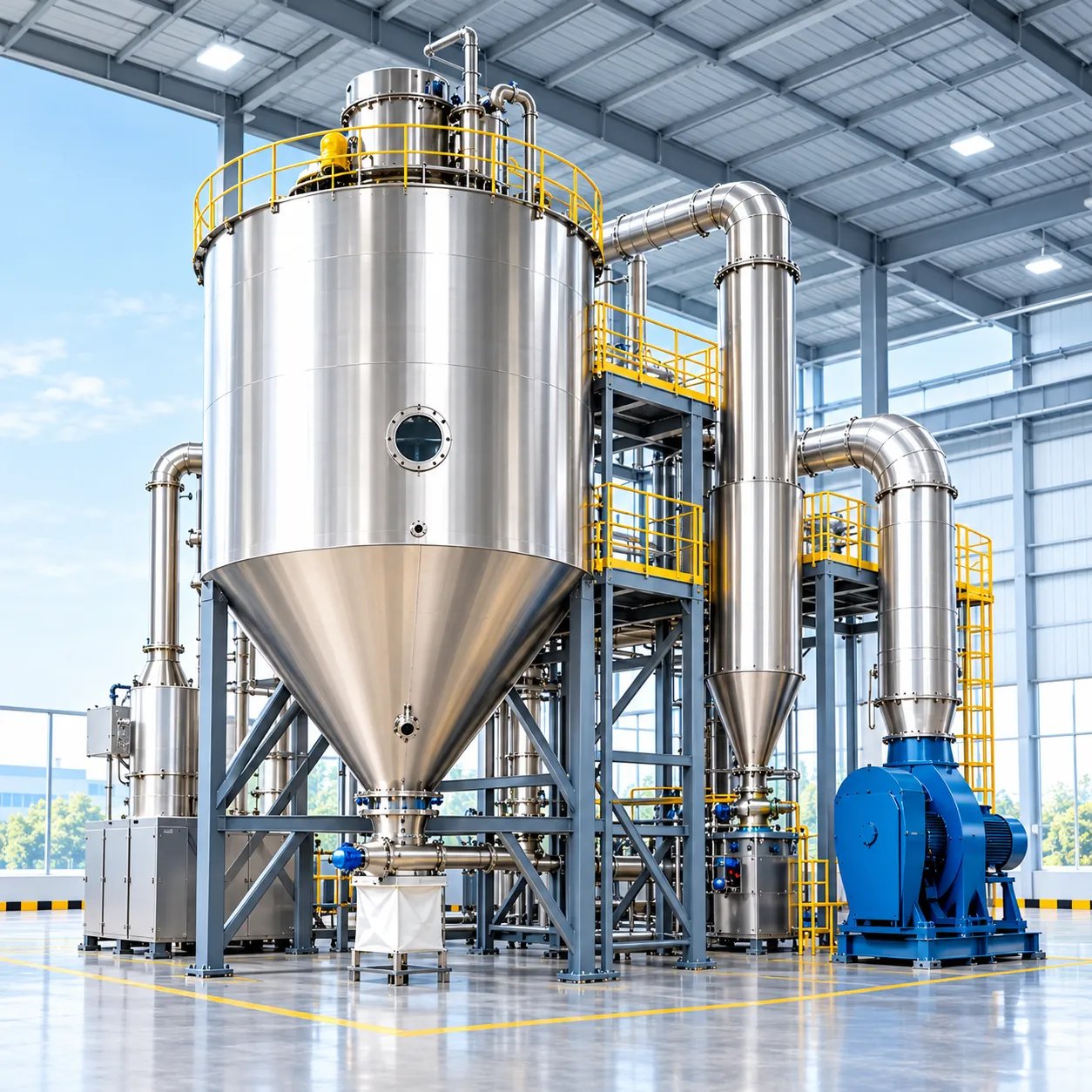
A spray dryer is a tightly coupled system. Inlet air temperature, airflow, feed rate, feed solids and atomization all affect the outlet temperature, and the outlet temperature in turn largely determines the final powder moisture. Change one variable and several others respond. If you are new to the equipment, our overview of how an industrial spray dryer works, its components and flow diagram shows how these elements connect.
Disturbances arrive constantly. Feed solids vary from tank to tank. Ambient humidity changes through the day and across seasons. Steam pressure fluctuates when other users on site draw more. Filters gradually load with dust, reducing airflow. An operator watching gauges can respond to some of these, but only after the effect becomes visible, and different operators respond in different ways. The result is variation that no amount of training fully removes.
What PLC and SCADA Actually Do
A spray dryer control system usually has four layers:
- Field instruments: temperature sensors (often RTDs or thermocouples), pressure and differential pressure transmitters, flow meters, level sensors and analyzers measure what is happening in the plant.
- Final control elements: variable frequency drives on fans, pumps and atomizers, modulating burners or steam control valves, and automated dampers and valves carry out control actions.
- PLC (Programmable Logic Controller): the industrial computer that reads the instruments, runs the control loops, executes start-up and shutdown sequences and enforces safety interlocks, typically with scan times measured in milliseconds.
- HMI and SCADA (Supervisory Control and Data Acquisition): the operator interface and supervisory layer, providing plant graphics, alarms, trends, recipe management, historical data storage and reports.
The PLC handles fast, deterministic control on the plant floor, while SCADA gives operators and managers visibility and records. Together they replace manual adjustments with consistent, rule-based control.
The Control Loops That Matter Most
Consistency in spray drying depends on a handful of key loops. The table below summarizes them.
| Control Loop | Measured Variable | Manipulated Variable | Effect on Consistency |
|---|---|---|---|
| Inlet temperature | Hot air temperature entering the chamber | Burner firing rate or steam valve position | Steady drying energy supply |
| Outlet temperature | Exhaust air temperature | Feed pump speed | Stable residual moisture in the powder |
| Airflow and chamber pressure | Chamber pressure or air flow | Supply or exhaust fan speed | Constant residence time and safe slight negative pressure |
| Atomization | Atomizer speed, nozzle pressure or atomizing air flow | Atomizer drive VFD, pump speed or air valve | Consistent droplet and particle size |
| Feed conditions | Feed tank level, temperature and sometimes density | Transfer pumps, heaters, agitators | Uniform feed entering the atomizer |
Inlet Temperature Control
A PID loop compares the measured inlet temperature with its setpoint and adjusts the burner or steam valve continuously. Good tuning keeps the inlet temperature stable despite changes in steam pressure, fuel quality or ambient air temperature, so the drying energy entering the chamber stays constant.
Outlet Temperature Control by Feed Rate
This is the loop that most directly protects powder quality. Because outlet temperature closely tracks powder moisture, the PLC adjusts the feed pump speed to hold the outlet at its setpoint. If feed solids drop and the powder becomes wetter, the outlet temperature falls and the controller reduces the feed rate within seconds. Many experienced engineers regard this loop as the backbone of spray dryer automation.
Airflow and Pressure Control
Fan speed control keeps airflow constant as filters load and ducts foul, which keeps residence time and cyclone efficiency stable. Maintaining a slight negative pressure in the chamber also prevents powder leaking out of doors and joints.
Atomizer Control
For rotary atomizers, wheel speed sets droplet size. Holding the speed constant with a VFD, and monitoring vibration and bearing temperature, keeps particle size steady and protects the machine. AKSH's rotary disk atomization systems use VFD drives that let operators adjust speed precisely for the target droplet size.
Interlocks and Automated Sequences
Many quality problems happen during transitions rather than steady running. Automated sequences make these transitions repeatable:
- Pre-start checks: the PLC confirms that doors are closed, utilities are available and safety devices are healthy.
- Air system start: fans start in the correct order and the chamber reaches its pressure setpoint.
- Heat-up: the heater ramps up at a controlled rate to protect equipment and reach stable temperatures.
- Water run: the atomizer runs on water to stabilize the outlet temperature before product is introduced.
- Changeover to feed: the system switches from water to product smoothly, with the outlet loop taking control.
- Shutdown: feed is replaced by water, the heater cools down in a controlled way and fans stop only when temperatures are safe.
Interlocks protect people, product and equipment. Typical examples include stopping the feed if airflow is lost, cutting the heater on high temperature, tripping the atomizer on high vibration, and initiating safe shutdown on a fire or explosion detection signal. These actions happen in the same way every time, which manual operation cannot guarantee.
Recipe Management: Repeating the Best Batch
Plants that dry several products, or several grades of one product, benefit greatly from recipe management. Each recipe stores the validated setpoints for inlet and outlet temperature, atomizer speed, airflow and alarm limits. When the operator selects a product, the system loads the correct values automatically, removing the risk of transcription errors or personal preferences. Access levels can restrict who may change a recipe, so the validated settings are protected. Recipes also make product changeovers faster and more predictable, because the plant moves directly to known-good conditions instead of relying on an operator to rediscover them by trial and error at the start of every campaign.
Alarms, Trends and Data Logging
Consistency also depends on spotting problems early. SCADA systems display real-time trends of every key variable and raise alarms when values move outside set limits, often before the powder itself is affected. A slow rise in chamber differential pressure might indicate developing wall deposits; a drift in the feed rate needed to hold outlet temperature might reveal a change in feed solids.
Historical data turns troubleshooting from guesswork into analysis. When a batch fails specification, engineers can compare its trends with those of a good batch and identify what changed. This same data helps improve yield and energy performance, topics covered in our guides on improving powder recovery and energy-saving tips for spray dryers.
Compliance and Electronic Records
Pharmaceutical and some food manufacturers must prove that each batch was made under controlled conditions. Control systems designed for regulated environments provide secure user access, electronic batch records, audit trails and electronic signatures in line with requirements such as 21 CFR Part 11. AKSH's hygienic spray dryers can be supplied with PLC and SCADA platforms that include these features to support qualification activities.
Integrating Cleaning Into the Control System
Cleaning is part of consistency too. Residues left from a previous batch can contaminate the next or cause deposits that break off into the product. When cleaning-in-place is controlled by the same automation platform, wash sequences, temperatures, flow rates and chemical concentrations are repeated exactly and logged. AKSH's automatic CIP systems use PLC recipe control with inline conductivity, flow, temperature and pH instrumentation and can be integrated into existing PLC and SCADA architectures.
Manual vs Automated Operation at a Glance
- Response to disturbances: manual control reacts after the effect is visible; automatic loops respond within seconds.
- Operator variation: different shifts make different adjustments manually; automation applies the same rules every time.
- Start-up and shutdown: manual transitions vary and often generate off-spec product; automated sequences are repeatable.
- Records: handwritten logs are incomplete and slow to analyze; SCADA archives every variable continuously.
- Safety: manual responses depend on attention; interlocks act immediately and consistently.
Consistent drying is also a foundation for product shelf life and quality, as explained in our article on ensuring consistency and shelf life in food powders.
Common Pitfalls in Spray Dryer Automation
A control system is only as good as its design, instruments and tuning. Several mistakes regularly limit the benefits plants expect from automation:
- Poorly located sensors: an outlet temperature sensor placed where it is affected by radiation from hot surfaces or by powder build-up will feed the controller misleading data. Sensor location and protection deserve careful thought.
- Untuned or default loops: PID controllers left at factory settings may oscillate or respond sluggishly. Tuning each loop on the real plant, first on water and then on product, makes a large difference.
- Worn final control elements: a sticking steam valve or a damper with slack in its linkage cannot follow the controller's commands, however good the logic.
- Too many alarms: when operators face a constant stream of low-priority alarms, they begin to ignore them. A structured alarm philosophy with clear priorities keeps attention on what matters.
- Operators bypassing automation: if the system is hard to use or poorly explained, operators may switch loops to manual and lose the benefits. Good HMI design and training prevent this.
- No ownership of data: trends and reports deliver value only if someone reviews them regularly and acts on what they show.
Avoiding these pitfalls is largely a matter of treating automation as part of the process design rather than an add-on supplied at the end of the project. When the engineers who size the dryer also define its control philosophy, sensors, loops and sequences fit the way the plant actually behaves.
Upgrading an Existing Spray Dryer
Many plants run older dryers with relay panels or standalone temperature controllers. A retrofit is often a cost-effective way to gain the benefits described above without replacing the drying equipment. A typical upgrade follows these steps:
- Audit the plant: review existing instruments, drives, wiring and the condition of valves and dampers.
- Define the control philosophy: agree on loops, interlocks, sequences, alarms and reporting needs.
- Upgrade field devices: replace unreliable sensors and add VFDs where speed control is needed.
- Build and test the panel: program the PLC and SCADA, ideally testing logic before site installation.
- Commission and tune: check every loop, test interlocks and tune controllers on water and then on product.
- Train and hand over: train operators and maintenance staff and provide clear documentation.
Once a solid automation and data foundation is in place, plants can consider more advanced tools such as model-based control and simulation. Our article on how digital twin technology can optimize spray drying explores where this direction may lead.
Why AKSH Engineering
AKSH Engineering Systems Pvt. Ltd., based in Ahmedabad, Gujarat, has designed and built spray drying and evaporation plants since 2013, with more than 100 installations. Our team of technocrats brings over 100 years of combined experience, and because we design both the process equipment and its controls, the automation is built around how the dryer actually behaves. Our instrumentation, automation and control systems cover field instruments, PLC and HMI panels, centralized SCADA with historical logging and batch reporting, flameproof panels for hazardous areas and retrofits for third-party dryers. You can explore the complete automation and control range on our website.
Conclusion
Consistent powder is the result of consistent conditions, and consistent conditions are very hard to achieve by hand in a process that changes within seconds. PLC and SCADA automation stabilizes the key loops, makes start-up and shutdown repeatable, protects validated recipes, raises early warnings and records every batch. The payoff is tighter quality, higher yield, better energy use and easier compliance.
If you are planning a new spray dryer or want to modernize the controls on an existing one, contact the AKSH Engineering team. We will help you define the right control architecture for your product and your plant.