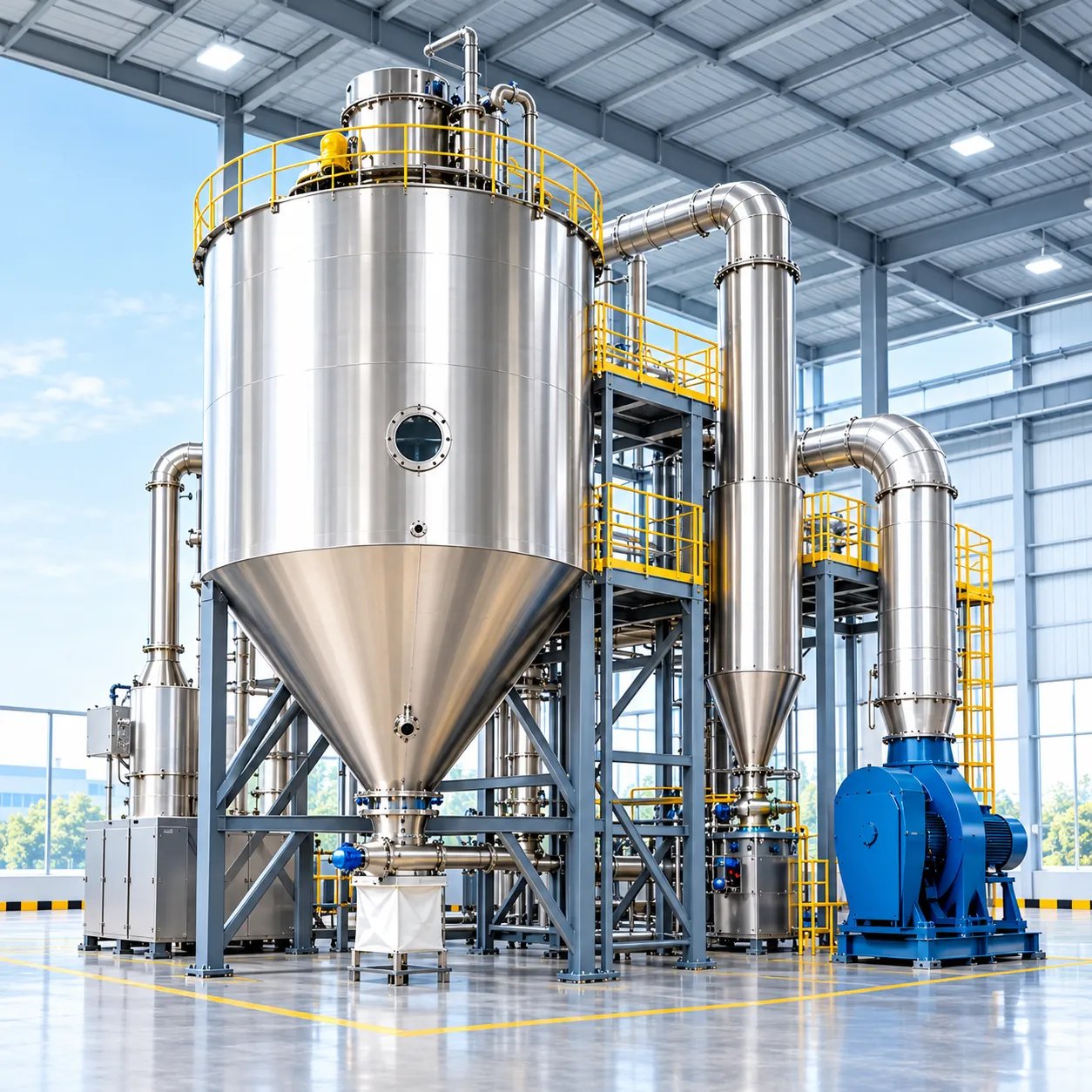

Walk through almost any plant that makes milk powder, instant coffee, reactive dyes, herbal extracts or ceramic tile body, and you will find a tall stainless steel cone at the heart of the process. That cone is an industrial spray dryer, and it does something no other single machine does as well: it takes a pumpable liquid and turns it into a dry, free-flowing powder in one continuous pass, usually within a few seconds of residence time.
This article is a ground-level introduction for engineers, plant heads and buyers who are new to spray drying or who need to explain it to colleagues. We cover what a spray dryer machine is, the working principle in plain language, every major component in the system, and a step-by-step flow diagram description that traces the path of liquid, air and powder through a typical plant. Where a topic deserves a deeper dive, we point you to the dedicated guides in our knowledge library.
What Is an Industrial Spray Dryer?
An industrial spray dryer is a continuous drying system that converts a liquid feed, such as a solution, emulsion, suspension or slurry, into a particulate solid by spraying it as fine droplets into a stream of hot gas. The gas, usually heated air, supplies the energy that evaporates the water or solvent. The dried particles are then separated from the gas and collected as the finished powder.
Three features set spray drying apart: single-step conversion with no separate filtration and milling, a very short contact time that limits thermal damage, and engineered particles, since atomization and drying conditions control size, bulk density and flowability rather than simply removing water.
Because of these strengths, spray dryers are used across food and dairy, pharmaceuticals, nutraceuticals, dyes and pigments, agrochemicals, ceramics, detergents and even effluent treatment. AKSH Engineering's own industrial spray dryer range covers evaporation capacities from pilot scale up to 15,000+ kg/hr for commercial turnkey plants, which gives a sense of how widely the technology scales.
The Working Principle in Plain Language
The entire idea of spray drying rests on one physical fact: evaporation happens at a surface, so more surface means faster drying. A single liter of liquid held in a tray has a small exposed area and dries slowly. The same liter broken into droplets averaging, say, 50 microns across offers a surface area many thousands of times larger. When that cloud of droplets meets hot air, moisture leaves almost instantly.
There is a second, equally important effect. As water evaporates from a droplet, it absorbs latent heat, which keeps the droplet surface close to the wet-bulb temperature of the surrounding air rather than the much higher dry-bulb temperature. So even when the inlet air enters at 180 to 250°C, a typical figure for many aqueous products, the droplet itself often stays far cooler while it is still wet. This evaporative cooling is the reason spray drying is trusted for heat-sensitive materials such as proteins, enzymes and natural colors.
If you want the underlying thermodynamics, including drying-rate periods, wet-bulb behavior and energy balances, our companion article on the physics of spray drying and heat and mass transfer covers them in depth. For this introduction, it is enough to remember four stages:
- Atomization: the liquid is broken into a spray of droplets.
- Spray-air contact: the droplets are mixed with hot drying gas.
- Evaporation: moisture leaves the droplets and they solidify into particles.
- Separation: the powder is recovered from the gas stream.
Core Components of a Spray Dryer Machine
A spray dryer is not one machine but an integrated set of subsystems. Each one influences product quality, energy use and safety, so it is worth understanding what each part does.
1. Feed Tank and Feed Pump
The process begins with a feed preparation tank, often fitted with an agitator to keep solids in suspension and sometimes jacketed to hold the feed at a set temperature. From there, a feed pump delivers the liquid to the atomizer. The pump type depends on the atomizer: low-pressure positive displacement or peristaltic pumps are common with rotary atomizers, while high-pressure piston or plunger pumps serve pressure nozzles. A variable-speed drive on the pump allows operators to trim the feed rate, which is the main handle for holding the outlet temperature steady.
2. Air Filter, Supply Fan and Air Heater
Ambient air is drawn in through filters that remove dust and, in hygienic plants, fine particulates. A supply fan pushes the air through a heater. Heat sources vary widely: steam radiators, direct or indirect gas firing, thermic fluid (hot oil) heaters and electric heaters are all used. The choice depends on the required inlet temperature, fuel availability and whether the product can tolerate contact with combustion gases. Direct firing is efficient but adds combustion products to the air, so food and pharmaceutical plants often prefer indirect heating. Before entering the chamber, the hot air passes through a distributor that shapes the flow around the atomizer; poor distribution leads to wet zones and wall deposits.
3. Atomizer
The atomizer is often described as the heart of the spray dryer because droplet size largely determines final particle size. Two main families are used in industry:
- Rotary (centrifugal) atomizers: liquid is fed onto a disk or wheel spinning at high speed and flung off the rim as fine droplets. AKSH's rotary disk atomizers use VFD-controlled speeds up to 25,000+ RPM and wheels with wear-resistant carbide inserts for abrasive feeds.
- Nozzle atomizers: single-fluid pressure nozzles force liquid through a small orifice at high pressure, while two-fluid nozzles use compressed air to shear the liquid. AKSH's nozzle atomization systems cover hydraulic pressures up to 250+ bar and pneumatic air-assisted designs at roughly 2 to 7 bar.
Which atomizer is right for a given product is a subject in its own right. Our article on the types of industrial spray dryers and their ideal applications compares them in detail.
4. Drying Chamber
The drying chamber is the large cylindrical vessel with a conical bottom where spray and air meet. Its diameter must be large enough that droplets do not hit the wall while still wet, and its height must give enough residence time for drying to finish. Chambers for rotary atomizers tend to be wider and shorter, because the spray travels outward horizontally; nozzle towers tend to be taller and narrower, because the spray travels downward. Construction is usually stainless steel (SS304, SS316 or SS316L), with polished internal surfaces for food and pharmaceutical duty, and insulation and cladding outside to reduce heat loss.
5. Powder Separation and Gas Cleaning
Some powder leaves from the chamber cone through a rotary airlock valve, but the exhaust air still carries fine powder that must be recovered both for yield and for environmental compliance. The common devices are:
- Cyclone separators: use centrifugal force to drop out most of the powder; simple and robust.
- Bag filters: capture fine particles that pass the cyclone, often with pulse-jet cleaning.
- Wet scrubbers: wash residual dust out of the air, useful where the product is soluble or where emissions limits are strict.
Selection depends on particle size, value of the product, stickiness and emissions norms. Our guide on cyclone separators vs bag filters vs scrubbers explains the trade-offs, and AKSH supplies matching pollution control systems for complete plants.
6. Exhaust Fan and Stack
An induced-draft exhaust fan pulls air through the whole system and maintains a slight negative pressure in the chamber so that powder does not leak out. The cleaned air is then discharged through a stack, or, in heat-recovery designs, passed through an air-to-air heat exchanger to preheat incoming air.
7. Instrumentation and Control
A modern spray dryer is run from a PLC with an HMI or SCADA system. Key measured variables include inlet temperature, outlet temperature, chamber pressure, feed rate, atomizer speed or nozzle pressure, and airflow. The most common control loop holds outlet temperature constant by adjusting feed rate, because outlet temperature correlates closely with final powder moisture. Interlocks protect against fire, overheating and fan failure. AKSH's instrumentation, automation and controls packages are designed around these loops.
Spray Dryer Flow Diagram: Following the Process Step by Step
A process flow diagram for a spray dryer can look complicated, but it is really three streams that meet and part again: the liquid stream, the air stream and the powder stream. The numbered sequence below follows those streams through a typical open-cycle, co-current plant, which is the most common industrial arrangement.
- Feed preparation: Liquid concentrate is mixed and held in the feed tank at the target solids content, often 30 to 60 percent for many products, after upstream evaporation where needed.
- Feed filtration and pumping: The feed passes through an inline strainer to remove lumps and is pumped at a controlled rate to the atomizer.
- Air intake and heating: Ambient air is filtered, pushed by the supply fan and heated to the set inlet temperature.
- Air distribution: Hot air enters the top of the chamber through the air disperser, surrounding the atomizer.
- Atomization: The feed is broken into a cloud of droplets at the top of the chamber.
- Drying: Droplets and air travel downward together; moisture evaporates, the air cools, and droplets become solid particles.
- Primary discharge: Coarser particles settle into the chamber cone and leave through a rotary valve.
- Secondary recovery: Exhaust air with fines passes to a cyclone, where most of the remaining powder is separated and discharged.
- Final cleaning: A bag filter or scrubber removes residual fines from the air.
- Exhaust: The exhaust fan discharges clean air to the stack or through a heat recovery unit.
- Powder handling: Collected powder is conveyed, cooled if required, sieved and packed.
On a drawn flow diagram, you would see the feed line enter from the left, the air line enter from the top or side through heater and fan, the chamber in the center, and the exhaust path leaving the cone toward the cyclone, filter and fan on the right. Powder lines leave downward from the chamber cone and the cyclone to the packing area.
Common Plant Configurations
The basic flow above has several important variations. The table summarizes the most common ones.
| Configuration | How It Differs | Typical Use |
|---|---|---|
| Open-cycle, single-stage | Air passes once through the system and is exhausted; all drying happens in the chamber | Most aqueous products: dyes, chemicals, many food powders |
| Multistage (with integrated fluid bed) | Partially dried powder finishes drying in a fluid bed at lower temperature; allows agglomeration | Instant and non-dusty powders: dairy, beverages, extracts |
| Closed-cycle (inert gas) | Nitrogen is recirculated; solvent vapor is condensed and recovered | Solvent-based APIs, specialty chemicals, oxygen-sensitive products |
| Hygienic / sanitary | Polished SS316L contact parts, HEPA air filtration, CIP | Pharmaceuticals, infant nutrition, dairy |
| Effluent / ZLD spray dryer | Heavy-duty design to dry high-TDS wastewater into salt | Zero liquid discharge in chemical and textile plants |
Air and spray can also meet in different directions. In co-current flow, both move downward together, so the hottest air meets the wettest droplets and the driest powder meets the coolest air, which protects heat-sensitive products. In counter-current flow, air rises against falling particles, giving denser, hotter particles suited to robust products like some detergents. Mixed-flow designs combine both, often with an upward-facing nozzle in a fountain arrangement.
Key Operating Parameters to Know
Even a well-designed plant must be operated within the right window. The variables that operators watch most closely are:
- Inlet air temperature: sets the drying capacity; higher temperatures evaporate more water per kilogram of air.
- Outlet air temperature: the best indicator of final moisture; higher outlet usually means drier powder but more thermal exposure.
- Feed solids: higher solids reduce the water load and often increase particle size and bulk density.
- Atomizer speed or nozzle pressure: controls droplet size, and therefore particle size.
- Airflow: together with chamber size, determines residence time and evaporation capacity.
Because these variables interact, consistency depends heavily on good automation. Our article on how PLC and SCADA automation improves spray dryer consistency explains the control strategies used on modern plants.
Advantages and Limitations
The strengths of spray drying, continuous operation, gentle treatment and control over particle properties, have been covered above. It is equally important to know where the technology is less suitable:
- It must evaporate all the water in the feed, so energy per kilogram of product is higher than for mechanical dewatering followed by other drying methods. Pre-concentrating the feed in an evaporator is common for this reason.
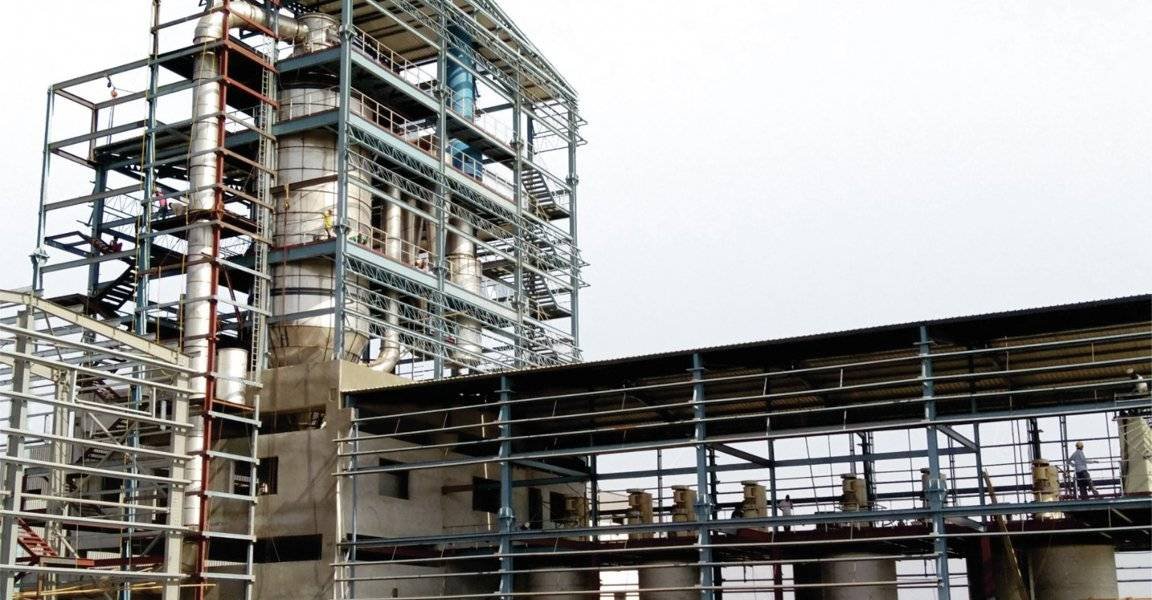
- Large plants need significant building height and footprint.
- Very sticky, low-melting-point products can deposit on walls unless the process is carefully designed.
- Wet cakes or filter cakes that cannot be pumped are better handled by flash, spin flash, rotary or fluid bed dryers. You can compare those options across our drying systems category.
Why AKSH Engineering
AKSH Engineering Systems Pvt. Ltd., based in Ahmedabad, Gujarat, has designed and manufactured spray drying, evaporation and turnkey drying plants since 2013, with more than 100 installations in India and export markets. Our team of technocrats brings over 100 years of combined experience, and every system is designed and built in-house. That means the atomizer, chamber, air system, powder recovery and controls are engineered together around your feed.
Conclusion
An industrial spray dryer is, at its core, a simple idea executed with a great deal of engineering: break a liquid into droplets, dry them in hot gas within seconds, and recover the resulting powder. Understanding the components and the flow of liquid, air and powder through the plant makes it much easier to discuss requirements with suppliers, troubleshoot operations and evaluate new projects.
If you are exploring spray drying for a new product or want a second opinion on an existing line, speak with the AKSH Engineering team. Share your feed details and target powder properties, and our engineers will suggest a suitable configuration.