
Few powders are made under tighter scrutiny than infant formula. Manufacturers must meet strict regulatory standards, demanding customer specifications and exacting hygiene expectations, and they must do so batch after batch, often around the clock. The drying step sits at the heart of that challenge. It is where a carefully prepared liquid becomes the powder that will be packed and shipped, and it is also where heat, moisture, air handling and cleanability all have to be controlled at once.
That is why most large infant formula plants are built around multistage spray dryers. This article looks at the topic strictly from a processing and engineering standpoint: how formula powder is made, why multistage drying fits the job, and the hygienic design, automation and safety features that a modern formula drying plant needs. We do not discuss the nutritional composition of formula, which is the responsibility of each manufacturer and the regulations that apply to them.
How Infant Formula Powder Is Made
Infant formula producers generally use one of three manufacturing routes:
- Wet-mix process: all ingredients are mixed into a liquid, which is heat treated, homogenized, concentrated and spray dried into a complete powder.
- Dry-blend process: separately produced base powders and minor ingredients are blended in dry form, with no spray drying of the final mix on site.
- Hybrid process: a spray-dried base powder is produced by the wet-mix route, and some ingredients are added afterward by dry blending.
Spray drying is central to the wet-mix and hybrid routes. A typical wet-mix line runs through several steps before and after the dryer:
- Ingredient preparation and mixing: liquid and powdered ingredients are dissolved or dispersed under controlled conditions.
- Heat treatment: the mix is heat treated according to the manufacturer's process and food safety plan.
- Homogenization: fat is dispersed into fine, stable droplets so the emulsion stays uniform through concentration and drying.
- Concentration: water is removed in an evaporator to raise solids before drying, which is far more energy efficient than removing it in the dryer.
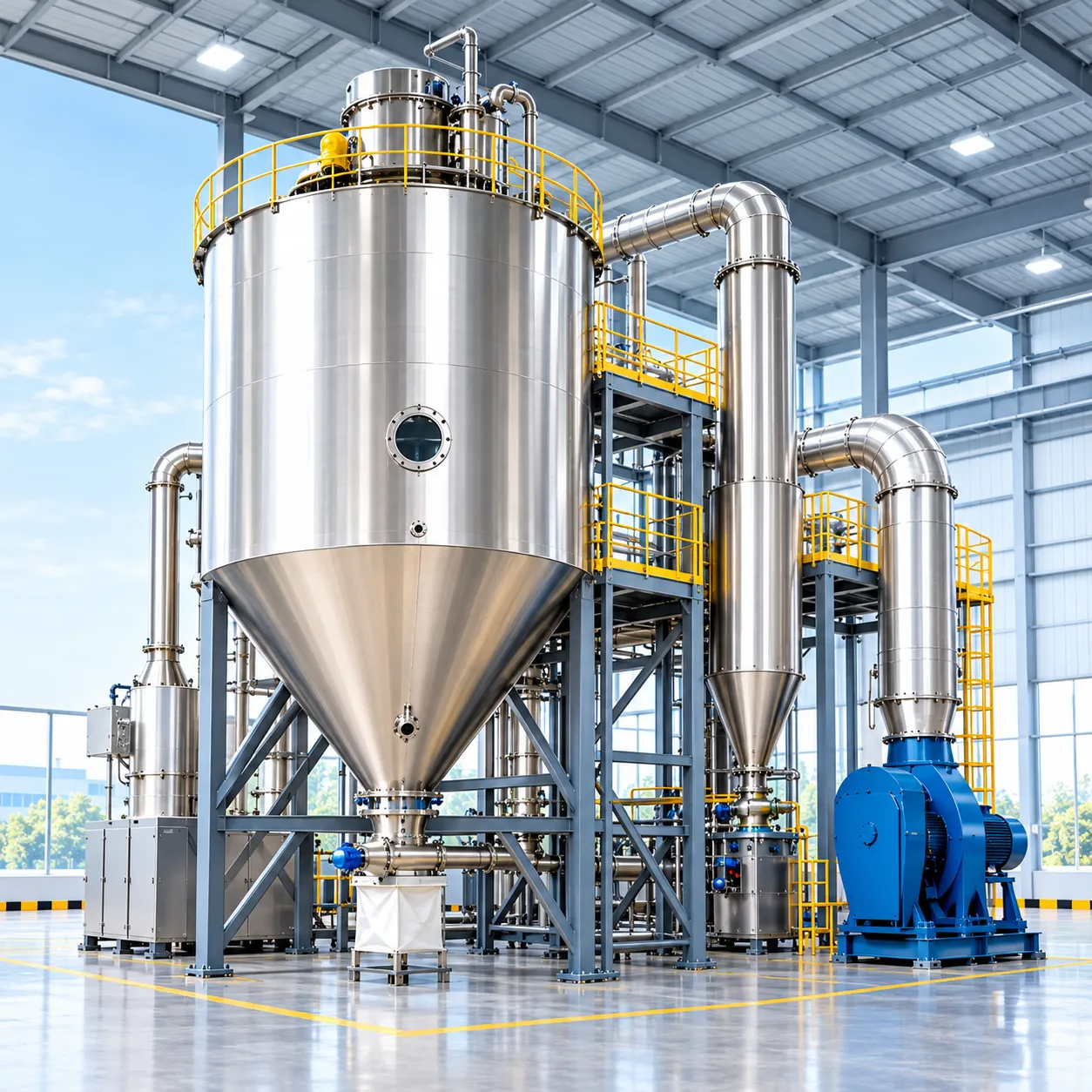
- Multistage spray drying: the concentrate is atomized, dried, agglomerated in the fluid bed and cooled.
- Powder handling and packing: the powder is sieved, stored, sometimes blended, and packed, often under a protective gas atmosphere.
Concentration is usually handled by industrial evaporators, and the evaporator and dryer are best designed together so the concentrate arrives at the right solids content and temperature for atomization.
What the Drying Step Must Achieve
From an engineering point of view, the dryer in a formula plant has to deliver several things at once:
- Low, consistent residual moisture for stable storage of the packed powder.
- Limited thermal exposure for heat-sensitive ingredients in the mix.
- Good reconstitution behavior: the powder must wet, sink and disperse readily without lumps.
- Controlled bulk density so that cans and pouches fill consistently and scoops deliver a uniform volume.
- Low dust and good flow for clean handling and accurate filling.
- Hygienic operation with protection against contamination from air, surfaces and people.
A single-stage spray dryer can struggle to reach all of these together, particularly with fat- and sugar-containing feeds. Achieving low final moisture in one pass requires a high exhaust temperature, which increases thermal load and the risk of sticky deposits. The multistage design addresses this directly.
Why Multistage Drying Fits Infant Formula
A multistage spray dryer splits drying into two or three stages. The concentrate is atomized into the main chamber, where most of the water evaporates, leaving the particles with a controlled amount of residual moisture. The particles then fall onto an integrated fluid bed where low-temperature air completes drying gently, and finally pass to an external vibrating fluid bed for cooling and conditioning before packing.
Lower Thermal Load
Because the fluid bed finishes the drying, the main chamber can run with a lower exhaust air temperature than a single-stage dryer making the same powder. The particles spend less time at elevated temperature, which reduces the thermal load on heat-sensitive ingredients and on the powder as a whole.
Agglomeration for Easy Reconstitution
Particles reaching the integrated fluid bed are still slightly moist on the surface, so they collide and bind into porous agglomerates. Fines from the cyclones or bag filters can be returned to the drying zone to join these agglomerates. The result is a coarser, more open powder structure that wets and disperses readily and produces less dust during filling and use.
Precise Moisture Control
The fluid bed gives a second, independently controlled drying step. Operators can fine-tune the final moisture there without changing conditions in the spray chamber, which helps hold moisture within tight limits from shift to shift.
Better Handling of Sticky Feeds
Formula concentrates contain fat and carbohydrates that can become sticky in the chamber. Leaving controlled residual moisture and finishing in a fluidized state reduces wall deposits and lump formation, which in turn supports longer production runs between cleanings.
Energy Efficiency
Running the chamber with higher inlet and lower exhaust temperatures improves thermal efficiency. AKSH product data indicates that this approach can reduce specific steam and fuel consumption by up to 15 to 25 percent compared with single-stage drying, depending on product and design.
Flexible Atomization
Multistage formula dryers can be fitted with high-pressure nozzles or a high-speed rotary disk. Nozzles are often chosen when coarser primary particles are wanted to build larger agglomerates and higher bulk density, while rotary atomizers offer wide turndown and easy adjustment of particle size. The right option depends on the target powder structure, plant capacity and the producer's operating preferences, and is best confirmed through trials on representative concentrate.
Single-Stage vs Multistage for Formula Powder
| Aspect | Single-Stage Spray Dryer | Multistage Spray Dryer |
|---|---|---|
| Where final drying happens | Entirely in the spray chamber | Completed in an integrated fluid bed |
| Exhaust air temperature | Higher, to reach final moisture | Lower, as residual moisture is removed later |
| Thermal load on powder | Higher | Lower |
| Powder structure | Finer, often more dusty | Agglomerated, low dust, good wettability |
| Moisture control | One control point | Two independent stages |
| Sticky feed handling | More prone to wall deposits | Better tolerance through fluidization |
| Cooling before packing | Separate equipment required | Built into the external fluid bed stage |
Hygienic Design: The Non-Negotiable Requirement
In a formula plant, hygienic design matters as much as drying performance. Contamination is far easier to prevent through equipment and layout than to remove afterward, so hygiene is engineered into the plant from the first drawing.
Product-Contact Surfaces
Product-contact parts are made in SS316L or SS316, with smooth, crevice-free welds and polished internal finishes so residues have nowhere to hide. AKSH hygienic spray dryers are built with mirror-polished internal surfaces of Ra 0.4 µm or better, with electropolished options. The reasons for choosing particular stainless steel grades are discussed in our article on spray dryer construction materials.
Filtered Process Air
Large volumes of air pass through the dryer and fluid beds, and that air contacts the product directly. Hygienic designs use multi-stage filtration, including pre-filters and final HEPA filters, on the process air intake so that airborne particles do not reach the drying zone.
Cleaning-in-Place
Wet cleaning must be thorough, repeatable and documented. Integrated spray devices in the chamber, cyclones and ducts, supplied from an automatic cleaning-in-place system, deliver controlled time, temperature, chemical concentration and flow. Inline conductivity sensors confirm when chemicals have been rinsed away, and PLC data logging provides the cleaning record. The principles are explained in our guide to the fundamentals of clean-in-place technology.
Drying After Wet Cleaning and Dry Cleaning Practices
Moisture left behind after wet cleaning can create conditions for microbial growth in a powder plant. Formula producers therefore pay close attention to drying the plant thoroughly after wet cleaning and, in many areas, use controlled dry cleaning methods between wet cleans. Equipment design should support both: surfaces that drain fully, access for inspection, and components that can be dried quickly.
Hygienic Zoning
Powder plants are commonly divided into hygiene zones, with the strictest controls in areas where powder is exposed. Controlled personnel and material flows, air pressure differences between zones and separation of wet and dry areas all help protect the product. The dryer layout, including where powder is discharged, sieved and conveyed, should be planned with this zoning in mind.
Automation, Traceability and Data
Formula manufacturers need to demonstrate that each batch was produced within its defined process conditions. That requires reliable instrumentation and secure records.
- Closed-loop control of inlet and outlet temperatures, fluid bed air temperatures and feed rate keeps the process inside its validated window.
- Recipe management stores the settings for each product so changeovers are consistent.
- Batch records and audit trails capture process data, alarms and operator actions. AKSH hygienic systems can be supplied with PLC-SCADA platforms supporting 21 CFR Part 11 features such as user access levels, electronic records and audit trails.
- Interlocks protect product and equipment by stopping feed and heating if airflow or temperatures move outside safe limits.
These functions are delivered through AKSH instrumentation, automation and controls, and you can explore the related range in our automation and control category.
Powder Handling, Packing and Shelf Stability
The dryer's job does not end at the outlet of the external fluid bed. Powder must be cooled to a temperature suitable for storage and packing to reduce caking, sieved to remove any oversize agglomerates, and conveyed gently so the agglomerates are not broken back into fines. Many producers pack formula in cans or pouches under a protective gas atmosphere to limit oxygen exposure during storage. Consistent moisture, particle structure and packing practice all contribute to stable powder over its shelf life, a topic covered more broadly in ensuring consistency and shelf life in food powders.
Safety in Milk Powder Drying
Dairy-based powders are combustible as dust, and deposits that remain in hot areas of a dryer for long periods can overheat. Formula drying plants are therefore designed with appropriate explosion protection, temperature monitoring and fire detection, together with operating procedures that limit deposit buildup. Regular inspection and cleaning are as important for safety as they are for hygiene.
Key Questions When Specifying a Formula Drying Plant
- What evaporation capacity and annual output are required, and is future expansion planned?
- Will the plant follow a wet-mix or hybrid route, and how will the evaporator and dryer be integrated?
- Which atomization method, high-pressure nozzles or rotary disk, best suits the target powder structure?
- What residual moisture, bulk density and agglomerate size are targeted?
- What hygiene zoning, air filtration and cleaning strategy will the plant use?
- Which regulatory and customer standards must the automation and documentation satisfy?
- How will fines be returned, and how will the powder be cooled, sieved and conveyed to packing?
Infant formula is one of several demanding applications for this technology; for a wider view, see our overview of industrial applications of multistage spray dryers.
Why AKSH Engineering
AKSH Engineering Systems Pvt. Ltd., based in Ahmedabad, Gujarat, has designed and manufactured spray drying and evaporation plants since 2013 and has completed more than 100 installations. Our team of technocrats, with over 100 years of combined experience, designs and builds in-house, which allows us to engineer the evaporator, multistage dryer, CIP system and automation as one integrated, hygienic process. AKSH multistage spray dryers are custom sized from about 50 kg/hr to 10,000+ kg/hr water evaporation in SS304, SS316 and SS316L, with high-pressure nozzle or rotary disk atomization and fully automatic PLC and SCADA control with recipe management. We also serve customers outside India through exports.
Conclusion
Infant formula production asks a great deal of a spray drying plant: low and consistent moisture, limited thermal load, easy reconstitution, uniform bulk density, low dust and uncompromising hygiene, all at high throughput. Multistage spray dryers meet these demands by sharing the drying work between the spray chamber and fluid beds, creating agglomerated powders under gentler conditions with tighter control. Combined with hygienic construction, filtered air, automated cleaning and secure process records, they provide a robust engineering foundation for formula manufacturing.
If you are planning a new infant formula or specialty dairy powder line, or upgrading an existing dryer, contact the AKSH Engineering team. We will help you define the process, hygiene and automation requirements and design a multistage drying plant that fits your product and your standards.