
Product development budgets rarely fail because of one large, visible expense. They fail through a long list of smaller ones: kilograms of expensive active ingredient poured into trials that teach nothing, weeks of production capacity lost to experiments, a commercial dryer that needs modifications after start-up, or a launch that slips by a season because samples were not ready. Each of these is a cost of uncertainty, and spray drying projects carry more uncertainty than most, because powder properties are difficult to predict from a formulation on paper.
A pilot spray dryer is, at heart, a tool for buying down that uncertainty at a lower price. This article takes a financial view of pilot spray drying: where development money actually goes, which of those costs a pilot unit reduces, how to budget a pilot campaign, and how to decide whether to own a unit or run trials elsewhere. For the technical background, our article on what a pilot spray dryer is and why it matters in product development is a useful starting point.
Where Development Money Really Goes
Before looking at savings, it helps to list the cost centers in a typical spray-dried product project. Not all of them appear in the R&D budget, which is one reason they are easy to underestimate.
- Raw materials consumed in trials: actives, proteins, extracts, carriers and solvents used up during experiments.
- Equipment time: hours of dryer operation, plus cleaning and changeover, whether on your own plant or a third party's.
- People: scientists, operators, analysts and engineers involved in each trial.
- Analytical testing: moisture, particle size, bulk density, solubility, assay, microbiology and stability work for each batch.
- Scale-up errors: production equipment that is oversized, undersized or configured incorrectly, and the retrofits that follow.
- Commissioning losses: off-specification product and extended start-up periods on the commercial plant.
- Delay: revenue that arrives later than planned because the process was not ready.
The last three items are often the largest, and they are the ones a pilot spray dryer influences most.
Cost Driver by Cost Driver
| Cost Driver | Without a Pilot Stage | With a Pilot Spray Dryer |
|---|---|---|
| Material per trial | Production trials need large feed volumes to reach steady state | Trials can start from about 1 to 3 liters of feed on AKSH units |
| Equipment time | Production plant taken offline for experiments | Experiments run in parallel with production |
| Learning per trial | Few variables tested because each run is expensive | Many conditions mapped quickly and cheaply |
| Equipment design risk | Plant sized on assumptions and lab data | Plant sized on measured evaporation, yield and powder data |
| Commissioning | Process window found during start-up | Process window known before start-up |
| Samples for customers | Limited or delayed | Kilogram quantities available early |
| Time to market | Extended by rework and troubleshooting | Shortened by parallel, de-risked development |
Material Savings
A production tower has to fill its ducts, reach thermal equilibrium and stabilize before any representative powder appears, so even a short production trial consumes a substantial volume of feed. A pilot unit reaches steady operation with a small fraction of that volume, and high-efficiency cyclone recovery with polished chamber walls means more of the dried product is collected for testing. For high-value feeds such as APIs, enzymes, probiotics and specialty proteins, this is often the first and most visible saving.
Protecting Production Capacity
Every hour a commercial dryer spends on experiments is an hour it is not making saleable product. It also means cleaning before and after the trial, and in hygienic plants that can involve full cleaning validation. Moving development work to a separate pilot unit frees the production line entirely and removes the risk of cross-contamination between development and commercial products.
More Learning per Rupee
Because pilot trials are cheaper, teams can afford to explore more of the process window. Instead of testing two or three conditions and hoping one is good enough, they can run a structured set of experiments covering atomization, temperatures and feed concentration. The result is a better-optimized process, which pays back in production through higher yield, lower energy use and fewer rejects.
Avoiding Scale-Up Mistakes
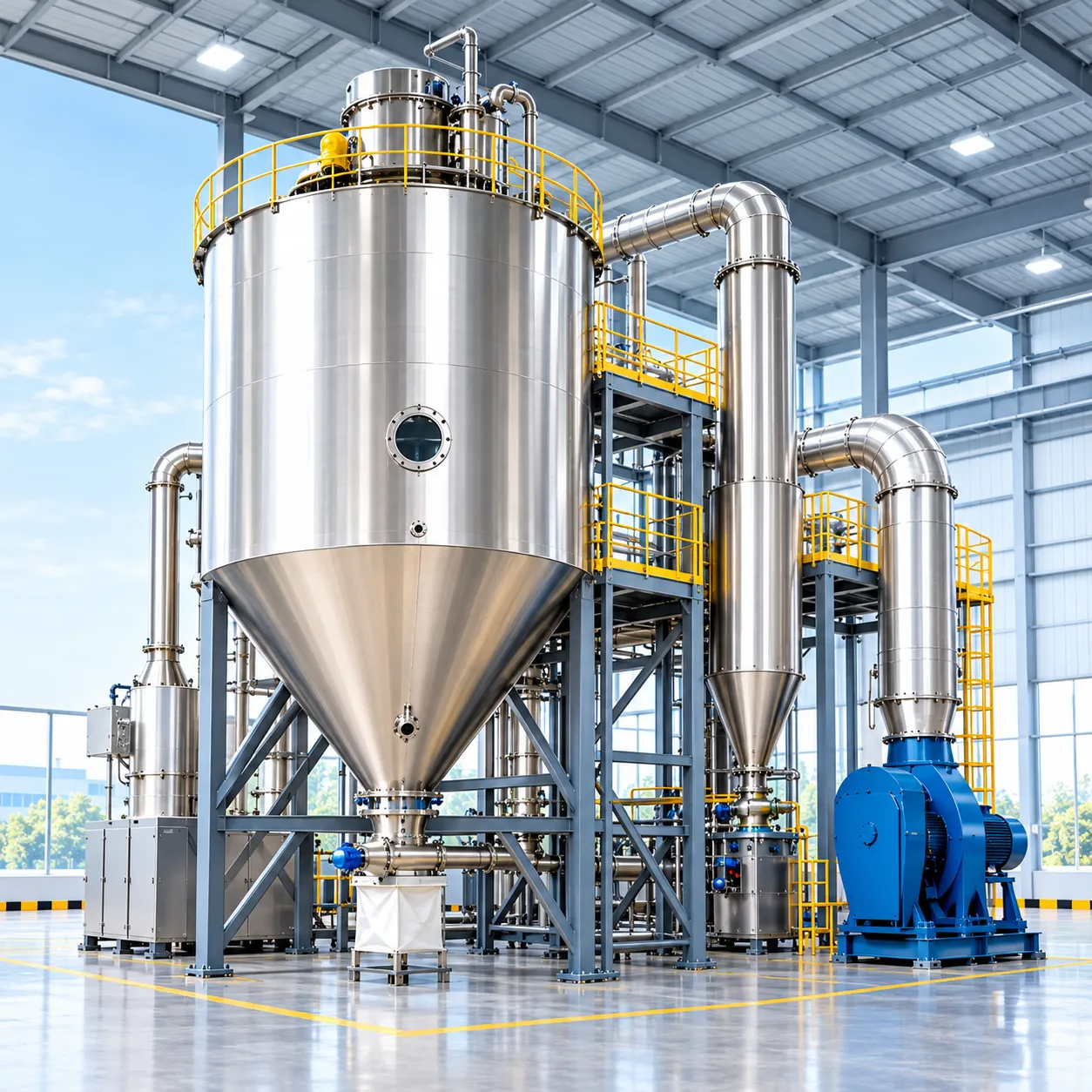
The single most expensive mistake in spray drying is a production plant that cannot make the product. Wrong chamber size, an unsuitable atomizer, insufficient powder recovery or inadequate heating capacity can each require costly modifications after installation. Pilot data on evaporation rate, heat consumption, yield and powder behavior allows the commercial industrial spray dryer to be designed on measured numbers rather than estimates. The step-by-step method is covered in our guide From Lab to Line: How to Use Pilot Spray Dryers for Seamless Scale-Up.
Shorter Commissioning
When a production plant starts up with a known operating window, commissioning becomes a matter of confirming expected performance rather than searching for it. That means less off-specification powder, fewer days of supplier engineers on site and a faster transition to saleable output.
Earlier Revenue
Kilogram quantities of representative powder let sales teams send samples to customers, start stability studies and complete packaging trials while the production plant is still being built. Running these activities in parallel rather than in sequence can bring forward the date of the first commercial order, which for many projects is the biggest financial benefit of all.
Operating Cost Insight Before You Commit
Pilot trials do more than reduce development spending; they also reveal what the product will cost to make. Measured heat consumption per kilogram of water evaporated, achievable outlet temperatures and realistic yield feed directly into the operating cost model for the production plant. This helps companies price the product correctly, compare process options such as higher feed solids or different inlet temperatures, and target efficiency from day one. Our article on energy-saving tips for industrial spray dryers shows how these levers translate into production savings.
A Simple Way to Estimate the Value of a Pilot Stage
Every company's numbers are different, but the logic for judging whether a pilot stage pays for itself is straightforward. Start by estimating the cost of the risks the pilot stage would remove, then compare that with the cost of the pilot work.
- Cost of a failed production trial: feed consumed, production hours lost, cleaning and analysis, multiplied by the number of trials you would realistically need without pilot data.
- Cost of a plant modification: a changed atomizer, an added fines collection stage or a resized heater, including the downtime needed to install it.
- Cost of delay: the margin on sales that would be lost for each month the launch slips.
- Cost of the pilot stage: the unit itself or trial fees, plus feed, people and analytics for the campaign.
Even with cautious assumptions, the risk side of this comparison is usually far larger than the pilot cost for any product with valuable ingredients or a meaningful market. The exercise is also useful internally, because it gives management a clear, quantified reason to approve development spending.
Where the Savings Are Largest
The financial case is strongest in industries where feed is expensive, specifications are tight or regulation is demanding:
- Pharmaceuticals and biotech: costly actives, small batch sizes and documentation requirements make every avoided production trial valuable.
- Nutraceuticals and specialty foods: probiotics, botanical extracts and protein ingredients are sensitive to heat and expensive to waste.
- Specialty chemicals and advanced materials: catalysts, pigments and battery materials need precise particle properties that are hard to predict without trials.
- Contract manufacturers: companies that develop many products for clients recover the cost of a pilot unit across a large number of projects.
How to Budget a Pilot Campaign
A pilot campaign is most cost-effective when it is planned like a project rather than run as a series of ad hoc trials.
- Set decision-focused objectives: list the decisions the campaign must support, such as atomizer type, chamber size, target outlet temperature and whether the product needs agglomeration.
- Estimate feed requirements: multiply the number of planned conditions by the feed volume each needs, then add a margin for repeat runs and start-up.
- Plan analytics in advance: agree which tests each batch needs, so laboratory capacity is ready and results come back quickly.
- Use structured experiments: a design-of-experiments approach extracts more information from fewer runs.
- Reserve time for confirmation runs: repeat the best conditions to prove repeatability before sizing production equipment.
- Document everything: logged trends from the control system become the design basis and, in regulated industries, part of the development record.
Own a Pilot Unit or Run Trials Elsewhere?
Many companies first meet pilot spray drying through trials at an equipment supplier or contract facility. That is a sensible route for a single project. Owning a pilot unit starts to make financial sense when several of the following apply:
- You develop new powder products or reformulations regularly, rather than once.
- Your formulations are confidential and you prefer not to send them outside.
- Trials need to be run quickly and repeatedly as formulations evolve.
- You want to produce small commercial batches, samples or niche products in-house.
- You need specific configurations, such as hygienic finishes or solvent handling, that are hard to find at third-party facilities.
When comparing options, include the cost of travel, scheduling delays and shipping feed to an external site, not just the trial fee. For organizations with a steady development pipeline, an in-house pilot spray dryer can quickly become one of the most productive assets in the R&D budget.
Configuring a Pilot Unit for Value
The cheapest pilot unit is not always the most economical. The configuration should match the work it will do:
- Capacity: large enough to generate representative powder and samples, small enough to conserve costly feed. AKSH pilot units are custom sized from 1 to 50 kg/hr water evaporation.
- Atomization: interchangeable rotary disk and two-fluid nozzle atomization avoids buying a second unit later.
- Hygiene: food, nutraceutical and pharmaceutical developers benefit from SS316L sanitary construction similar to a hygienic spray dryer at production scale.
- Solvent capability: if any formulation uses organic solvents, a closed-loop nitrogen pilot configuration keeps the work safe and mirrors the production approach used in a closed-loop spray dryer.
- Controls and data logging: PLC and HMI control with recorded trends makes every trial reusable as design data.
Readers comparing benchtop and pilot equipment on cost and capability can find a detailed side-by-side in how a pilot spray dryer differs from a lab spray dryer.
Hidden Costs That Pilot Trials Expose Early
- Stickiness and wall deposits that would reduce yield and demand frequent cleaning in production.
- Need for a carrier or drying aid, which changes the formulation cost per kilogram of product.
- Fines and dust that call for additional collection equipment or an agglomeration stage.
- Hygroscopic behavior that requires dehumidified air, special packaging or conditioned storage.
- Thermal sensitivity that limits inlet temperature and therefore throughput per unit of plant size.
Discovering any of these at pilot scale costs a few trials. Discovering them on a commercial plant can cost months.
Why AKSH Engineering
AKSH Engineering Systems Pvt. Ltd., based in Ahmedabad, Gujarat, has designed and manufactured spray drying and evaporation systems since 2013 and has completed more than 100 installations. Our team of technocrats brings over 100 years of combined experience, and all design and manufacturing is done in-house. We build pilot spray dryers in SS304, SS316 and SS316L with inlet air temperatures up to 350°C, open-loop or closed-loop nitrogen operation and PLC-based data logging, and we design the production plants that follow. When choosing a supplier, it is worth reading our guide to choosing the right spray dryer manufacturer, and you can view our wider range of drying systems.
Conclusion
A pilot spray dryer reduces product development costs in two ways. Directly, it cuts the material, equipment time and labor consumed by each experiment. Indirectly, and usually more significantly, it prevents expensive scale-up mistakes, shortens commissioning and brings revenue forward by making representative product available early. Planned well, a pilot campaign turns uncertainty into data at a fraction of the cost of learning the same lessons on a production plant.
If you are planning a new powder product or reviewing your development process, contact the AKSH Engineering team. We will help you scope a pilot spray dryer or trial plan that fits your products, your pipeline and your budget.