
Water-soluble polymers do quiet but essential work in hundreds of products. They thicken sauces and shampoos, bind tablets, form films on seeds and capsules, stabilize emulsions, flocculate solids in water treatment and control rheology in paints, adhesives and drilling fluids. Most of them are sold as powders, because a dry polymer is cheaper to ship, easier to store and more stable than a dilute solution. Turning that solution into a powder that dissolves quickly and cleanly is where the engineering challenge lies.
This guide looks at spray drying water-soluble polymers from a process engineer's point of view. It covers the main polymer families, the properties that make them difficult to dry, the design choices that matter most, and a practical approach to development and scale-up. Whether you produce cellulose ethers, synthetic polymers, natural gums or polymer-based carriers, the same underlying principles apply.
The Main Families of Water-Soluble Polymers
Water-soluble polymers are large molecules that dissolve, disperse or swell in water. For drying purposes, they are usually grouped by origin:
- Natural polymers: Gum arabic, guar, xanthan, alginates, pectin, carrageenan, gelatin and many plant and microbial gums.
- Semi-synthetic polymers: Modified natural materials, especially cellulose derivatives such as carboxymethyl cellulose (CMC), hydroxypropyl methylcellulose (HPMC) and hydroxyethyl cellulose, plus modified starches and maltodextrins.
- Synthetic polymers: Polyvinyl alcohol (PVA), polyvinylpyrrolidone (PVP), polyethylene glycol (PEG), polyacrylamides and polyacrylates, among others.
Some of these, such as maltodextrin and gum arabic, are among the easiest materials to spray dry and are widely used as carriers for other ingredients. Others, particularly high-molecular-weight synthetic polymers and some gums, are among the hardest. Understanding why is the first step to designing a good process.
What Makes Polymer Solutions Difficult to Spray Dry
High Viscosity at Low Solids
The defining feature of many polymer solutions is that viscosity rises steeply with concentration and molecular weight. A small-molecule solution might be easy to pump and atomize at 50 percent solids, while a high-molecular-weight polymer may become a thick gel at well under 10 percent. Low feed solids mean more water to evaporate per kilogram of product, which raises energy cost and limits capacity.
Stringy Atomization
Long polymer chains give solutions elasticity. Instead of breaking cleanly into droplets, the liquid can stretch into threads and filaments, sometimes described as cobwebbing or angel hair. These fibers dry into fluffy, low-density material that clogs cyclones and creates poor flow.
Stickiness and the Glass Transition
Amorphous polymers soften above their glass transition temperature, which falls as moisture content rises. A partly dried particle that is warm and still damp can be above its glass transition and therefore sticky. It adheres to walls, forms lumps and builds deposits in the cone and ducts. This is the most common cause of poor yield when drying polymers and sugar-rich carriers.
Skin Formation
Polymer solutions often form a skin on the droplet surface early in drying. The skin slows the escape of water vapor and can cause droplets to puff up into hollow, thin-walled particles. Hollow particles may break into fines during handling, and they reduce bulk density.
Hygroscopicity
Many water-soluble polymers absorb moisture from the air. A powder that leaves the dryer in good condition may cake in a silo or bag if it is not cooled and packed promptly under suitable conditions.
Poor Dissolution of Fine Powders
Fine polymer powders tend to form lumps when added to water. The outer layer of a clump hydrates quickly into a gel, sealing dry powder inside. Customers experience this as fish-eyes or undissolved lumps. Particle size and structure, which are set in the dryer, have a major influence on this behavior.
Thermal and Mechanical Degradation
High temperatures can discolor some polymers or reduce their molecular weight, and very high shear during atomization can also break long chains. Since viscosity and functional performance depend on molecular weight, these losses directly affect product value.
Polymer Types and Typical Drying Considerations
| Polymer Group | Examples | Typical Drying Considerations |
|---|---|---|
| Carriers and low-viscosity polymers | Maltodextrin, gum arabic, some modified starches | Relatively easy; higher solids possible; watch stickiness at high outlet temperatures |
| Cellulose ethers | CMC, HPMC, HEC | Viscosity limits solids; some grades show thermal gelation; dissolution behavior is critical |
| Natural gums | Guar, xanthan, alginates, pectin | Very high viscosity; often dried by other routes or at low solids; risk of fibrous atomization |
| Synthetic vinyl polymers | PVA, PVP | Film-forming and sticky; careful outlet temperature control and wall management needed |
| Polyacrylamides and polyacrylates | Flocculants, superabsorbent precursors | High molecular weight; shear and heat sensitivity; strong tendency to form threads |
| Proteins and protein-like polymers | Gelatin, collagen peptides | Heat sensitivity and stickiness; low outlet temperatures preferred |
Key Design Decisions
Feed Preparation
Because viscosity is the main limit, feed preparation often has the largest effect on capacity. Warming the feed can lower viscosity substantially for many polymers, allowing higher solids, provided the polymer does not gel on heating as some cellulose ethers do. Deaeration removes trapped air that would otherwise create foam and irregular particles. Filtration removes gels and undissolved lumps that block atomizers. Where a product allows it, controlled reduction of molecular weight before drying is sometimes used, but this is a product decision, not a drying one.
Atomizer Selection
The atomizer must break an elastic, viscous liquid into droplets without forming threads. Each type has strengths:
- A rotary disk atomizer tolerates high viscosity and has no fine orifice to clog. Wheel speed can be raised to increase shear and reduce droplet size. AKSH rotary atomizers use VFD control that allows speeds up to 25,000 RPM and above, which helps when working with demanding feeds.
- Two-fluid nozzles use compressed air or gas to shear the liquid and can handle viscous, elastic solutions at relatively low liquid pressure, at the cost of compressed air consumption.
- Pressure nozzles suit lower-viscosity polymer solutions and coarser powders with high throughput.
The AKSH nozzle atomization range covers both pressure and two-fluid nozzles. For a side-by-side discussion of the options, read our comparison of rotary disc and nozzle atomizers. Viewing all the options together in our atomization technologies category also helps when the feed is borderline between types.
Temperature Strategy
For polymers, the outlet temperature matters more than the inlet. The goal is to keep partially dried particles below their sticky point as they approach the walls and cone. In practice, this often means a moderate outlet temperature combined with an inlet temperature high enough to give good capacity. Because droplets are cooled by evaporation, the product temperature during the early, wet stage stays well below the inlet air temperature. Our guide to heat and mass transfer in spray drying explains why this is so and how drying rate changes as the particle dries.
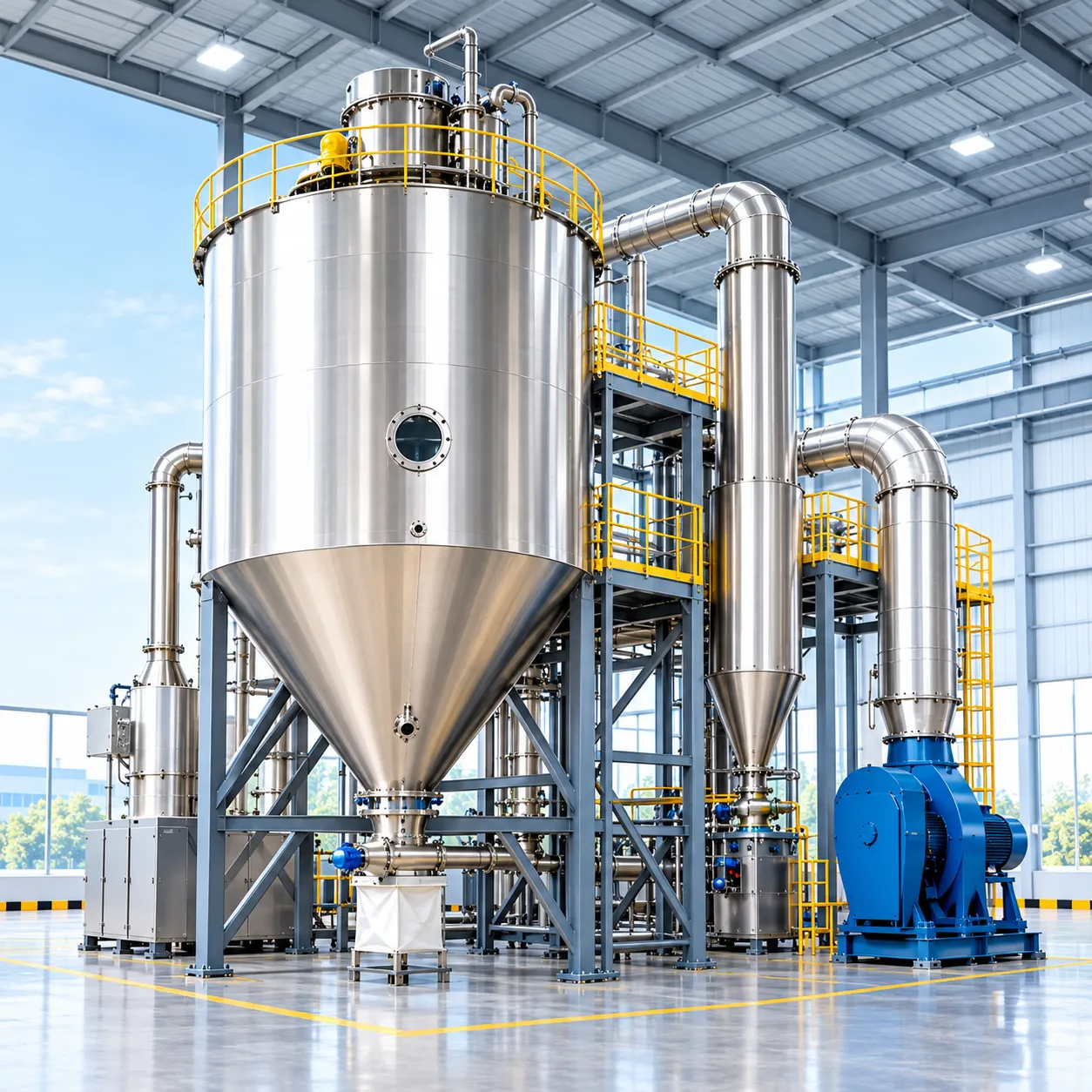
Chamber and Airflow Design
Sticky products need enough chamber volume and residence time to dry fully before touching a surface. Air distribution should avoid recirculation zones that carry wet particles back to the wall. Some plants use cooled or swept chamber walls, or introduce cool air near the cone, to reduce deposits. Chamber geometry should also suit the atomizer: rotary wheels need a wider chamber, nozzles a taller one.
Agglomeration for Better Dissolution
Fine, single particles often dissolve poorly. Agglomerated powders with an open, porous structure let water penetrate before a gel layer forms, so they disperse and dissolve more cleanly. Multi-stage spray dryers with integrated fluid beds, or a separate fluid bed after the spray dryer, are commonly used to build agglomerates and to cool the powder. Our article on why fluid bed dryers are essential for dust-free powders explains the granulation side of this in detail.
Powder Recovery
Low-density polymer powders and fines are easily carried into the exhaust. High-efficiency cyclones followed by bag filters are typical, and fines are often returned to the chamber to take part in agglomeration. Our guide to improving powder recovery in industrial spray dryers covers practical ways to raise yield.
Solvent-Based Polymer Systems
Not every polymer feed is water-based. Some specialty polymers and pharmaceutical solid dispersions are dissolved in ethanol, acetone or other organic solvents. These require a nitrogen-blanketed, closed-cycle design. An AKSH closed-loop spray dryer recirculates nitrogen, monitors oxygen and condenses the solvent for reuse, with specialty polymers and synthetic resins among its listed applications.
How End Use Shapes the Drying Target
The same polymer may need very different powder properties depending on where it is sold. A pharmaceutical binder or film-coating polymer is judged on purity, low moisture, consistent viscosity and compliance with pharmacopoeial limits, so gentle drying and sanitary construction come first. A food thickener must disperse without lumps in a consumer's kitchen or a beverage plant, which usually favors agglomerated powders. A flocculant for water treatment is valued for high molecular weight and fast dissolution in large make-up tanks, so avoiding chain degradation is critical. Construction and drilling additives are often sold on bulk price, which makes capacity and energy cost the dominant concerns. Defining the end use clearly at the start avoids designing a dryer that meets the wrong specification.
Safety Considerations
Most dry polymer powders are combustible, and fine organic dust suspended in air can form an explosive mixture. Spray dryers handling polymers should be assessed for dust explosion risk and protected appropriately, for example with explosion vents, suppression or isolation, depending on the material and local regulations. Good housekeeping, grounding and control of ignition sources in powder handling areas are equally important. Exhaust air cleaning also needs attention, since polymer fines can blind filters if humidity is not controlled.
A Step-by-Step Development Approach
- Characterize the solution: Measure viscosity against solids and temperature, check for thermal gelation and record glass transition behavior if available.
- Set product targets: Define moisture, bulk density, particle size, dissolution time and any limits on viscosity loss or color change.
- Screen atomization: Test rotary and nozzle routes to find which gives clean droplets without threads at the planned solids.
- Find the outlet window: Run trials at a range of outlet temperatures to identify the band that gives dry, non-sticky powder without damaging the polymer.
- Optimize solids and inlet temperature: Push solids and inlet temperature upward to improve capacity while staying inside the quality window.
- Evaluate agglomeration: Decide whether single-stage powder is acceptable or whether agglomeration is needed for dissolution and dust control.
- Test packaging and storage: Confirm that the powder remains free flowing at expected storage humidity and temperature.
- Scale up: Use the validated data to size the production dryer, atomizer, air system and powder handling.
Pilot-scale trials with industrial-style atomizers are particularly useful for polymers, because thread formation and wall deposits often appear only at realistic droplet sizes and chamber conditions.
Controlling Operating Cost
Since polymer feeds are often dilute, energy per kilogram of powder can be high. The biggest gains usually come from raising feed solids, through warming the feed or improving dissolution, and from operating the dryer at the highest inlet temperature the product tolerates. Heat recovery from exhaust air, well-maintained insulation and an efficient powder recovery system that minimizes losses also matter. In some cases, pre-concentrating the solution in an evaporator before drying can reduce total energy use, provided the concentrated solution remains pumpable.
For a broader view of selecting dryers for difficult feeds, our article on how to choose the right spray dryer for chemical slurries offers a useful framework.
Why AKSH Engineering
AKSH Engineering Systems Pvt. Ltd. has designed and manufactured spray drying and evaporation systems in Ahmedabad, Gujarat, since 2013, with more than 100 installations. Our team of technocrats brings over 100 years of combined experience, and all design and manufacturing is carried out in-house. Our industrial spray dryers are custom-sized to the feed, with rotary or nozzle atomization, automated PLC and SCADA control and options for powder recovery and heat recovery. For polymers, we pay particular attention to atomization, outlet temperature control and wall management, and we supply systems in India and for export.
Conclusion
Spray drying water-soluble polymers is a balance between competing demands: high solids versus pumpable viscosity, high temperature for capacity versus low temperature to avoid stickiness and degradation, and fine particles for quick drying versus coarse agglomerates for clean dissolution. The right answer depends on the polymer, its molecular weight and how the customer will use the powder.
If you are planning to spray dry a polymer or want to improve yield, capacity or dissolution on an existing line, contact the AKSH Engineering team. We will review your solution properties and product targets and recommend a drying configuration designed around them.