
Introduction
If you operate an industrial evaporator, you already know that fouling is one of the most persistent and costly problems you’ll face. Whether you’re concentrating chemicals, treating effluent, recovering solvents, or processing food and dairy products, fouling silently eats into your plant’s efficiency, energy consumption, and maintenance budget long before it becomes visible on a gauge or a production report.
At AKSH Engineering Systems Pvt. Ltd., we design and manufacture industrial evaporators and dryers for a wide range of process industries, and fouling is one of the most common concerns our clients bring to us — whether they’re troubleshooting an existing system or specifying a new one. In this article, we break down what evaporator fouling actually is, the different types you’re likely to encounter, why it happens, and — most importantly — how to prevent it through smart design, operating practices, and maintenance planning.
What Is Evaporator Fouling?
Evaporator fouling refers to the undesirable accumulation of unwanted material — scale, sludge, biological growth, or corrosion products — on the heat transfer surfaces of an evaporator, typically the tubes, plates, or calandria. This layer of deposit acts as an insulator, reducing the rate at which heat passes from the heating medium (usually steam) into the process liquid.
Even a thin fouling layer can have an outsized impact. A fouling deposit as thin as 1 mm can reduce heat transfer efficiency significantly, depending on the deposit’s thermal conductivity. Over time, this forces the plant to either increase steam pressure to compensate, extend batch cycle times, or accept lower throughput — all of which translate directly into higher operating costs.
Why Fouling Matters for Plant Performance
Before diving into specific fouling types, it’s worth understanding the downstream consequences of ignoring the problem:
- Reduced heat transfer efficiency — Fouling layers insulate the heat exchange surface, forcing higher steam consumption to achieve the same evaporation rate.
- Increased energy costs — More steam and longer cycle times mean higher utility bills, often the single largest recurring cost in an evaporation process.
- Reduced throughput — As fouling builds, the evaporator’s capacity drops, directly impacting production schedules and delivery timelines.
- Frequent unplanned shutdowns — Severe fouling can force emergency cleaning cycles, disrupting production planning and increasing labour costs.
- Accelerated equipment wear — Certain fouling types, especially those linked to corrosion, can shorten the working life of tubes, plates, and other critical components.
- Product quality issues — In food, pharma, and chemical processing, fouling deposits can contaminate the product stream or create conditions for microbial growth.
Understanding these consequences is the first step toward taking fouling seriously as a design and operational priority, not just a maintenance afterthought.
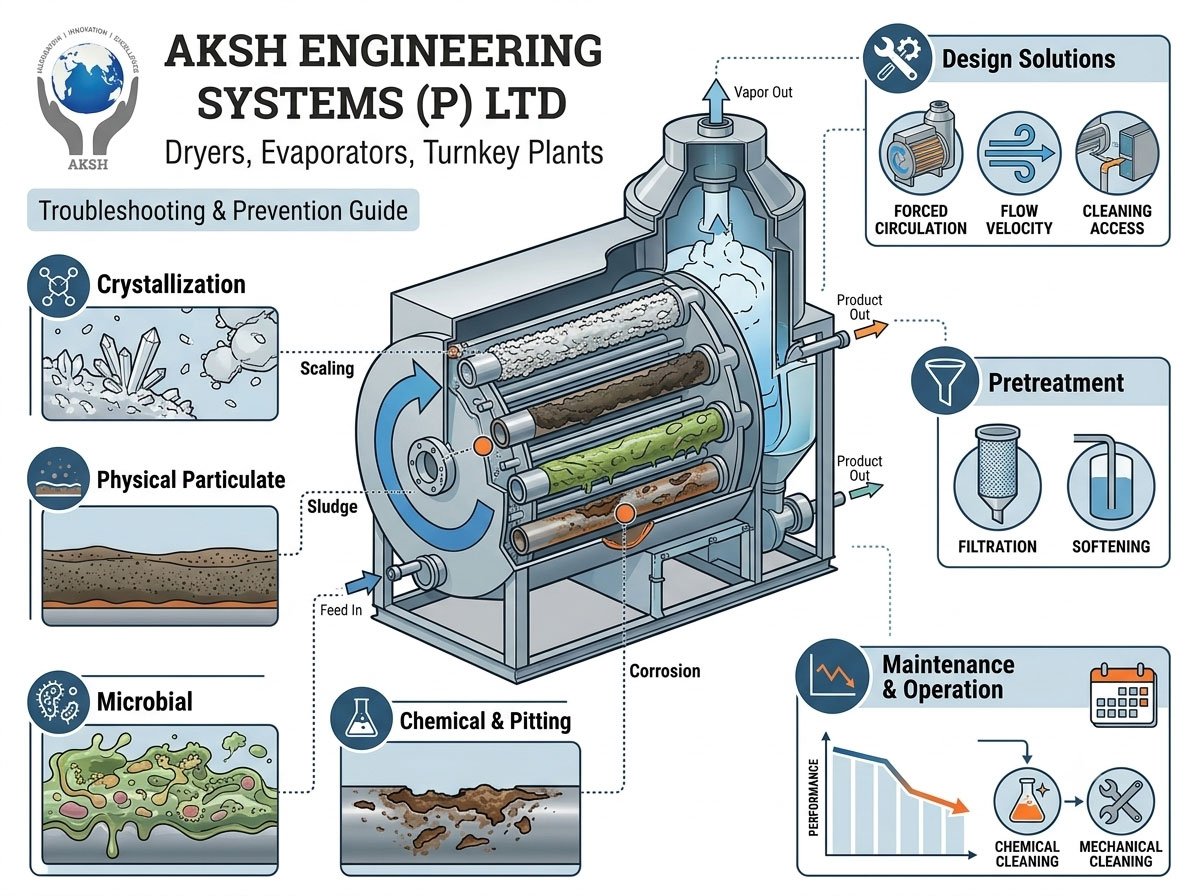
Common Types of Evaporator Fouling
Fouling isn’t a single phenomenon — it’s a family of related problems, each with different causes and different prevention strategies. Here are the most common types encountered in industrial evaporators.
1. Scaling (Crystallization Fouling)
Scaling occurs when dissolved solids in the process liquid exceed their solubility limit as the liquid heats up and concentrates, causing them to precipitate and crystallize onto the heat transfer surface. This is by far the most common fouling issue in evaporators handling salts, minerals, or inverse-solubility compounds.
Common scale-forming substances include:
- Calcium carbonate and calcium sulfate
- Magnesium salts
- Silica
- Sodium chloride and other soluble salts that become supersaturated during concentration
Scaling is particularly aggressive in evaporators processing brine, cooling tower blowdown, produced water, or hard process water, where dissolved mineral content is naturally high.
2. Sludge or Particulate Fouling
This type of fouling occurs when suspended solids, particulates, or precipitated matter settle and accumulate on surfaces, particularly in low-velocity zones of the evaporator. Unlike scaling, which is a chemical precipitation process, particulate fouling is largely a physical settling phenomenon, often worsened by poor circulation or inadequate flow velocity across heat transfer surfaces.
3. Biological Fouling (Biofouling)
Common in evaporators handling organic-rich streams — food processing effluent, dairy waste, sugar liquors, or biological wastewater — biofouling occurs when microorganisms colonize wetted surfaces and form biofilms. These biofilms not only insulate the heat transfer surface but can also trap other particulates, accelerating the fouling process further.
4. Corrosion Fouling
Corrosion fouling develops when the heat transfer surface itself reacts chemically with the process fluid, forming a layer of corrosion products (like iron oxide) that adheres to the surface. This is especially prevalent in evaporators processing acidic or chloride-rich streams, or where dissimilar metals create galvanic corrosion conditions.
Corrosion fouling is particularly concerning because it doesn’t just reduce efficiency — it can compromise the structural integrity of tubes and plates over time.
5. Chemical Reaction Fouling
Some process liquids undergo chemical reactions at elevated evaporator temperatures — polymerization, degradation, or thermal decomposition — that produce sticky or solid byproducts which adhere to hot surfaces. This is common in evaporators handling organic chemicals, certain polymers, and heat-sensitive food products like fruit juices or dairy concentrates, where localized overheating (often near the heat transfer surface) triggers burning or caramelization.
What Causes Evaporator Fouling? Root Factors to Understand
While each fouling type has its own mechanism, several underlying factors influence how quickly and severely fouling develops:
- High operating temperatures at the heat transfer surface, which accelerate scaling, chemical reaction fouling, and thermal degradation of the process liquid.
- Low flow velocity or poor circulation, allowing particulates and precipitates to settle rather than being carried through the system.
- Concentration of the process liquid beyond its solubility threshold, a natural consequence of evaporation itself, but one that must be actively managed.
- Inadequate pretreatment of feed streams, allowing suspended solids, hardness, or organic load to enter the evaporator unchecked.
- Poor material selection, where the tube or plate material isn’t compatible with the corrosivity or chemical nature of the process fluid.
- Inconsistent or infrequent cleaning schedules, allowing thin fouling layers to build into thick, hard-to-remove deposits.
- Improper evaporator design for the specific application — using a design better suited to a clean, low-fouling fluid for a high-fouling process stream.
How to Prevent Evaporator Fouling: Practical Strategies
The good news is that fouling is largely manageable — and in many cases preventable — through the right combination of design choices, operating discipline, and maintenance planning.
1. Choose the Right Evaporator Design for Your Process
Not all evaporators are created equal, and fouling tendency should be a primary factor in selecting evaporator type. For example:
- Forced Circulation Evaporators are well suited to fouling and scaling services because high liquid velocities across the heat transfer surface reduce the opportunity for deposits to settle and adhere.
- Falling Film Evaporators work well for heat-sensitive and moderately fouling liquids, since the thin liquid film minimizes residence time at high temperature.
- Rising Film (Climbing Film) Evaporators are generally better suited to lower-fouling, lower-viscosity liquids.
At AKSH Engineering Systems, we work closely with clients to match evaporator configuration to the specific fouling characteristics of their process liquid rather than offering a one-size-fits-all solution.
2. Optimize Operating Temperature and Concentration
Operating at the lowest practical temperature difference (ΔT) across the heat transfer surface reduces the driving force for scale formation and chemical degradation. Similarly, avoiding over-concentration — pushing the liquid well past its saturation point — reduces the risk of sudden, aggressive scaling.
3. Maintain Adequate Flow Velocity
Ensuring sufficient liquid velocity across heat transfer surfaces, particularly in forced circulation systems, keeps particulates in suspension and reduces settling. Regularly monitoring pump performance and circulation rates helps catch velocity drop-off before fouling accelerates.
4. Pretreat the Feed Stream
Investing in upstream pretreatment — filtration, softening, pH adjustment, or clarification — reduces the load of scale-forming minerals, suspended solids, and organic material entering the evaporator. This is often the single most cost-effective fouling prevention measure available, since it’s far cheaper to remove contaminants before they reach the evaporator than to clean them off afterward.
5. Select Corrosion-Resistant Materials
Choosing tube, plate, and calandria materials appropriate to the corrosivity of the process stream — stainless steel grades, titanium, or specialty alloys where needed — reduces corrosion fouling and extends equipment life. Material selection should account not just for the primary process fluid but also for cleaning chemicals used during maintenance.
6. Implement a Structured Cleaning Schedule
Rather than waiting for performance to degrade noticeably, implementing a proactive cleaning schedule — based on historical fouling rates for your specific process — prevents thin deposits from hardening into difficult-to-remove scale. Cleaning approaches include:
- Chemical (CIP) cleaning using acid or alkaline solutions matched to the specific fouling type
- Mechanical cleaning for tubes, using brushes or hydro-jetting
- Steam-out or hot water flushing for lighter biological or organic fouling
7. Monitor Performance Continuously
Tracking key indicators — overall heat transfer coefficient, steam consumption per unit of evaporation, and temperature differentials — allows plant teams to detect the early stages of fouling before it becomes severe. A gradual decline in heat transfer coefficient is often the clearest early warning sign that cleaning is due.
8. Consider Anti-Fouling Additives
For certain applications, chemical additives such as scale inhibitors, dispersants, or biocides can help control fouling rates, particularly in evaporators handling cooling water, brine, or organic-rich streams. These should be selected and dosed carefully in consultation with a water treatment specialist, since inappropriate use can create new problems downstream.
9. Design for Accessibility and Maintainability
An evaporator that’s easy to inspect and clean will be maintained more consistently than one where access is difficult. At AKSH Engineering Systems, we factor in inspection ports, accessible tube bundles, and maintainable configurations at the design stage, recognizing that even the best-designed system will eventually need cleaning.
The Cost of Ignoring Fouling vs. the Cost of Prevention
It’s tempting to treat fouling as a routine maintenance issue to be dealt with reactively. But the cumulative cost of unmanaged fouling — in wasted energy, lost production time, premature equipment replacement, and unplanned shutdowns — typically far exceeds the investment required for proper design, pretreatment, and a disciplined maintenance schedule.
A well-designed evaporator, matched correctly to your process liquid’s fouling characteristics, combined with sensible operating practices and a proactive cleaning regime, can operate for years with predictable, manageable maintenance requirements rather than constant firefighting.
How AKSH Engineering Systems Can Help
At AKSH Engineering Systems Pvt. Ltd., we specialize in designing and manufacturing industrial evaporators and dryers engineered for the realities of your specific process stream — not generic assumptions. Our team works with you to understand your feed characteristics, fouling tendencies, and operating constraints, and we design accordingly: selecting the right evaporator type, materials, flow configuration, and maintenance access to minimize fouling and maximize uptime.
Whether you’re specifying a new evaporator system or troubleshooting persistent fouling issues in an existing installation, our engineering team is ready to help you find a practical, cost-effective solution.
Get in touch with our team today: 🌐 Website: akshengineering.com
Frequently Asked Questions
Q1. How often should an industrial evaporator be cleaned? Cleaning frequency depends heavily on the process liquid, fouling type, and operating conditions. High-scaling services (like brine concentration) may require cleaning every few weeks, while low-fouling applications might go months between cleanings. Monitoring heat transfer coefficient trends is the best way to determine an optimal, plant-specific schedule rather than relying on a fixed calendar interval.
Q2. What’s the difference between scaling and fouling? Scaling is a specific type of fouling caused by crystallization of dissolved solids as they exceed their solubility limit. Fouling is the broader term covering all types of unwanted deposit buildup, including scaling, particulate settling, biological growth, corrosion products, and chemical reaction residues.
Q3. Can fouling be completely eliminated? In most industrial processes, fouling cannot be completely eliminated, but it can be significantly minimized through proper evaporator design, feed pretreatment, optimized operating conditions, and a disciplined cleaning schedule.
Q4. Which evaporator type is best for high-fouling applications? Forced circulation evaporators are generally the preferred choice for high-fouling, high-scaling, or crystallizing services, since the higher liquid velocities across heat transfer surfaces help minimize deposit buildup compared to falling film or rising film designs.
AKSH Engineering Systems Pvt. Ltd. designs and manufactures industrial evaporators, dryers, and process equipment tailored to your application. Visit akshengineering.com to discuss your project.