
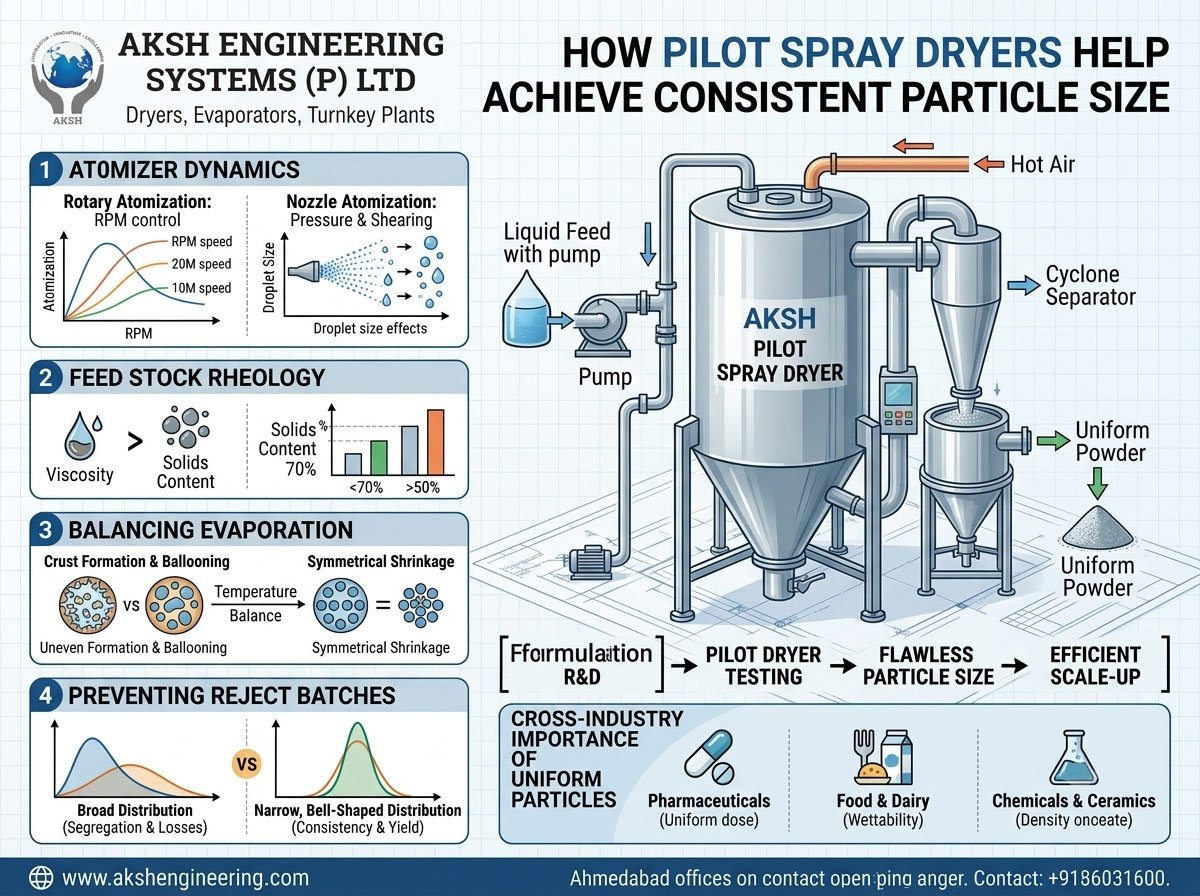
In powder manufacturing, particle size consistency is not just a metric of quality—it is the defining factor of a product’s commercial viability. Whether you are producing highly soluble milk powders, free-flowing pharmaceutical active ingredients (APIs), uniform ceramic granules, or encapsulated food flavors, the dimensions of your particles dictate how your product performs.
An irregular particle size distribution can cause uneven dissolution rates, clumping during storage, unpredictable chemical reactions, and packaging instabilities. Achieving absolute consistency, however, is immensely difficult on a large commercial scale without preliminary empirical data.
This is where a pilot spray dryer steps in as an indispensable engineering asset. By acting as a highly precise, controllable replica of an industrial plant, it gives R&D teams and production engineers the exact environment they need to master particle engineering.
Based in the industrial hub of Ahmedabad, AKSH Engineering Systems Pvt. Ltd. manufactures cutting-edge pilot and industrial spray dryers designed to take the guesswork out of powder characteristics. In this guide, we break down exactly how pilot-scale testing empowers industries to achieve flawless, highly consistent particle sizes before hitting full-scale production.
1. The Anatomy of Particle Size Control in Spray Drying
To understand how a pilot spray dryer helps control particle dimensions, it helps to look at the primary physical forces at play inside the system, as illustrated in the system flow diagram below:
    [ Liquid Feed Input ] ──► Controlled Pump Speed
               │
               ▼
     [ Atomizer Chamber ] ───► Rotary Disk (RPM) OR Pressure Nozzles (Bar)
               │
               ▼
  [ Hot Air Contact Zone ] ──► Flash Evaporation & Shell Formation
               │
               ▼
   [ Final Cyclone Separator ] ──► Uniform Powder Output
Particle size is fundamentally determined during the millisecond window when the liquid feed is atomized into a mist of droplets and comes into contact with the drying air stream. The final diameter of the dry powder depends on:
- Initial droplet size generated by the atomizer.
- Solids concentration and viscosity of the liquid feed.
- Evaporation rate, which is controlled by the balance of inlet and outlet temperatures.
2. Perfecting Atomizer Dynamics on a Scalable Level
The atomizer is the absolute heart of particle size distribution. In industrial manufacturing, you generally choose between two primary mechanisms: Rotary Atomizers and Pressure/Two-Fluid Nozzles.
A pilot spray dryer from AKSH Engineering Systems Pvt. Ltd. allows engineers to interchange and experiment with both configurations seamlessly to observe their direct impact on particle size.
Rotary Atomization Adjustments
In a rotary system, liquid feed is introduced to a rapidly spinning disk. The centrifugal force breaks the liquid into fine droplets. The droplet size is inversely proportional to the disk speed:

On a pilot unit, engineers can precisely vary the RPM using Variable Frequency Drives (VFDs). Testing at 15,000 RPM versus 25,000 RPM allows you to generate distinct batches of powder, send them directly to a laser diffraction analyzer, and chart the exact curve required to hit a tight target micron range.
Nozzle Atomization Variables
For pressure nozzles, the fluid velocity and pressure (measured in bars) dictate the spray energy. Simultaneously, two-fluid nozzles introduce compressed air to shear the liquid feed. A pilot dryer enables precise adjustments to the nozzle orifice diameter and the air-to-liquid mass ratio. Finding the sweet spot where the spray angle matches the chamber geometry prevents droplets from merging or hitting the walls, eliminating coarse, un-uniform agglomerates.
3. Calibrating Feed Stock Rheology and Solids Content
It is a common misconception that particle size is purely a mechanical setting on the machine. The chemical and physical properties of the liquid feed play an equal, if not greater, role.
- Viscosity Hurdles: Highly viscous liquids resist being broken down by atomizers, resulting in larger, uneven droplets.
- Solids Content Variations: A feed with a 20% solids concentration will yield significantly smaller and lighter hollow particles than a feed with a 45% solids concentration, even if atomized at identical machine settings.
Attempting to alter the formulation mix or concentration directly on a large commercial tower is an expensive logistical nightmare. A pilot spray dryer requires a minimum volume of liquid feed, allowing R&D teams to systematically change the solids percentage, track how viscosity alters under different pre-heating temperatures, and establish the precise formulation boundaries needed to keep particle sizes uniform.
4. Balancing Flash Evaporation and Crust Formation
Once a droplet is born inside the drying chamber, its rate of shrinkage determines its final dry size. This is controlled by the thermodynamic balance of the system:
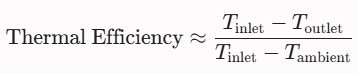
If the Inlet Temperature (Tinlet) is excessively high, the outer shell of the droplet dries instantly, forming a rigid crust. As the moisture trapped inside vaporizes, it expands, causing the particle to balloon, crack, or explode into fragmented, irregular dust shards.
Conversely, if the temperature is too low, the droplet does not dry completely before reaching the chamber cone, causing it to merge with other damp particles (uncontrolled agglomeration) or stick to the walls.
A pilot spray dryer acts as a safe, highly instrumented thermodynamic lab. Operators can adjust the air velocity and temperature profiles incrementally to ensure smooth, uniform evaporation where the droplet shrinks symmetrically into a solid, spherical particle of predictable dimensions.
5. Preventing Sieve Fractions and Reject Batches during Scale-Up
When a powder product fails to maintain consistent particle size, it leads to severe downstream processing costs:
- Segregation: During transit, smaller particles settle to the bottom of containers while larger ones rise to the top, causing product inconsistency for the end consumer.
- Sifting Losses: If a batch has a broad particle size distribution, it must be mechanically sieved. Particles that are too fine (dust) or too coarse are rejected, leading to substantial raw material waste.
By running comprehensive test profiles on an AKSH Engineering Systems pilot dryer, you generate a highly reliable dataset mapping out the exact operational parameters required for a narrow, bell-shaped distribution curve (low span factor). This eliminates the costly trial-and-error phase when migrating the process to a full-scale commercial installation.
The Cross-Industry Importance of Uniform Particles
| Industry | Why Consistent Particle Size Matters | Pilot Testing Focus |
| Pharmaceuticals | Dictates exact dosage uniformity, tablet compression capability, and drug dissolution rates in the body. | Precise nozzle pressure adjustments to avoid micro-fine dust that causes inhalation hazards. |
| Food & Dairy | Determines how quickly instant powders dissolve in water (wettability) and prevents caking in jars. | Controlling structural agglomeration and avoiding rapid crust formation. |
| Chemicals & Ceramics | Influences the density and structural integrity of molded ceramic components during subsequent pressing phases. | Minimizing hollow particles and maintaining high bulk density through rotary disk calibration. |
Achieve Engineering Precision with AKSH
Controlling the particle size of your spray-dried powder is the difference between an average product and an industry-leading one. A pilot spray dryer provides the ultimate combination of control, flexibility, and predictability needed to achieve flawless consistency.
At AKSH Engineering Systems Pvt. Ltd., based in Ahmedabad, we engineer custom pilot-scale spray drying solutions that mirror industrial-level realities with unmatched precision. Our systems are built using premium components, advanced variable speed controls, and highly accurate thermal sensors, allowing your team to confidently map out your powder’s exact physical traits.
Take control of your powder morphology today. Contact our technical team in Ahmedabad or explore our complete catalog of industrial drying and evaporation turnkey systems by visiting our official website at www.akshengineering.com.