The transition from chemical-heavy agriculture to biological solutions represents the next frontier in global food security. However, the primary bottleneck for manufacturers is not identifying the “super-microbe”—it is keeping it alive from the laboratory to the field.
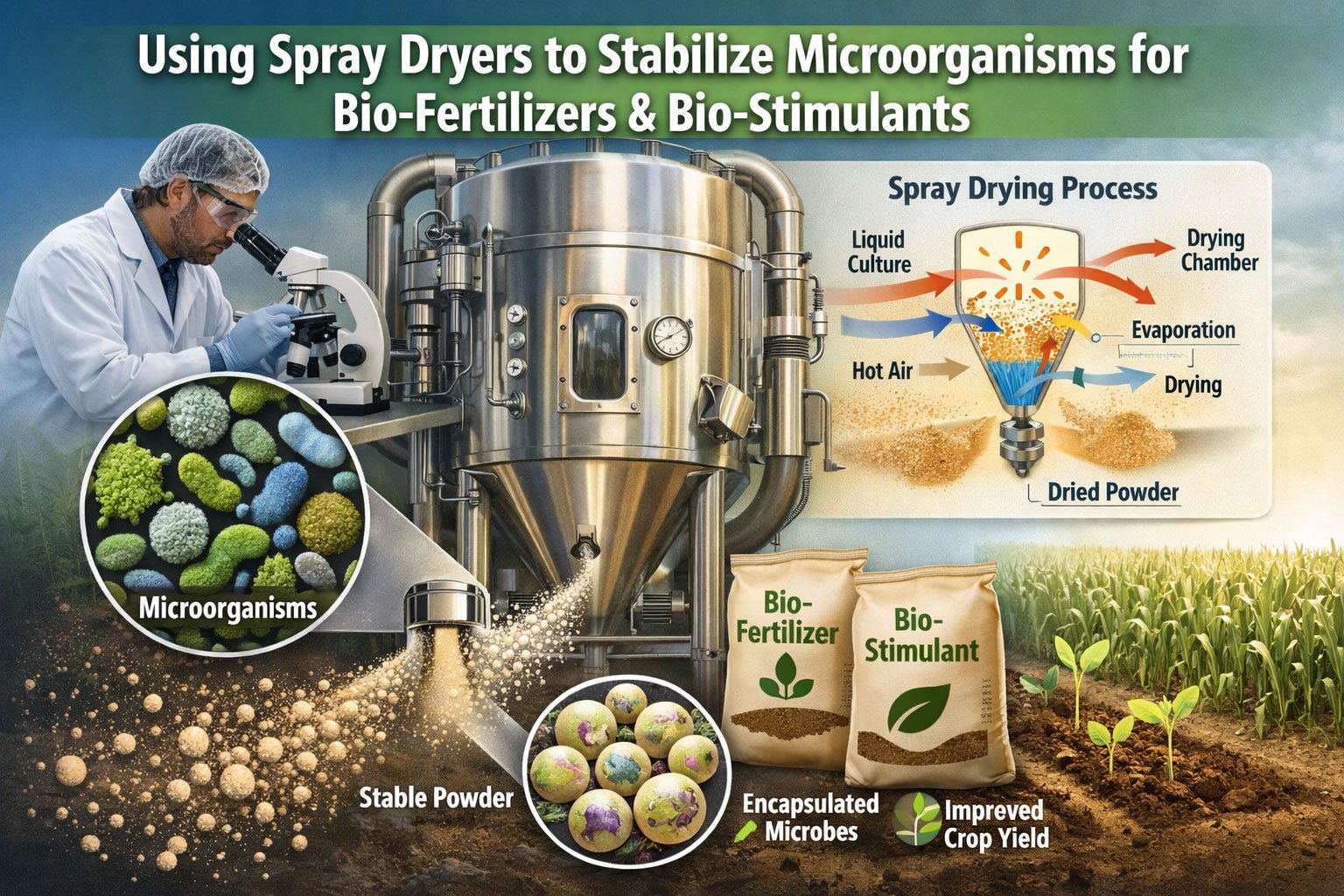
At AKSH Engineering Systems Pvt. Ltd., we have pioneered specialized Spray Drying Technologies specifically engineered for the delicate requirements of bio-fertilizers and bio-stimulants. This technical guide explores how to stabilize microorganisms while maintaining high CFU (Colony Forming Units) counts and extended shelf life.
1. The Survival Challenge: Why Stability is Everything
Microorganisms such as Rhizobium, Azotobacter, and Bacillus subtilis are highly sensitive to their environment. When sold as liquid formulations, they face rapid degradation, contamination risks, and high cold-chain logistics costs.
Spray drying offers a superior alternative by converting these microbes into a stable, dry powder. The challenge lies in the “Thermal Shock.” If the temperature is too high, the cell membranes rupture; if it is too low, the product remains damp and prone to fungal growth.
2. The Science of Micro-Encapsulation
To protect the “living cargo,” AKSH Engineering utilizes Micro-encapsulation during the spray drying process. This involves mixing the microbial broth with a “protective matrix” before it enters the dryer.
Common Carriers & Protectants:
- Maltodextrin & Starch: Provide a structural shield against heat.
- Skim Milk Powder: Offers protein protection for cell walls.
- Gum Arabic: Excellent for moisture barrier properties.
- Trehalose: A specialized sugar that prevents “desiccation stress” by replacing water molecules in the cell membrane.
3. Engineering the “Cool” Spray Dryer
Standard industrial spray dryers are often too “aggressive” for biologicals. AKSH Engineering has redesigned the traditional system for Bio-Stabilization:
A. Low-Temperature Air Dehumidification
Since microbes require lower inlet temperatures (Tin), we use Dehumidified Air Systems. By removing moisture from the intake air before heating it, we can achieve efficient drying at temperatures as low as 60°C–80°C, significantly below the lethal threshold for most beneficial bacteria.
B. High-Shear Rotary Atomization
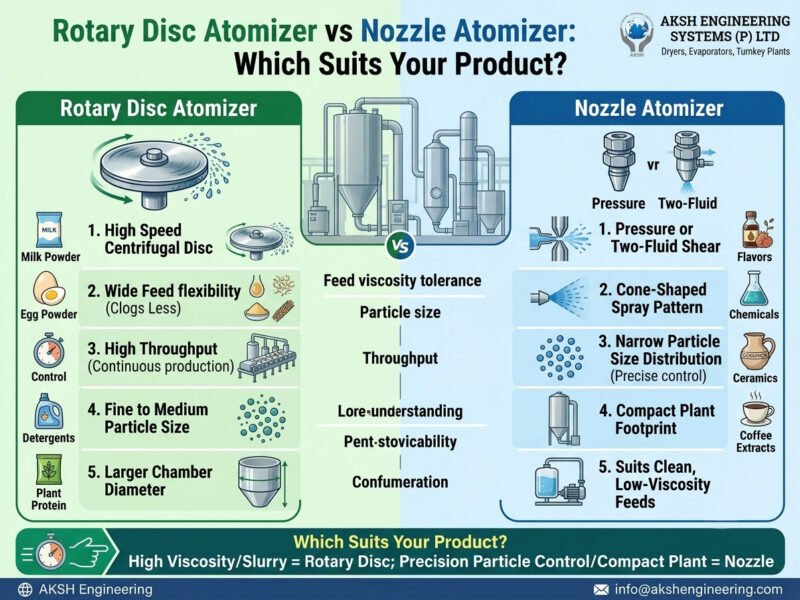
The way the “mist” is formed matters. Standard nozzles can create mechanical shear stress that tears bacterial cells. AKSH uses precision-engineered Rotary Atomizers with smooth-flow channels to minimize physical trauma to the microorganisms during the atomization phase.
C. Concurrent Airflow Patterns
In our bio-spec dryers, the hot air and the microbial mist move in the same direction (concurrent). This ensures that the hottest air contacts the wettest droplets. As the water evaporates, it creates a “cooling envelope” around the microbe, keeping the internal temperature of the cell far below the air temperature.
4. Bio-Stimulants: Stabilizing the Non-Living Actives
Bio-stimulants (like seaweed extracts, humic acids, and protein hydrolysates) are less “fragile” than live bacteria but are highly hygroscopic (they absorb moisture from the air).
The AKSH Solution for Bio-Stimulants:
- Integrated Fluid Bed Cooling: After the powder leaves the spray dryer, it enters an AKSH Fluid Bed Cooler. This “shocks” the powder into a stable state and prevents it from clumping or “caking” in the bag.
- Particle Size Engineering: We control the nozzle pressure to ensure the powder has the perfect “wettability” for the farmer to easily mix it in a spray tank.
5. Technical Tips for High CFU Recovery
To achieve a standard of quality in your production, consider these AKSH internal benchmarks:
- Residence Time: Keep the “flight time” in the chamber under 20 seconds.
- Outlet Temperature (Tout): This is the most critical number. For live Bacillus species, we aim for a Tout of 45°C–50°C.
- Instant Cooling: The powder must be moved to a humidity-controlled packaging area immediately to prevent re-hydration.
6. Comparison: Liquid vs. Spray-Dried Bio-Products
| Feature | Liquid Bio-Fertilizer | AKSH Spray-Dried Powder |
| Shelf Life | 3–6 Months | 12–24 Months |
| Storage | Requires Refrigeration | Ambient Temperature |
| Contamination | High Risk | Low Risk (Low water activity) |
| Logistics | Expensive (Shipping water) | Cost-Effective (Concentrated) |
| Stability | Fluctuates with temp | Highly stable |
7. Conclusion: Scaling the Bio-Economy
The future of sustainable farming depends on our ability to deliver “life in a bag.” By utilizing the precision thermal engineering of AKSH Engineering Systems Pvt. Ltd., manufacturers can transform fragile laboratory cultures into robust, market-ready bio-fertilizers.