
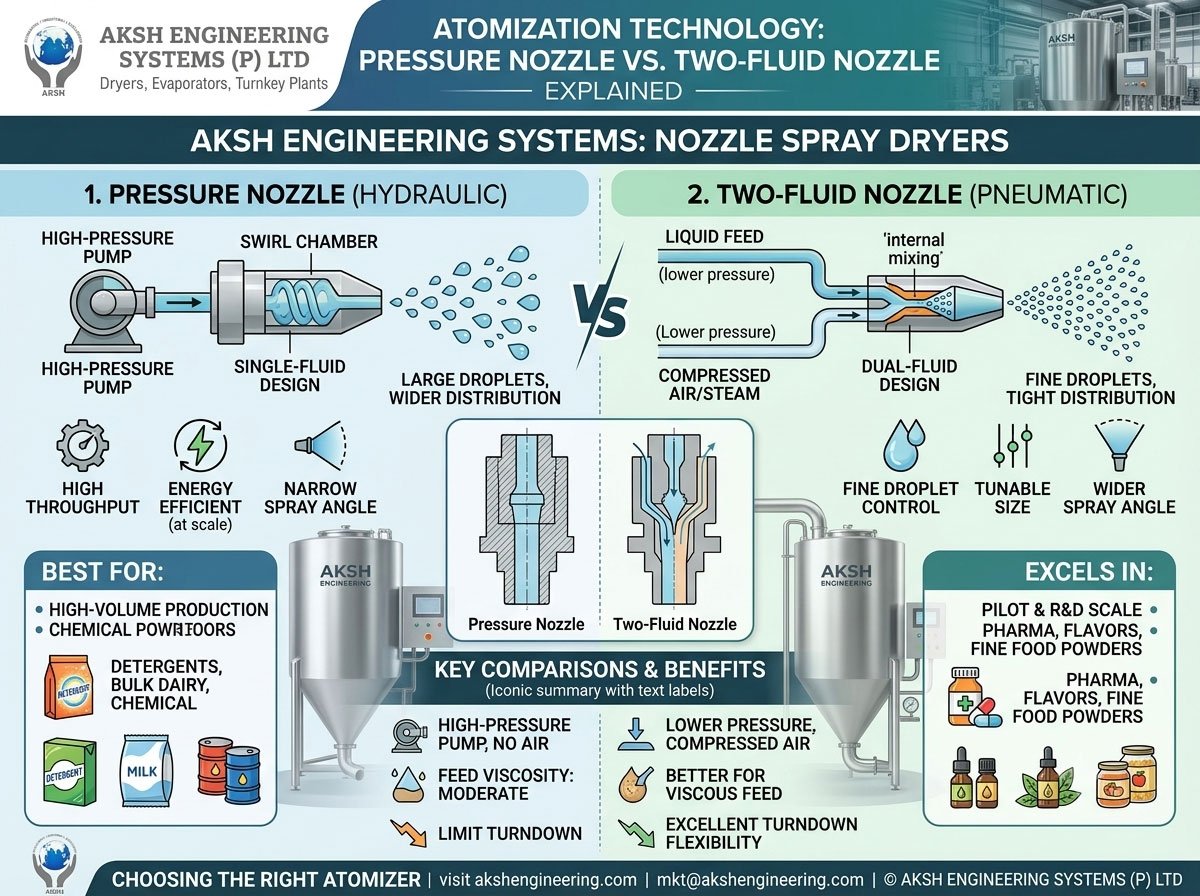
Atomization is the single most decisive step in spray drying. It’s the moment a liquid feed gets converted into a cloud of fine droplets, and everything that happens afterward — drying rate, particle size, powder morphology, yield, and even product quality — traces back to how that spray was formed. Among nozzle-based atomization systems, two technologies dominate industrial spray drying: the pressure nozzle (also called a hydraulic or single-fluid nozzle) and the two-fluid nozzle (also called a pneumatic or twin-fluid nozzle).
They sound similar, and both fall under the broad “nozzle atomization” category as opposed to rotary disc atomization. But mechanically, operationally, and in terms of the powders they produce, they behave quite differently. Choosing the wrong one for your product or throughput can mean chronic clogging, inconsistent particle size, or unnecessary energy costs. This guide breaks down exactly how each works, where each excels, and how to decide which belongs in your spray drying line.
How Nozzle Atomization Works, in Brief
Before comparing the two, it helps to understand what nozzle atomization is actually doing. Unlike a rotary atomizer — which flings liquid outward off a spinning wheel using centrifugal force — a nozzle atomizer forces liquid through a small precision-engineered orifice, breaking it into droplets through either pressure energy or shear from a second fluid. That distinction is exactly where pressure nozzles and two-fluid nozzles diverge.
What Is a Pressure Nozzle?
A pressure nozzle atomizes liquid using hydraulic energy alone. The feed is pumped at high pressure — typically 50 to 300 bar, depending on the application — through a small orifice, often preceded by a swirl chamber that imparts a rotational component to the flow. As the liquid exits the orifice, the combination of high velocity and swirl causes it to break up into a thin conical sheet, which then disintegrates into droplets.
Key characteristics
- Single-fluid design: Only the liquid feed passes through the nozzle — no compressed air or steam is required for atomization.
- Droplet size control: Governed primarily by feed pressure, orifice diameter, and swirl chamber geometry. Higher pressure and smaller orifices generally produce finer droplets.
- Narrow spray angle, high velocity: Produces a directional, cone-shaped spray pattern that penetrates deep into the drying chamber.
- High feed rate capability: Because there’s no secondary atomizing fluid diluting or limiting throughput, pressure nozzles handle high production volumes efficiently.
Where pressure nozzles excel
Pressure nozzles are the go-to choice for large-scale, high-throughput operations with feed materials that are relatively low in viscosity and abrasiveness — think detergent powders, some dairy powders, and various chemical intermediates. Because energy consumption per unit of liquid atomized is comparatively low (no compressed air generation needed), pressure nozzles are often the more energy-efficient option at scale.
Where pressure nozzles struggle
- Turndown ratio is limited. Reducing feed rate significantly (to slow production or handle low-viscosity batches) drops the pressure and coarsens the spray, hurting particle uniformity.
- Orifice wear and clogging: Small orifices are prone to blockage from particulates or crystallizing solids, and abrasive feeds erode the orifice edge over time, gradually changing droplet size distribution.
- Less flexibility for viscous or shear-sensitive feeds: High pressure alone may not adequately atomize thick or non-Newtonian fluids without excessive orifice wear or feed pump strain.
What Is a Two-Fluid Nozzle?
A two-fluid nozzle — also known as a pneumatic or air-atomizing nozzle — uses a secondary compressed fluid, almost always compressed air (sometimes steam), to shear the liquid feed into droplets. The liquid is introduced at relatively low pressure, and high-velocity air impinges on it either inside the nozzle body (internal mixing) or just outside the orifice (external mixing), tearing the liquid stream apart through aerodynamic shear rather than hydraulic pressure alone.
Key characteristics
- Dual-fluid design: Requires both a liquid feed line and a compressed air (or steam) supply, along with the associated compressor/air-prep infrastructure.
- Droplet size control: Governed by the air-to-liquid ratio, air pressure, and liquid feed rate — giving operators an additional, independent control variable beyond feed pressure alone.
- Fine, tunable droplet sizes: Capable of producing very fine, narrow droplet-size distributions, even at relatively low liquid feed rates.
- Lower liquid-side pressure requirement: Because atomization energy comes largely from the air stream, the liquid itself doesn’t need to be pumped at extreme pressure, reducing wear on liquid-side components.
Where two-fluid nozzles excel
Two-fluid nozzles are the preferred choice for pilot-scale and small-to-medium production runs, R&D and formulation development, and products that demand very fine, consistent particle size — pharmaceutical intermediates, flavors and fragrances, specialty nutraceuticals, and high-value food ingredients. Because the air-to-liquid ratio can be adjusted independently of the total feed rate, two-fluid nozzles offer excellent turndown flexibility — you can run at low throughput without sacrificing spray quality, which is exactly why they’re a staple on pilot spray dryers used for product development and scale-up trials.
Where two-fluid nozzles struggle
- Higher energy cost per kilogram at scale: Generating and maintaining compressed air adds a parasitic energy load that becomes less economical as production volume grows.
- Lower maximum throughput: Air-atomizing nozzles are generally not the first choice for very high-capacity commercial lines where pressure nozzles or rotary atomizers dominate.
- Additional infrastructure: Requires a clean, dry, oil-free compressed air system — an added utility and maintenance dependency, especially critical in food and pharma applications where air purity affects product safety.
Pressure Nozzle vs Two-Fluid Nozzle: Side-by-Side Comparison
| Parameter | Pressure Nozzle | Two-Fluid Nozzle |
|---|---|---|
| Atomization energy source | Liquid pressure (hydraulic) | Compressed air/steam (pneumatic) |
| Typical operating pressure | 50–300 bar (liquid side) | 1–7 bar (air side), low liquid pressure |
| Droplet size control | Pressure + orifice size | Air-to-liquid ratio |
| Best throughput range | High-volume, continuous production | Low to medium volume, pilot/R&D scale |
| Turndown flexibility | Limited | Excellent |
| Energy efficiency at scale | Higher | Lower (compressed air overhead) |
| Feed viscosity tolerance | Moderate | Better for higher viscosity/shear-sensitive feeds |
| Wear/clogging risk | Higher (small orifice, high pressure) | Lower liquid-side wear |
| Infrastructure needs | High-pressure pump, filtration | Compressed air system, air prep unit |
| Typical applications | Detergents, bulk dairy, chemical powders | Pharma, flavors, fine food powders, pilot trials |
Particle Size and Droplet Distribution: The Core Trade-off
The fundamental trade-off between these two atomizer types comes down to how droplet size is controlled and how tightly it can be held.
With a pressure nozzle, droplet size is essentially locked to feed pressure and orifice geometry. To change particle size meaningfully, you either change the orifice (a hardware swap) or adjust pressure — which also changes your throughput. This coupling between flow rate and droplet size is the single biggest limitation of pressure nozzle systems.
A two-fluid nozzle decouples these variables. Because air pressure and liquid feed rate can be adjusted independently, operators can hold droplet size roughly constant while varying throughput, or fine-tune droplet size at a fixed production rate — a level of control that’s especially valuable when developing a new formulation or scaling a product from lab to pilot to production.
Energy and Operating Cost Considerations
At production scale, the energy story tends to favor pressure nozzles, since generating high-pressure liquid flow is generally more energy-efficient than compressing large volumes of air. However, this calculus changes for smaller batch sizes or intermittent production — the fixed overhead of running a compressor is proportionally less punishing when you also account for the improved yield and reduced rework that comes from tighter particle size control on high-value products.
This is why the right choice isn’t purely a technical decision — it’s an economic one tied to your production volume, product value, and how frequently your formulation changes. A Multistage Spray Dryer running a stable, high-volume commodity powder is a very different economic environment than a pilot spray dryer cycling through multiple formulations per week.
Maintenance, Hygiene, and Food/Pharma Considerations
For food and pharmaceutical applications, nozzle choice also intersects with hygiene design. Two-fluid nozzles, because they require compressed air in direct contact with the product stream, demand oil-free, filtered, food-grade compressed air systems to avoid contamination risk — an important consideration when specifying a Hygienic Spray Dryer for sensitive products. Pressure nozzles, with their single-fluid design, eliminate that particular contamination pathway but require robust in-line filtration to prevent particulate matter from damaging or blocking the fine orifice — typically paired with a properly specified Automatic Cleaning-in-Place System to maintain orifice cleanliness between production runs.
Wear parts also differ in maintenance profile. Pressure nozzle orifices and swirl inserts are typically hardened or ceramic-coated to resist erosion from high-velocity, sometimes abrasive feeds, and are treated as routine, inexpensive replacement items — available as standard Spray Dryer Accessories. Two-fluid nozzles have their own wear considerations around air cap geometry but generally see less liquid-side erosion given the lower liquid pressures involved.
How This Compares to Rotary Disc Atomization
It’s worth noting that nozzle atomization — whether pressure or two-fluid — isn’t the only atomization method available. A Rotary Disc Atomizer uses centrifugal force from a high-speed spinning wheel rather than pressure or air shear, and tends to offer gentler handling for shear-sensitive or highly viscous feeds, along with simpler operation at variable throughput. If you’re weighing atomizer options more broadly, our detailed comparison, Rotary Disc Atomizer vs Nozzle Atomizer: Which Suits Your Product?, covers that decision in depth and is a useful companion read to this one.
Decision Checklist: Which Nozzle Type Fits Your Application?
Ask yourself the following before specifying an atomizer:
- What’s your production volume? High, continuous volume → pressure nozzle. Low-to-medium, variable volume, or pilot/R&D → two-fluid nozzle.
- How fine and consistent does your particle size need to be? Very fine, tightly controlled distribution → two-fluid nozzle.
- How often does your formulation change? Frequent formulation changes or scale-up work → two-fluid nozzle’s independent control variables offer more flexibility.
- What’s your feed viscosity and abrasiveness? Highly viscous or shear-sensitive → lean toward two-fluid nozzle or reconsider rotary disc atomization. Low-viscosity, high-volume, less abrasive → pressure nozzle is typically more economical.
- What’s your energy budget and existing utility infrastructure? No compressed air system on-site, or energy cost is a primary concern at scale → pressure nozzle.
- What are your hygiene and contamination-control requirements? Food/pharma-grade compressed air infrastructure available and needed for fine control → two-fluid nozzle with proper air prep. Otherwise, pressure nozzle avoids the air-contact contamination pathway altogether.
Frequently Asked Questions
1. Which nozzle type produces finer particles — pressure or two-fluid? Two-fluid nozzles generally achieve finer, more tightly controlled droplet size distributions because atomization energy comes from adjustable air shear rather than pressure and orifice geometry alone.
2. Can a spray dryer be switched between pressure nozzle and two-fluid nozzle atomization? In many cases, yes — nozzle atomization heads are often modular and can be swapped on the same lance or chamber fitting, provided the dryer’s feed pump and (for two-fluid systems) compressed air infrastructure support the change. Consulting the original equipment design is recommended before switching.
3. Is a two-fluid nozzle more expensive to operate than a pressure nozzle? At high production volumes, yes, primarily due to compressed air generation costs. At pilot or lower-volume scale, the operating cost difference narrows considerably, and the flexibility benefits often outweigh the energy overhead.
4. Do pressure nozzles clog more easily than two-fluid nozzles? Pressure nozzles typically have smaller orifices operating at higher pressure, making them more susceptible to blockage from particulates or crystallizing solids unless feed filtration is well maintained.
5. Which nozzle type is better for pilot-scale spray drying trials? Two-fluid nozzles are generally preferred for pilot and R&D work because of their independent control over droplet size and throughput, which is valuable when testing multiple formulations or scaling up a new product.
Final Thoughts
Neither pressure nozzles nor two-fluid nozzles are universally “better” — they’re optimized for different points on the throughput-versus-control spectrum. Pressure nozzles win on energy efficiency and raw throughput for stable, high-volume production. Two-fluid nozzles win on flexibility, fine particle control, and adaptability for R&D, pilot work, and high-value, low-to-medium volume products.
At AKSH Engineering Systems Pvt. Ltd., we design and supply both pressure nozzle and two-fluid nozzle atomization systems as part of our complete range of Nozzle Spray Dryers, engineered and matched to your product’s viscosity, particle size targets, and production volume. Our team can help you evaluate which atomization technology — nozzle or rotary disc — is the right long-term fit for your process.
Get in touch: Visit akshengineering.com or write to us at mkt@akshengineering.com to discuss your atomizer selection and spray drying application.
Explore more insights on our Industrial Dryers blog category.
Related reading: