Industrial processes — from spray drying and grinding to material handling and combustion — generate airborne dust, fumes, and particulate matter that must be captured before they escape into the atmosphere or your workspace. Choosing the wrong dust collection system doesn’t just hurt air quality; it can lead to product loss, equipment wear, regulatory penalties, and unsafe working conditions.
Three technologies dominate the industrial dust control landscape: cyclone separators, bag filters (baghouses), and wet scrubbers. Each works on a completely different principle, and each has a sweet spot where it outperforms the others. This guide breaks down how they work, where they excel, where they fall short, and how to decide which one — or which combination — fits your process.
Why Dust Collection Matters for Industrial Plants
Before comparing the three systems, it’s worth understanding why dust collection is non-negotiable for modern manufacturing:
- Regulatory compliance — Pollution control boards mandate particulate emission limits (measured in mg/Nm³) for stack discharge. Non-compliance invites fines and shutdown notices.
- Product recovery — In industries like food processing, pharmaceuticals, and chemicals, the “dust” is often valuable product. Efficient separation means less material loss and better yield.
- Worker safety — Fine particulate exposure causes respiratory illness. Combustible dusts (wood, flour, metal powders) also pose explosion risks if not controlled.
- Equipment protection — Dust-laden air damages downstream fans, ducts, and HVAC systems, increasing maintenance costs.
- Process efficiency — In systems like spray dryers and rotary dryers, dust collection is integrated into the process itself, recovering fines that would otherwise be wasted.
With that context, let’s look at each technology.
What Is a Cyclone Separator?
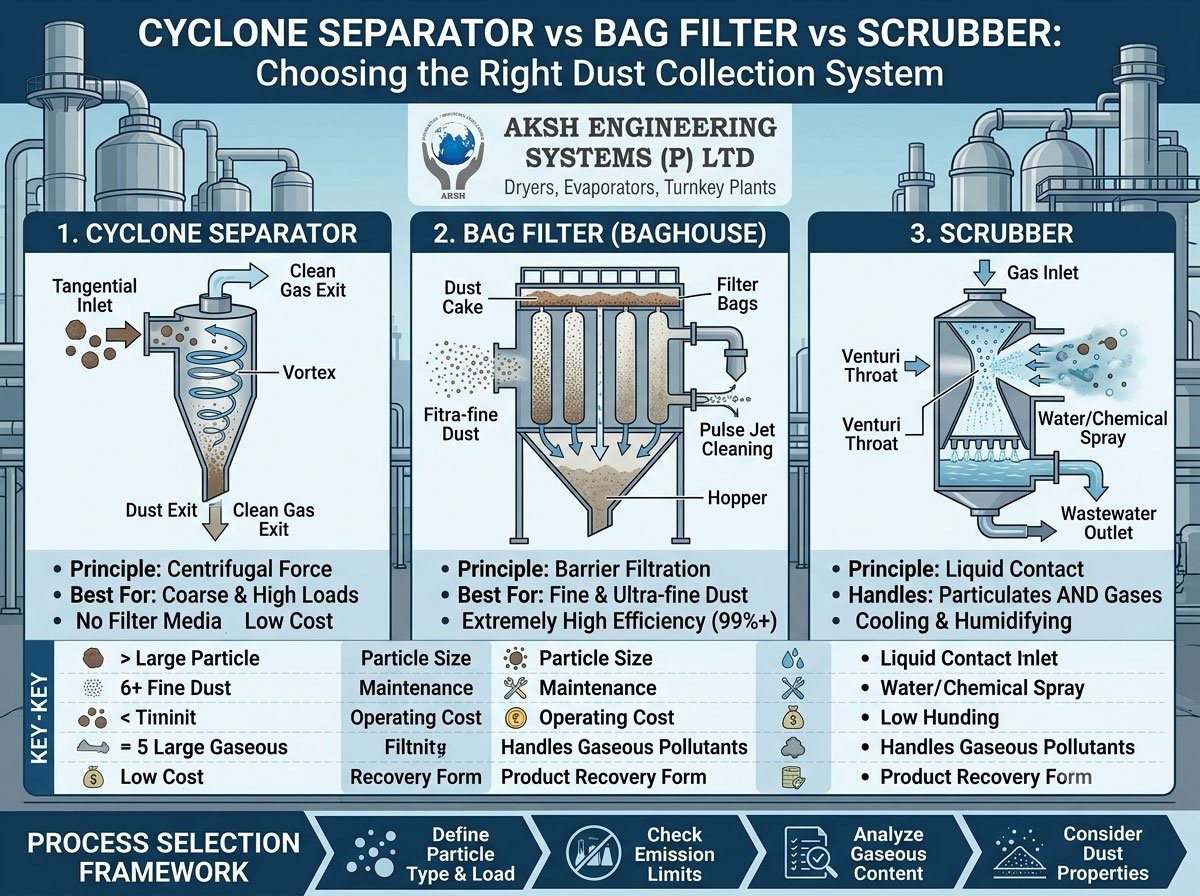
A cyclone separator is a mechanical, filter-less device that uses centrifugal force to separate particles from an air or gas stream. Dust-laden air enters tangentially near the top of a cylindrical-conical chamber, creating a high-speed vortex. Heavier particles are flung outward against the cyclone wall, lose momentum, and fall into a collection hopper at the bottom, while the cleaned air exits through a central outlet pipe.
Advantages of Cyclone Separators
- No moving parts and no filter media — this means minimal maintenance and no filter replacement costs.
- Handles high dust loads and coarse particles exceptionally well, making it ideal as a pre-separator ahead of finer filtration stages.
- Withstands high temperatures and abrasive dust without degrading, unlike fabric filters that can burn or clog.
- Low capital cost compared to bag filters and scrubbers of similar capacity.
- Continuous operation with negligible pressure drop variation over time.
Limitations of Cyclone Separators
- Poor efficiency on fine particles — typically below 90–95% collection efficiency for particles under 10 microns (PM10), and much worse for sub-5-micron dust.
- Not suitable as a standalone solution where strict emission norms apply.
- Efficiency drops sharply if airflow velocity is not properly maintained.
Best Applications
Cyclone separators are the go-to choice for spray dryers, rotary dryers, fluid bed dryers, pneumatic conveying systems, and grinding/milling operations where the goal is to recover coarse-to-medium product particles or protect downstream equipment from bulk dust before finer polishing filtration.
What Is a Bag Filter (Baghouse)?
A bag filter, or baghouse, captures dust by passing contaminated air through fabric filter bags (commonly polyester, polypropylene, Nomex, or PTFE-coated media depending on temperature and chemical resistance needs). As dust accumulates on the bag surface, it forms a “filter cake” that actually improves filtration efficiency over time. Periodically, bags are cleaned via pulse-jet, reverse air, or mechanical shaking mechanisms to dislodge the collected dust into a hopper.
Advantages of Bag Filters
- Extremely high collection efficiency — routinely achieves 99%+ efficiency, even for sub-micron particulate, making it the preferred choice for strict emission compliance.
- Versatile media options allow customization for temperature range, moisture, and chemical exposure.
- Dry collection process means recovered material stays dry and reusable — critical for food, pharma, and chemical powders.
- Scalable from small dust extraction units to massive industrial baghouses handling lakhs of cubic meters per hour.
Limitations of Bag Filters
- Higher maintenance — bags wear out, tear, or blind (clog) over time and need periodic replacement.
- Not ideal for sticky, moist, or hygroscopic dust, which can cause bag blinding and reduced airflow.
- Fire and explosion risk with combustible dusts if not fitted with proper spark arrestors and explosion venting.
- Higher footprint and capital cost than a comparable cyclone separator.
Best Applications
Bag filters excel in cement plants, pharmaceutical powder handling, chemical processing, foundries, woodworking, and any process requiring fine particulate capture to meet stringent Pollution Control Board (PCB) norms. They’re also widely used as a polishing stage after a cyclone pre-separator, combining the strengths of both technologies.
What Is a Scrubber?
A scrubber (wet scrubber) removes particulates and/or gaseous pollutants by bringing the contaminated air stream into contact with a liquid, typically water or a chemical solution. As dust particles collide with water droplets, they become heavier and are separated out, either through gravity settling, impingement plates, or a venturi throat design that maximizes turbulence and contact.
Advantages of Scrubbers
- Simultaneously handles particulate matter AND gaseous/odor pollutants (SO₂, HCl, VOCs, ammonia) — something dry systems like cyclones and bag filters cannot do.
- Handles hot, moist, sticky, or explosive dust safely, since water eliminates ignition risk.
- Cools the gas stream as part of the process, which can be useful in high-temperature applications.
- Effective on fine particulates and mist when a high-energy venturi design is used.
Limitations of Scrubbers
- Generates wastewater/sludge that requires additional treatment and disposal — an added operational and environmental consideration.
- Higher operating costs due to water and chemical consumption, plus pump energy requirements.
- Corrosion risk on internal components depending on the chemical nature of the pollutant.
- Not suitable when dry product recovery is the goal, since captured material ends up in slurry form.
Best Applications
Scrubbers are the preferred choice for chemical process exhausts, fertilizer plants, pharmaceutical fume extraction, metal pickling/plating lines, and any process emitting corrosive gases or odorous compounds alongside particulate matter.
Side-by-Side Comparison
| Parameter | Cyclone Separator | Bag Filter | Scrubber |
|---|---|---|---|
| Collection Efficiency | Moderate (70–95%, weaker on fine dust) | Very High (99%+, even sub-micron) | High (varies by design, strong on gases) |
| Best Particle Size | Coarse to medium | Fine to ultra-fine | Fine particulates + gases |
| Maintenance | Very Low | Moderate to High (bag replacement) | Moderate (wastewater handling) |
| Capital Cost | Low | Moderate to High | Moderate to High |
| Operating Cost | Very Low | Moderate | Higher (water/chemical use) |
| Handles Gaseous Pollutants | No | No | Yes |
| Handles Sticky/Moist Dust | Poor | Poor (blinding risk) | Good |
| Product Recovery Form | Dry | Dry | Wet/slurry |
| Typical Role | Pre-separator / bulk recovery | Final/fine filtration for compliance | Combined particulate + gas control |
How to Choose the Right System for Your Plant
Selecting between a cyclone separator, bag filter, and scrubber isn’t about picking a single “best” technology — it’s about matching the equipment to your dust characteristics, emission targets, and process constraints. Here’s a practical framework:
- Start with particle size and load. If your process generates large volumes of coarse dust (as in spray drying, rotary drying, or size reduction), a cyclone separator as the first stage will handle 80–90% of the load cheaply and protect downstream equipment.
- Check your emission compliance requirement. If your state Pollution Control Board mandates particulate emission below 50 mg/Nm³ (or stricter), a standalone cyclone will not suffice. You’ll need a bag filter — often installed after a cyclone in a two-stage system — to hit compliance targets economically.
- Identify if gaseous pollutants are present. If your exhaust carries acidic gases, ammonia, solvent vapors, or odor alongside particulates, a scrubber (or a scrubber combined with dry filtration) is essential, since dry collectors cannot neutralize gaseous emissions.
- Consider dust properties. Sticky, hygroscopic, or moisture-laden dust tends to blind bag filters and reduce their life; a scrubber or a well-designed cyclone may be more robust in these conditions.
- Factor in fire and explosion risk. Combustible dusts (organic powders, metal fines, coal dust) need careful system selection with proper safeguards — scrubbers inherently reduce ignition risk, while bag filters require explosion venting and spark detection.
- Evaluate total cost of ownership, not just upfront price. A cyclone is cheap to install but may not meet compliance alone. A bag filter costs more upfront but has predictable, manageable running costs. A scrubber’s water/chemical and effluent treatment costs can add up significantly over the equipment’s life.
Why Many Industrial Plants Use a Multi-Stage Approach
In real-world applications, the most efficient and cost-effective dust control setups rarely rely on a single technology. A common configuration is:
Cyclone Separator (bulk removal) → Bag Filter (fine polishing) → optional Scrubber (gas/odor control)
This staged approach reduces the load on the more expensive fine-filtration or scrubbing equipment, extends bag life, lowers water/chemical consumption in scrubbers, and delivers the best overall efficiency-to-cost ratio. It’s a design philosophy widely used in spray drying, chemical processing, and pharmaceutical granulation plants where both dry product recovery and emission compliance matter simultaneously.
Conclusion
There is no universal winner in the cyclone separator vs bag filter vs scrubber debate — each system solves a different problem. Cyclone separators are unbeatable for low-cost, low-maintenance bulk dust removal. Bag filters deliver the fine-particulate efficiency needed for strict emission compliance. Scrubbers are indispensable when gaseous pollutants or hazardous, moist dust are part of the equation. The right choice — or right combination — depends on your specific process, dust characteristics, and regulatory obligations.
At AKSH Engineering Systems Pvt. Ltd., we design and manufacture customized dust collection and air pollution control systems — including cyclone separators, bag filters, and scrubbers — engineered around your process parameters, dust load, and compliance requirements. Our team can help you evaluate your existing setup or design a multi-stage system that maximizes efficiency while minimizing operating costs.
Get in touch with our engineering team to discuss the right dust collection solution for your plant: 📧 mkt@akshengineering.com 🌐 akshengineering.com