At AKSH Engineering Systems Pvt. Ltd., we specialize in bridging the gap between raw material characteristics and final powder specifications. This guide provides a deep dive into the mechanical and thermal differences between Spray, Flash, and Fluid Bed Dryers.
1. Defining the “Material Cake” Challenge
Before choosing a dryer, you must define your feed. In industrial processing, a “cake” typically refers to the high-solids discharge from a centrifuge or filter press.
- Liquid/Slurry: Pumpable, often 10–50% solids.
- Sticky/Pasty Cake: Cohesive, difficult to convey, often 50–85% moisture.
- Crumbly/Granular Cake: Non-cohesive, free-flowing when wet.
The dryer you select must handle the rheology of this feed while protecting the product’s thermal integrity.
2. Technology Breakdown: Working Principles
A. Spray Drying: From Liquid to Powder in Seconds
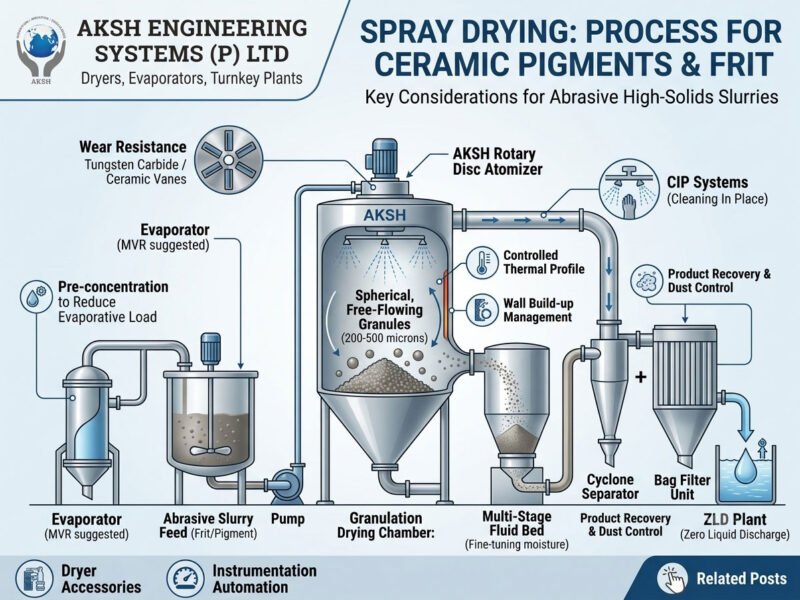
Spray drying is a unique “one-step” process. It is the only technology that can transform a liquid feed directly into a finished powder with precise particle size control.
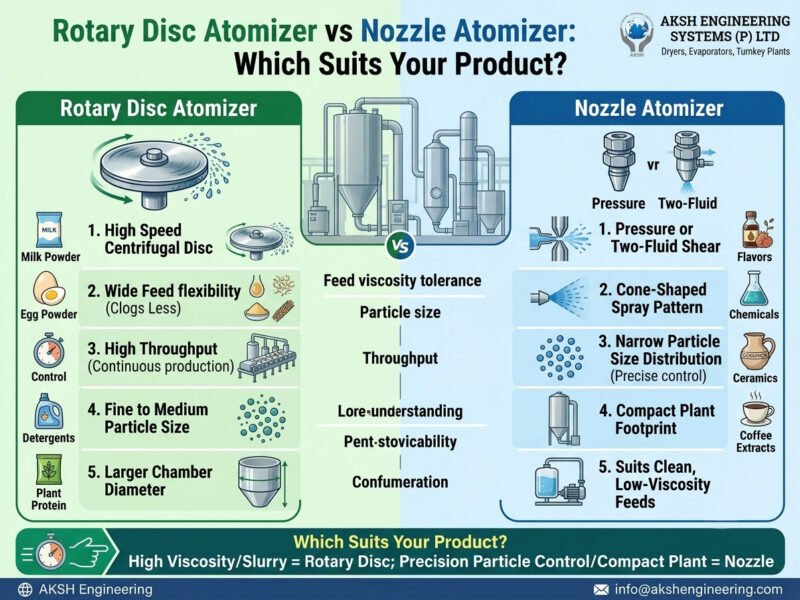
- Mechanism: The feed is atomized into a fine mist (using rotary wheels or nozzles) and contacted with high-velocity hot air.
- Best For: Solutions, emulsions, and pumpable slurries.
- AKSH Edge: Our Rotary Atomizer systems are designed for high-capacity industrial throughput, producing spherical, free-flowing particles ideal for the food and pharma sectors.
B. Flash Drying (Pneumatic Drying): The High-Speed Specialist
Flash drying is the go-to for “material cakes.” It uses high-velocity hot air to pneumatically convey and dry materials almost instantaneously.
- Mechanism: The wet cake is introduced into a high-temperature air stream. The turbulent mixing causes surface moisture to “flash” off.
- Best For: Filter cakes, centrifuge discharge, and heat-sensitive powders.
- Specialized AKSH Systems: * Spin Flash Dryer: Features a mechanical agitator at the base to break down sticky cakes.
- Cage Mill Flash Dryer: Ideal for lumpy or hard materials that require de-agglomeration during drying.
C. Fluid Bed Drying: The Gentle Finisher
Fluid bed drying suspends solid particles in an upward-flowing stream of air, creating a “boiling” effect.
- Mechanism: Hot air passes through a perforated distributor plate, lifting the particles so they behave like a fluid.
- Best For: Granules, crystals, and pre-formed particles that require uniform drying and cooling.
- Versatility: Often used as a second stage after spray drying to “instantize” powders.
3. Comprehensive Comparison Chart
Use this table as your primary selection tool based on material characteristics and desired outcomes.
| Feature | Spray Dryer | Flash Dryer (Spin/Cage) | Fluid Bed Dryer |
| Feed Consistency | Liquid, Slurry, Emulsion | Filter Cake, Paste, Wet Solid | Granules, Crystals, Powder |
| Drying Time | 15–30 Seconds | 1–10 Seconds (Instant) | 5–60 Minutes |
| Particle Shape | Spherical & Uniform | Irregular / De-agglomerated | Preserves Original Shape |
| Heat Sensitivity | Excellent (Evaporative cooling) | High (Ultra-short residence) | Good (Precise temp control) |
| Footprint | Large (Vertical towers) | Compact (Vertical/Horizontal) | Moderate |
| Typical Moisture | 40% to 90% | 15% to 85% | 5% to 20% |
| Energy Efficiency | Moderate | Very High | High |
4. Selection Framework: Which One for Your Cake?
Scenario 1: You have a pumpable slurry but want a “granulated” feel.
Choose: Spray Dryer with Integrated Fluid Bed. AKSH Engineering offers multi-stage systems where the initial drying happens in the chamber, and the final “agglomeration” happens on a fluid bed at the bottom. This creates dust-free, instant-dissolving powders.
Scenario 2: You have a sticky, thixotropic filter cake (e.g., Pigments or Bio-sludge).
Choose: Spin Flash Dryer.
Standard flash dryers might clog with sticky feeds. An AKSH Spin Flash Dryer uses a high-shear agitator to break the cake into fine particles, increasing surface area and ensuring 100% moisture removal without clumping.
Scenario 3: You have crystalline material that is mechanically fragile.
Choose: Fluid Bed Dryer.
Spray and Flash dryers involve high-velocity impact or atomization which can shatter delicate crystals. The fluid bed provides the gentlest environment, ensuring the crystal lattice remains intact while removing deep-seated internal moisture.
5. The Engineering Advantage of AKSH Systems
At AKSH Engineering Systems, we don’t just sell machines; we design thermal solutions.
- Material Testing: We evaluate the “sticking point” of your material cake in our testing facilities.
- Custom Atomization: Whether you need a Pressure Nozzle for coarse granules or a Rotary Atomizer for fine powders.
- Energy Recovery: All our dryers can be fitted with heat exchangers to recover exhaust heat, significantly lowering your OPEX.
Conclusion
Choosing between Spray, Flash, and Fluid Bed technology requires a deep understanding of your material’s “behavior” under heat and pressure. For liquid feeds, the Spray Dryer is king. For heavy, moisture-laden cakes, the Flash Dryer offers unmatched speed and efficiency. For secondary drying and granular consistency, the Fluid Bed is the industry standard.