Egg powder — whole egg, egg white (albumen), and egg yolk powder — is one of the most widely used ingredients in bakery, confectionery, noodle manufacturing, mayonnaise production, nutraceuticals, and food service. It’s shelf-stable, easy to transport, and cuts out the handling and storage costs of liquid or shell eggs. But it’s also a product with a well-documented food safety history that shaped the regulations manufacturers operate under today.
Because raw eggs can carry Salmonella and other pathogens, every stage of egg powder production — from breaking and filtering to pasteurization, spray drying, and packaging — is a food safety control point. For plant owners and process engineers, understanding why these steps exist, and how the spray drying system itself needs to be designed around them, is just as important as understanding the drying process alone.
This article breaks down the food safety and pasteurization considerations that matter most when producing egg powder at commercial scale.
Why Egg Products Require Mandatory Pasteurization
The safety requirements around egg products aren’t a recent addition — they go back decades. In the United States, the Egg Products Inspection Act made pasteurization mandatory for all egg products distributed for consumption, specifically to destroy Salmonella. Since mandatory pasteurization became standard practice, pasteurized egg products have had a strong safety record, with pasteurization credited as the key control step that prevents Salmonella from reaching consumers through processed egg products.
Most countries with developed food safety regulation — India’s FSSAI, the EU’s food hygiene regulations, USDA/FDA in the US — apply similar logic: raw egg mass (the liquid product after eggs are broken, filtered, and blended) must be treated to a validated pathogen-reduction step before it is dried, and dried egg powder itself is often subject to additional lot-testing before release.
The core technical challenge is this: eggs are heat-sensitive. Egg proteins begin to coagulate at a relatively low temperature, and coagulation is irreversible — once it happens, the egg loses the very functional properties (whipping, binding, emulsifying) that make it valuable as an ingredient. So pasteurization has to walk a narrow line: hot enough, and held long enough, to achieve a validated reduction in pathogens, but not so hot that it cooks the product.
Pasteurization: Temperature, Time, and the Coagulation Problem
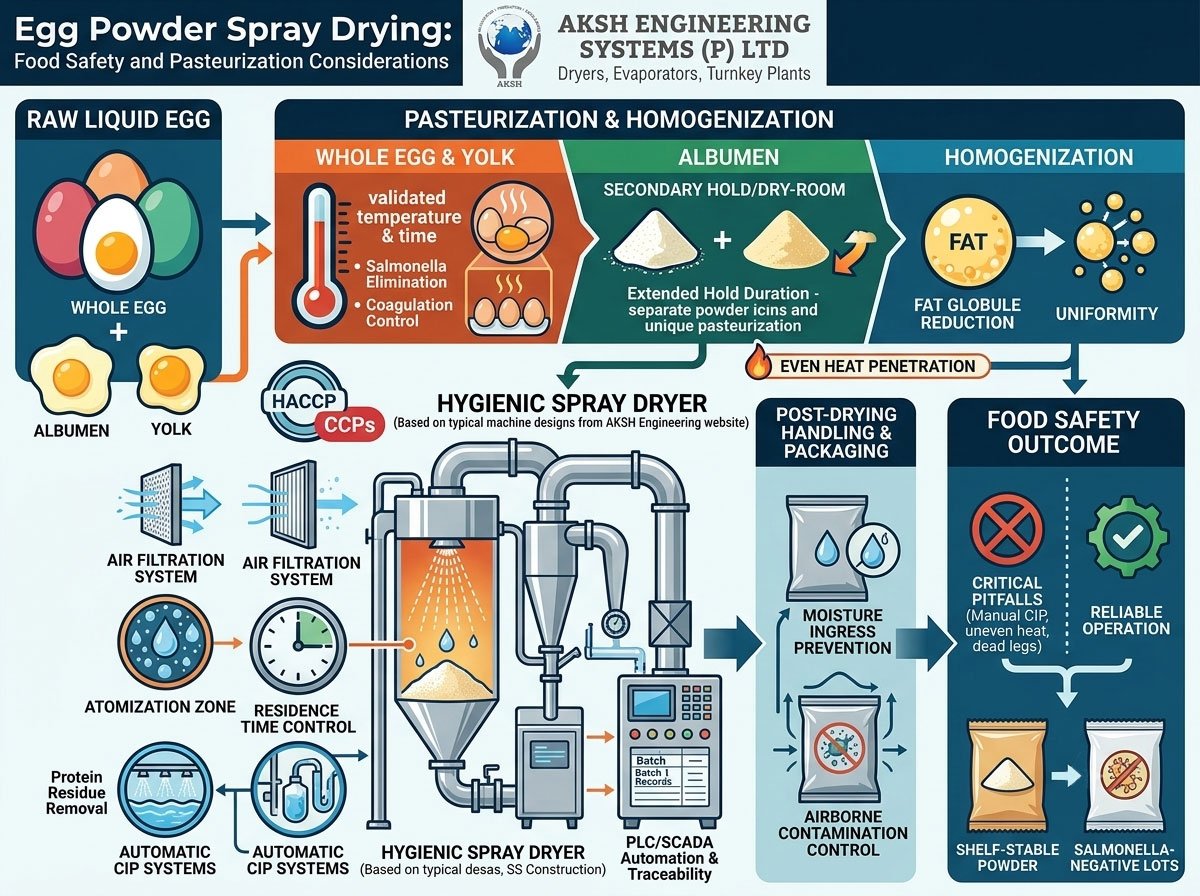
Whole egg and yolk pasteurization is typically carried out using a High Temperature Short Time (HTST) process, similar in principle to dairy pasteurization, but calibrated specifically for egg proteins:
- Whole egg mix is generally pasteurized at temperatures in the general range of 60°C (140°F) held for several minutes, low enough to avoid coagulation of the egg proteins but sufficient to achieve the required log reduction of Salmonella.
- Egg yolk, having a higher solids and fat content, tolerates slightly different time-temperature combinations than whole egg or albumen.
- Egg albumen (egg white) is the most heat-sensitive of the three, since its proteins coagulate at the lowest temperatures. This is why albumen has historically also relied on a secondary “hold” or “room-drying” pasteurization step after drying — holding the dried albumen powder at a controlled temperature for an extended period (regulatory frameworks have specified holding spray-dried albumen at defined temperatures for multiple days) until it tests negative for Salmonella.
The target across all of this is typically expressed as a validated log reduction in Salmonella populations (a 5-log reduction is a commonly cited industry benchmark), verified through process validation studies rather than assumed from equipment settings alone.
This is precisely why pasteurization equipment and time-temperature parameters cannot be treated as generic — they need to be validated for the specific egg fraction (whole egg, yolk, or albumen), the total solids content of the mix, and the throughput of the plant.
Homogenization: An Underrated Food Safety and Quality Step
Before pasteurization, egg mass is typically homogenized. This step reduces the size of fat globules in the mixture so they don’t separate or clump during heat treatment and subsequent drying. From a food safety standpoint, homogenization matters because:
- It creates a more uniform product, which means heat penetrates evenly during pasteurization — uneven heat distribution is one of the biggest risks to pasteurization effectiveness.
- It reduces the risk of localized under-processing, where pockets of the mix don’t reach the target temperature for the required hold time.
- It improves the physical stability and reconstitution properties of the final dried powder.
Skipping or under-specifying homogenization is a common but avoidable design mistake in smaller or retrofit egg processing lines.
From Pasteurized Liquid to Powder: Where Spray Drying Fits In
Once the egg mass has been pasteurized and cooled, it’s fed into the spray dryer, where it’s atomized into fine droplets and dried rapidly using hot air — typically in a co-current configuration to protect the heat-sensitive proteins from prolonged exposure to high temperatures.
Several process parameters directly affect both food safety and product quality at this stage:
Inlet and outlet air temperature. These need to be controlled tightly enough to complete drying quickly (minimizing microbial regrowth risk in the wet particle before it dries) without denaturing proteins or causing excessive Maillard browning, which affects color, solubility, and flavor.
Final moisture content. Egg powder is typically dried down to a low moisture level — generally in the low single-digit percentage range — because moisture content is one of the primary factors controlling microbial stability and shelf life in a dry powder product. Water activity (aw), not just total moisture percentage, is the more precise indicator of microbial safety, and well-designed spray drying systems are tuned to hit a target water activity that inhibits bacterial and mold growth during storage.
Residence time and particle formation. Poor atomization or uneven droplet size distribution can lead to some particles drying fully while others remain under-dried in the core — creating localized “hot spots” for moisture retention that compromise both shelf stability and food safety.
Hygienic equipment design. This is where the drying equipment itself becomes a food safety control, not just a processing step. Spray dryers used for egg powder need:
- Sanitary (hygienic) construction — smooth, crevice-free internal surfaces, food-grade stainless steel, and welds finished to hygienic standards to prevent product build-up and microbial harborage points.
- Effective Clean-in-Place (CIP) systems, since egg residue is an excellent growth medium for bacteria if allowed to accumulate on interior surfaces between production runs.
- Air filtration on the drying air supply, to prevent airborne contamination from being introduced into the product during drying.
- Sealed, contamination-resistant powder collection and conveying systems downstream of the drying chamber.
HACCP and Critical Control Points in Egg Powder Production
A well-run egg powder facility maps its entire process — from egg receiving through packaging — against a Hazard Analysis and Critical Control Points (HACCP) plan. For egg powder specifically, the critical control points typically include:
- Raw material receiving and candling/inspection of shell eggs (or verification of supplier certificates for liquid egg inputs)
- Breaking, filtering, and cooling of the liquid egg mass to limit bacterial growth before processing
- Pasteurization — the primary microbial kill step, validated by time/temperature records
- Spray drying — controlling final moisture/water activity as a stability control point
- Post-drying handling and packaging — preventing recontamination of the finished dry powder, particularly from moisture ingress or airborne contaminants
- Lot testing — verifying finished product is Salmonella-negative before release
Every one of these points needs supporting equipment capable of consistent, repeatable performance — which is why process automation (PLC/SCADA-based control of temperatures, flow rates, and CIP cycles) has become close to a baseline requirement rather than an optional upgrade for regulated egg powder production.
Common Food Safety Pitfalls in Egg Powder Plants
Some of the most frequent issues seen in egg powder operations — particularly in retrofit or under-specified plants — include:
- Inconsistent pasteurization hold times due to poorly designed holding tubes or inadequate flow control, leading to under-processed batches
- Dead legs and crevices in piping and equipment that are difficult to clean, allowing bacterial biofilm to develop over time
- Inadequate drying air filtration, allowing airborne contamination during the drying stage
- Moisture content drift during extended production runs, especially without real-time moisture monitoring, resulting in inconsistent water activity across batches
- Manual, non-validated CIP cycles that clean visually but don’t reliably remove protein residue at a microbiological level
Each of these is, at its root, an equipment and process design issue as much as a procedural one — which is why the choice of spray drying and automation equipment has a direct bearing on how consistently a plant can meet food safety requirements.
Designing an Egg Powder Line for Food Safety From the Start
For manufacturers setting up a new egg powder line or upgrading an existing one, a few design principles consistently separate reliable, compliant operations from problem-prone ones:
- Choose hygienic-design spray drying equipment built specifically for food and dairy-grade applications, not a general industrial dryer adapted after the fact.
- Integrate automatic CIP systems rather than relying on manual cleaning, to ensure repeatable, validated cleaning cycles between batches.
- Invest in instrumentation and automation for real-time monitoring of pasteurization temperature/hold time and drying parameters — this turns food safety from a periodic check into a continuously monitored control system.
- Plan for full traceability, with batch records linking raw material lots through pasteurization records to final packaged powder lots.
- Work with an equipment manufacturer experienced specifically in egg and dairy powder applications, since the hygienic design requirements differ meaningfully from spray drying used in chemical or industrial powder production.
Conclusion
Egg powder is a genuinely useful, shelf-stable ingredient — but only when the production process is engineered around the specific food safety demands of egg proteins. Pasteurization remains the primary defense against Salmonella, and spray drying, moisture control, and hygienic equipment design determine whether that safety margin holds up through drying, packaging, and storage. Getting this right isn’t just a regulatory checkbox; it’s what protects a brand’s reputation and its customers.
For manufacturers evaluating a new egg powder line, the equipment decision is inseparable from the food safety outcome — pasteurization systems, hygienic spray dryers, CIP systems, and process automation all need to be specified together, not as an afterthought.
About AKSH Engineering Systems Pvt. Ltd.
AKSH Engineering Systems Pvt. Ltd. designs and manufactures industrial spray dryers, egg powder plants, and hygienic spray dryers for food, dairy, and pharmaceutical manufacturers, along with supporting systems including automatic Clean-in-Place (CIP) systems and instrumentation and process automation built for regulated, food-grade production environments.
To discuss an egg powder plant project or a hygienic spray drying upgrade, reach out at mkt@akshengineering.com or visit akshengineering.com.
Related reading:
- How Is Spray Drying Revolutionizing Food and Pharmaceutical Products?
- How PLC/SCADA Automation Improves Spray Dryer Consistency
- Cyclone Separator vs Bag Filter vs Scrubber: Choosing the Right Dust Collection System
Browse related category: Industrial Dryers | CIP Systems