Every plant manager running a spray dryer has faced the same frustrating scenario: the recipe hasn’t changed, the raw material looks the same on paper, and yet the finished powder comes out slightly different from the last batch. Maybe the moisture content is a fraction of a percent higher than spec. Maybe the particle size distribution has shifted, changing how the powder flows or dissolves. Maybe there’s a fine dusting of product stuck to the chamber wall that wasn’t there last week.
These aren’t random accidents. They’re the natural result of running a highly interdependent thermal process with manual or semi-automatic control. Spray drying converts a liquid feed into a dry powder in a matter of seconds, and that transformation depends on several variables — feed rate, atomization, inlet and outlet air temperature, and airflow — staying in precise balance with each other, continuously, for the entire length of a production run. A human operator, no matter how experienced, simply cannot react to these variables as fast as the process itself changes.
This is exactly the problem that PLC (Programmable Logic Controller) and SCADA (Supervisory Control and Data Acquisition) systems were built to solve. In this article, we’ll break down exactly how PLC/SCADA automation improves spray dryer consistency — parameter by parameter — and why plants that automate their spray drying process see measurable gains in product quality, yield, and traceability.
Why Spray Dryer Consistency Is So Hard to Achieve Manually
Before looking at what automation does, it’s worth understanding why consistency is difficult in the first place.
A spray dryer works by atomizing a liquid feed into fine droplets and exposing them to a stream of hot air inside a drying chamber. As the droplets travel through the chamber, moisture evaporates almost instantly, leaving behind dry particles that are collected at the bottom of the chamber or in a cyclone separator. The entire residence time of a droplet in the chamber is typically just a few seconds.
Because the process happens so fast, there’s very little room for error or delay in correcting it. If the outlet air temperature drifts upward by even a couple of degrees, the moisture content of the final product changes immediately — there’s no “buffer stage” downstream to fix it. If feed rate increases slightly but atomizer speed doesn’t adjust to match, droplet size grows, and so does the final particle size. If chamber pressure isn’t held steady, product can be pulled toward the walls, leading to buildup, scorching, and yield loss.
In a manually operated plant, an operator typically checks gauges and readouts periodically — maybe every 15 to 30 minutes — and makes adjustments based on what they see and what experience tells them. This works, to a degree, but it has three structural weaknesses:
- Delay. By the time a deviation is noticed and corrected, part of the batch has already been affected.
- Inconsistency between operators. Two operators with different levels of experience will make different adjustments to the same situation, leading to batch-to-batch and shift-to-shift variation.
- No continuous record. Manual logsheets capture data at intervals, not continuously, making it hard to reconstruct exactly what happened if a batch fails to meet specification.
PLC/SCADA automation directly addresses all three of these weaknesses.
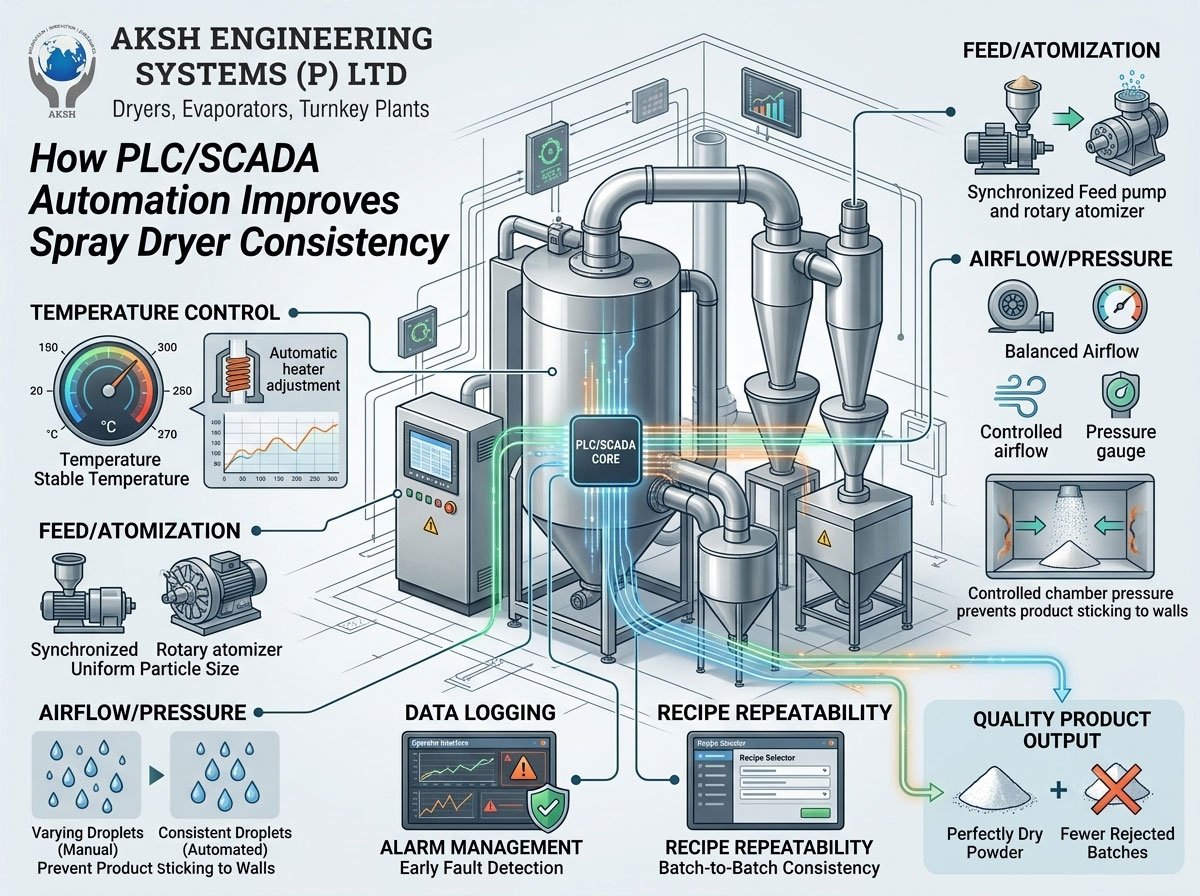
1. Real-Time, Closed-Loop Temperature Control
Outlet air temperature is widely considered the single most important variable in spray drying, because it has a direct and almost immediate effect on the final moisture content of the powder. Too high, and the product may be over-dried, scorched, or degraded (a serious concern for heat-sensitive food ingredients and pharmaceutical actives). Too low, and moisture content creeps above specification, risking microbial growth, caking, or reduced shelf life.
A PLC manages this through a closed-loop PID (Proportional-Integral-Derivative) control system. Temperature sensors (typically RTDs or thermocouples) placed at the inlet and outlet continuously feed data to the controller. The PLC compares the actual reading against the setpoint and adjusts the heater output, hot air damper position, or burner firing rate in real time — often multiple times per second — to correct even small deviations before they become significant.
The practical result is that outlet temperature can be held within a very tight band, often ±1–2°C of the target, for the entire duration of a run. Compare that to manual control, where temperature might swing by 5–10°C between operator checks, and it’s easy to see why moisture content becomes far more predictable and repeatable under automated control.
2. Synchronized Feed Rate and Atomization
Particle size and particle size distribution are determined largely by the relationship between feed rate and atomizer performance — whether that’s a rotary disc atomizer’s rotational speed or a nozzle’s pressure/flow rate. If either one drifts independently of the other, droplet size (and therefore final particle size) changes.
In an automated system, feed rate and atomizer speed are linked through PLC logic, often as a fixed ratio or through a cascade control loop. If the feed pump speed changes — for example, to compensate for a viscosity change in the incoming slurry — the atomizer speed is automatically adjusted to maintain the correct droplet size. This kind of coordinated, simultaneous adjustment is extremely difficult to replicate manually, because it requires an operator to watch and adjust two variables at once, in real time, with the correct ratio in mind.
The payoff shows up directly in product quality: more uniform particle size means more consistent bulk density, flowability, reconstitution behavior, and appearance — all properties that customers and downstream processes are sensitive to.
3. Stable Airflow and Chamber Pressure
Spray dryers depend on a carefully maintained pressure differential between the drying chamber and the surrounding environment. This differential controls the direction of airflow, prevents product from escaping through gaps or being pulled toward chamber walls, and keeps the cyclone separator or bag filter operating efficiently.
Over the course of a production run, conditions inside the system change — filters gradually load with fine particulate, ambient temperature and humidity shift, and blower performance can vary slightly. A SCADA system continuously monitors chamber pressure, blower speed, and exhaust fan draft, using variable frequency drives (VFDs) to make small, continuous corrections that keep the pressure differential stable regardless of these changes.
This matters more than it might seem. Unstable chamber pressure is one of the most common causes of product sticking to chamber walls, inconsistent particle carryover into the cyclone, and localized scorching where product lingers too long near hot surfaces. Holding airflow and pressure steady removes a major source of unpredictable variation from the process.
4. Continuous, Automatic Data Logging
One of the most underrated benefits of PLC/SCADA automation is simply the quality of the data it produces. Every relevant parameter — inlet and outlet temperature, feed rate, atomizer speed, chamber pressure, cyclone differential pressure, blower speed — is recorded automatically, continuously, and with an accurate timestamp.
This creates a complete digital batch record without a single manual logsheet. For a quality team, this is transformative. If a batch is later found to be out of specification, the root cause can usually be identified within minutes by reviewing the trend data, rather than relying on an operator’s memory of what happened three hours earlier. For companies that need to demonstrate consistency to customers, auditors, or regulatory bodies — particularly relevant in food and pharmaceutical manufacturing — this kind of traceable, tamper-resistant record is often a baseline requirement, not a nice-to-have.
5. Alarm Management and Early Fault Detection
A SCADA system doesn’t just record data passively — it actively watches for deviations and raises alarms before a small problem becomes a large one. If outlet temperature starts trending upward, if atomizer speed drops unexpectedly, or if a feed line pressure suggests a partially clogged nozzle, the system flags it immediately, often before the change is visible in the final product.
This shifts the entire maintenance and quality posture of the plant from reactive to proactive. Instead of discovering a problem after an entire batch has been produced out of spec — or worse, after a safety-relevant condition has developed — operators are alerted within seconds and can intervene while the issue is still minor. Over time, this alarm history also becomes a valuable diagnostic tool, helping identify recurring issues like a nozzle that fouls faster than others or a damper that sticks intermittently.
6. Recipe-Based Repeatability for Multi-Product Plants
Many spray drying operations aren’t running a single product around the clock — they’re switching between multiple formulations, each with its own ideal temperature profile, feed rate, atomizer setting, and airflow configuration. In a manual environment, this means operators resetting each parameter by hand, based on a written SOP or, worse, on memory.
PLC recipe management eliminates this variability entirely. Each product’s full parameter set is stored digitally and can be recalled and loaded automatically at the press of a button during changeover. This guarantees that Product A is always run at exactly the same settings, batch after batch, regardless of which operator is on shift or how experienced they are. For contract manufacturers or plants producing several SKUs on shared equipment, this is often one of the single biggest contributors to reducing batch-to-batch variation.
The Combined Effect on Product Quality and Cost
Individually, each of these automation elements addresses a specific source of variability. Together, they compound into something more significant: a spray drying process that behaves the same way every time, regardless of who is operating it or what time of day it is.
Plants that transition from manual or semi-automatic control to full PLC/SCADA automation typically report several consistent outcomes:
- Tighter moisture content specifications, often within a fraction of a percentage point, run after run.
- More uniform particle size and bulk density, improving flow characteristics, packaging consistency, and reconstitution behavior.
- Fewer rejected or reworked batches, since deviations are caught and corrected before they affect the whole run.
- Reduced energy consumption, because precise temperature and airflow control avoids the inefficiency of over-drying or over-compensating for drift.
- Lower long-term maintenance costs, since early fault detection prevents minor issues from escalating into equipment damage.
- A complete, audit-ready digital record of every batch, supporting quality certifications and customer requirements.
The upfront investment in PLC/SCADA integration is often recovered relatively quickly through reduced scrap, lower energy use, and less time spent troubleshooting quality deviations after the fact — before even accounting for the intangible value of a more consistent, defensible product.
Frequently Asked Questions
What is the difference between a PLC and a SCADA system in spray drying? A PLC is the controller that directly manages the process in real time — reading sensors and adjusting outputs like heaters, dampers, and motor speeds through control loops. SCADA sits above the PLC, providing the operator interface, trend graphs, alarm management, and long-term data logging that let plant staff monitor and analyze the process.
Can existing manual spray dryers be retrofitted with PLC/SCADA automation? In most cases, yes. Retrofitting typically involves adding or upgrading sensors, installing control valves and VFDs where needed, and integrating a PLC and SCADA interface — without necessarily replacing the entire dryer.
Does automation reduce the need for skilled operators? Not exactly — it changes their role. Instead of manually adjusting parameters reactively, operators focus on monitoring trends, responding to alarms, and managing recipe changeovers, which generally requires a different (and often more analytical) skill set rather than fewer skills overall.
Conclusion
Spray dryer consistency isn’t achieved by chance — it’s engineered. PLC/SCADA automation replaces reactive, delayed, experience-dependent manual control with continuous, real-time correction across every variable that affects product quality: temperature, feed rate, atomization, and airflow. The result is a process that produces the same quality outcome batch after batch, with a complete digital record to prove it.
At AKSH Engineering Systems Pvt. Ltd., we design and manufacture spray dryers with PLC/SCADA automation engineered in from the start — not added as an afterthought. If you’re evaluating how automation could improve consistency, yield, or traceability in your own spray drying process, we’d be glad to discuss your specific requirements.
Website: akshengineering.com Email: mkt@akshengineering.com