Every industrial manufacturer that generates wastewater eventually faces the same question: should we install a conventional Effluent Treatment Plant (ETP) that treats water to a dischargeable standard, or invest in a Zero Liquid Discharge (ZLD) system that recovers virtually all the water and leaves nothing but a dry solid residue?
It’s rarely a simple choice. Conventional treatment costs less upfront and is easier to operate, but it depends on a discharge point — a drain, a river, or a common effluent treatment plant — and that dependency is becoming a liability as pollution control boards tighten norms year after year. ZLD costs significantly more to build and run, but it removes discharge risk almost entirely and turns water into a resource the plant can reuse indefinitely.
At AKSH Engineering Systems Pvt. Ltd., we design and manufacture evaporation and drying systems — including the multiple-effect evaporators, mechanical vapour recompression (MVR) systems, spray dryers, and spin flash dryers that sit at the heart of any ZLD scheme — for food, chemical, pharmaceutical, and process industries across India. This guide breaks down the real cost and benefit differences between the two approaches, so you can make a decision based on numbers rather than assumptions.
What Is Conventional Effluent Treatment?
A conventional ETP treats industrial wastewater to a level that meets the discharge norms set by the Central Pollution Control Board (CPCB) or the relevant State Pollution Control Board (SPCB), and then releases the treated water — into a municipal sewer, a water body, or onto land for irrigation, depending on the permitted route.
A typical conventional ETP includes:
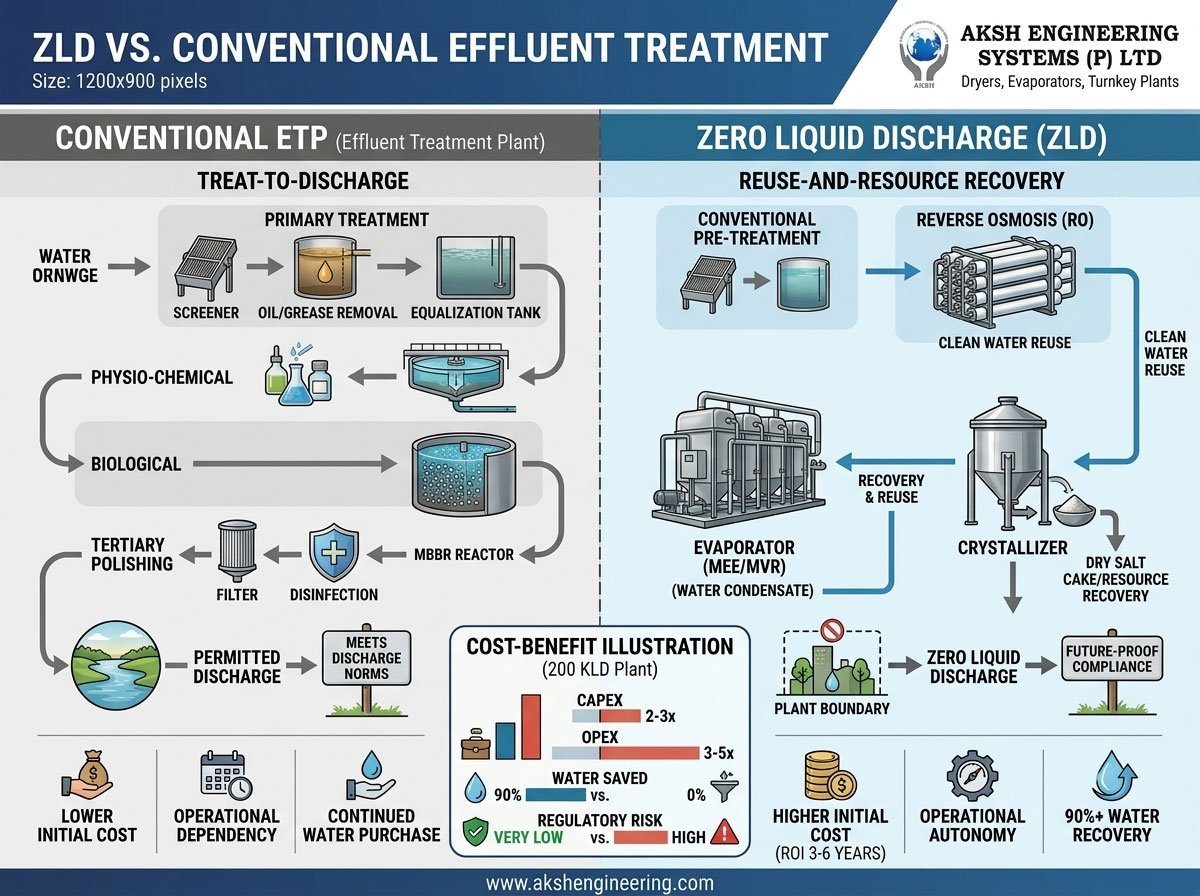
- Primary treatment: screening, oil and grease removal, equalization, and neutralization
- Physico-chemical treatment: coagulation, flocculation, and clarification to remove suspended solids and heavy metals
- Biological treatment: aerobic or anaerobic processes (ASP, SBR, MBBR, or MBR) to break down organic load
- Tertiary polishing: filtration and disinfection before discharge
The process stops once the treated water meets the prescribed discharge parameters (BOD, COD, TSS, pH, and so on). Nothing further is required — the water leaves the plant boundary.
What Is Zero Liquid Discharge (ZLD)?
ZLD takes the same starting point — raw effluent — but instead of discharging the treated water, it pushes the process further until there is no liquid effluent left at all. A ZLD scheme typically adds these stages after conventional pre-treatment:
- Reverse Osmosis (RO): concentrates dissolved salts while producing clean permeate for reuse in cooling towers, boilers, or process washing
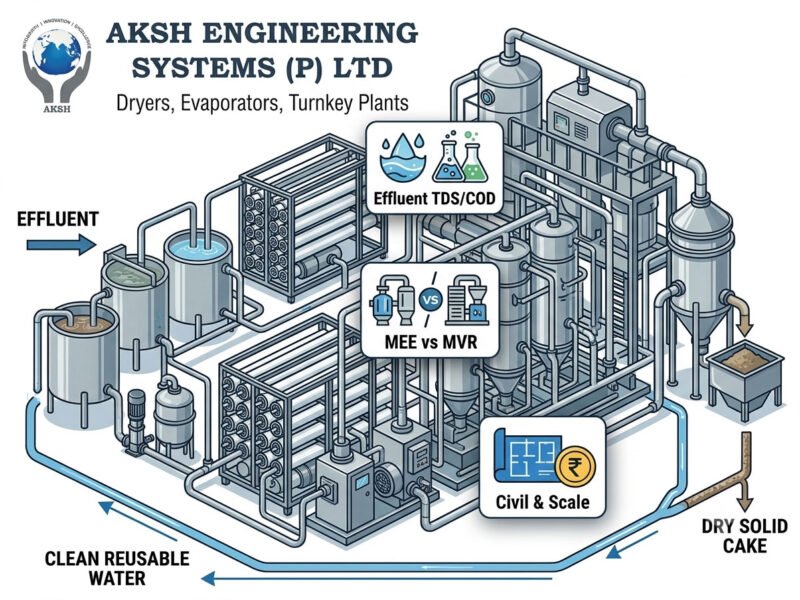
- Multiple-Effect Evaporator (MEE) or Mechanical Vapour Recompression (MVR): evaporates the RO reject further, recovering additional water as condensate
- Crystallizer: concentrates the remaining brine into a dry salt cake or crystalline solid that can be disposed of as per hazardous waste norms, or in some cases sold
The result is a facility that discharges nothing to the environment — the only outputs are reusable water and a dry solid residue.
Capital Cost Comparison
This is where the two approaches diverge most sharply.
Conventional ETP: For a standard industrial ETP, capital cost typically ranges from roughly ₹60,000 to ₹2,00,000 per KLD (kilolitre per day) of installed capacity, depending on effluent strength, the technology chosen (MBBR is generally 20–30% cheaper than MBR of equal capacity), and the degree of automation required. A mid-sized 500 KLD plant built to a straightforward discharge standard commonly falls in the ₹1.5–4 crore range.
ZLD System: Adding zero liquid discharge to the same base plant roughly doubles to triples the total capital cost. A 500 KLD ZLD plant can run anywhere from ₹6–12 crore, and complex, high-TDS effluents (common in textile dyeing, pharmaceutical API manufacturing, and specialty chemicals) can push this figure higher still. The jump is driven almost entirely by the RO, evaporation, and crystallization stages — equipment that a conventional plant simply doesn’t need.
Why the gap exists: Evaporation and crystallization equipment is capital-intensive by nature — thick-walled vessels, heat exchangers, vapour compressors, and corrosion-resistant metallurgy (often SS316L, Hastelloy, or titanium for aggressive effluents) all add cost that has no equivalent in a biological treatment train.
Operating Cost Comparison
Capital cost tells only half the story. Where the two systems really separate is in day-to-day running cost, measured in ₹ per kilolitre (KL) of effluent treated.
Conventional ETP running cost generally falls in the ₹15–40 per KL range, dominated by aeration energy, chemical dosing (coagulants, flocculants, pH correction), and sludge handling.
ZLD running cost can reach ₹80–220 per KL, and the evaporator stage is almost always the reason why. Evaporation is inherently energy-hungry — typically 12–18 kWh per cubic metre even with an optimized MVR system, compared to conventional MEE, which can cost 50–60% more in energy terms than MVR for the same duty. This is precisely why modern ZLD designs push RO recovery rates as high as 92–95% before the effluent ever reaches the evaporator: every cubic metre recovered by membranes at the RO stage is a cubic metre the energy-intensive evaporator never has to process.
Other recurring ZLD operating costs include:
- Membrane replacement and cleaning chemicals for the RO stage
- Salt/sludge disposal at an authorized Treatment, Storage and Disposal Facility (TSDF), typically ₹3,000–8,000 per tonne
- Skilled operator and maintenance staff for a more complex process train
- Annual maintenance contracts (AMC) for evaporator and crystallizer equipment
It’s worth noting that two ZLD plants of identical rated capacity can still show a 2–4x difference in ₹/KL operating cost, purely based on RO recovery efficiency and whether the evaporator uses conventional MEE or more efficient MVR technology. Equipment selection at the design stage has an outsized impact on lifetime running cost — this is exactly where engineering expertise pays for itself.
The Hidden Side of the Ledger: What Conventional Treatment Doesn’t Show You
A cost comparison based only on capex and opex understates the real picture, because it leaves out costs and risks that only show up over the life of the plant:
1. Water purchase and scarcity cost. A conventional ETP discharges treated water and the plant still buys fresh water for its processes. A ZLD plant recovers 90%+ of its water for reuse, offsetting a real, ongoing cost — particularly significant in water-stressed regions, which describes a large share of India’s industrial clusters. India holds roughly 4% of the world’s freshwater resources while supporting close to 16% of its population, which is precisely why water reuse economics increasingly favor ZLD in high-consumption sectors.
2. Regulatory and compliance risk. Discharge norms are not static. Pollution Control Boards have progressively tightened permissible limits, and in several states — particularly for textile, pharmaceutical, dyeing, and chemical clusters — ZLD is no longer optional; it’s mandated for specific categories of industry (commonly Red and Orange category units above defined capacity thresholds). A conventional ETP that meets today’s norm can become non-compliant with tomorrow’s, forcing a costly retrofit under regulatory pressure rather than a planned capital cycle.
3. Resource recovery revenue. In several sectors, the salt or mineral recovered at the ZLD crystallizer stage has resale value — sodium chloride from textile effluent, for instance, can sometimes be sold to chemical processors rather than landfilled. When resource recovery is included in the model, industry studies have found ZLD systems in high-volume plants generating meaningful additional return, in some cases 20%+ ROI, once salt and water recovery income are factored in alongside avoided water purchase costs.
4. Business continuity and license to operate. A discharge violation can mean plant closure orders, which cost far more than any treatment upgrade. ZLD removes this exposure almost entirely, since there’s no discharge point to violate.
5. Downtime cost of ETP failure or drain restrictions. In common effluent treatment plant (CETP)-dependent clusters, a member unit’s non-compliant discharge can trigger restrictions on the entire cluster’s drain access. ZLD-equipped units are insulated from this shared risk.
A Simplified Cost-Benefit Illustration
To put real numbers around the comparison, consider a mid-sized chemical plant evaluating both routes for a 200 KLD effluent stream:
| Factor | Conventional ETP | ZLD System |
|---|---|---|
| Approx. capital cost | ₹1.2–2.5 crore | ₹4–8 crore |
| Approx. running cost | ₹25–35 per KL | ₹90–150 per KL |
| Water recovered for reuse | Minimal (discharged) | 90–95% |
| Fresh water purchase avoided | No | Yes — significant, ongoing |
| Regulatory exposure | Depends on discharge norm changes | Very low — no discharge point |
| Resource recovery potential | None | Possible (salt, minerals) |
| Typical payback vs. baseline | N/A (lower-cost baseline) | Often 3–6 years, faster where water/salt recovery revenue is strong |
Once avoided water-purchase cost and any resource-recovery income are subtracted from the ZLD operating cost, the effective gap between the two options narrows considerably — sometimes to within 15–25% of the conventional plant’s net cost per KL, depending on local water tariffs and effluent characteristics. This is the calculation that boards and CFOs need to see, because “ZLD costs 3x more” and “ZLD costs 20% more once you count what it saves you” lead to very different investment decisions.
When Conventional Treatment Is Still the Right Choice
ZLD isn’t universally justified. A conventional ETP remains the sensible option when:
- Your industry category and discharge volume don’t attract a ZLD mandate from CPCB/SPCB
- You have reliable, low-cost access to a municipal sewer or a well-managed CETP
- Your effluent has low TDS and low toxicity, making standard biological treatment fully adequate
- Capital budget constraints make the 2–4x cost multiplier for ZLD genuinely prohibitive in the near term
- Water is not scarce or expensive in your operating location
Food processing, dairy (for general sanitary effluent), light engineering, and several categories of general manufacturing typically fall into this bracket, provided their effluent doesn’t carry high salinity or hazardous constituents.
When ZLD Is the Right Investment
ZLD earns its higher price tag when:
- Your sector faces a regulatory mandate — textile dyeing, pharmaceutical API/bulk drug manufacturing, and specialty/agro chemicals are common examples across Indian states
- Your facility operates in a water-stressed region where fresh water cost or availability is a genuine operational constraint
- Your effluent has high TDS or contains recoverable salts/minerals with resale value
- Your business cannot tolerate the compliance risk of a discharge-dependent process, whether for regulatory, reputational, or export-market reasons (many international buyers now require ZLD compliance from Indian suppliers as a condition of sourcing)
- You’re planning a new greenfield facility, where designing for ZLD from day one is considerably cheaper than retrofitting an operating conventional ETP later
Getting the Engineering Right Matters More Than the Technology Label
The single biggest driver of whether a ZLD investment pays off is not “ZLD vs. conventional” — it’s how well the ZLD train itself is engineered. Two facilities with identical effluent volumes and identical mandates can see running costs that differ by a factor of two to four, based entirely on:
- RO recovery percentage — every percentage point pushed higher shrinks the volume the evaporator must handle
- MVR vs. conventional MEE selection — MVR’s lower energy draw compounds into large savings over a plant’s operating life
- Evaporator design and heat-recovery integration
- Metallurgy selection matched correctly to effluent corrosivity, avoiding both over-engineering (wasted capex) and under-engineering (early failure)
This is where a treatability study and a properly simulated process design — done before capital is committed — separates a ZLD investment that pays back in three to four years from one that becomes a permanent operating cost drag.
Conclusion: It’s a Cost-of-Risk Decision, Not Just a Cost-of-Treatment Decision
Conventional effluent treatment will almost always look cheaper on a simple capex and opex comparison. But that comparison is incomplete unless it accounts for water scarcity, tightening discharge norms, resource recovery potential, and the business risk of depending on a discharge point that regulators can restrict at any time.
For industries facing a regulatory mandate, operating in water-stressed regions, or handling effluent with recoverable value, ZLD’s higher upfront cost is increasingly an investment in operational security rather than an optional environmental expense. For others, a well-designed conventional ETP remains the right, cost-effective choice — provided it’s built with enough headroom to adapt if norms change.
The right answer depends on your effluent characteristics, your regulatory category, your local water economics, and your growth plans — which is exactly why a proper feasibility and treatability study should come before any capital decision, not after.
Need Help Deciding Between ZLD and Conventional Effluent Treatment?
AKSH Engineering Systems Pvt. Ltd. designs and manufactures the evaporation, drying, and crystallization equipment that ZLD systems depend on — including multiple-effect evaporators, MVR systems, spray dryers, and spin flash dryers — for the food, chemical, pharmaceutical, and process industries across India.
If you’re evaluating whether your facility needs Zero Liquid Discharge or whether a conventional ETP will meet your requirements, our engineering team can walk you through a treatability assessment and a realistic cost comparison based on your actual effluent profile.
📩 Email: mkt@akshengineering.com 🌐 Website: https://akshengineering.com/
Frequently Asked Questions
1. Is ZLD mandatory for all industries in India? No. ZLD mandates typically apply to specific “Red” and “Orange” category industries above defined capacity thresholds — commonly textile dyeing, pharmaceutical, and certain chemical manufacturing units — as notified by the CPCB and respective State Pollution Control Boards. Many industries, including most food processing and general manufacturing units, can meet compliance with a well-designed conventional ETP.
2. How much more does a ZLD plant cost than a conventional ETP? As a general rule, ZLD adds roughly 2 to 4 times the capital cost of an equivalent conventional ETP, and running costs can be 3 to 6 times higher per kilolitre — mainly due to the energy demand of evaporation and crystallization.
3. Does ZLD pay for itself over time? In many cases, yes — particularly where water is scarce or expensive, and where recovered salts have resale value. Once avoided water-purchase costs and resource-recovery income are included, payback periods of 3 to 6 years are common, though this varies significantly by industry and location.
4. What is the biggest cost driver in a ZLD system? The evaporator stage. Evaporation is inherently energy-intensive, and choosing the right technology — MVR over conventional MEE, and maximizing RO recovery before the effluent reaches the evaporator — has the single largest impact on lifetime operating cost.
5. Can an existing conventional ETP be upgraded to ZLD later? Yes, though it’s generally more expensive and disruptive than designing for ZLD from the outset. Retrofitting requires adding RO, evaporation, and crystallization stages, along with upgrades to pre-treatment to protect the membranes — all achievable, but at a cost premium compared to a greenfield ZLD design.