The global transition toward clean energy has triggered an unprecedented surge in the demand for high-performance lithium-ion batteries. From electric vehicles (EVs) to grid-scale energy storage, the market demands batteries with higher energy density, faster charging capabilities, and impeccable safety standards.
Achieving these metrics starts at the raw material level. Among the various chemical processing techniques, spray drying has emerged as a cornerstone technology for synthesizing advanced battery materials.
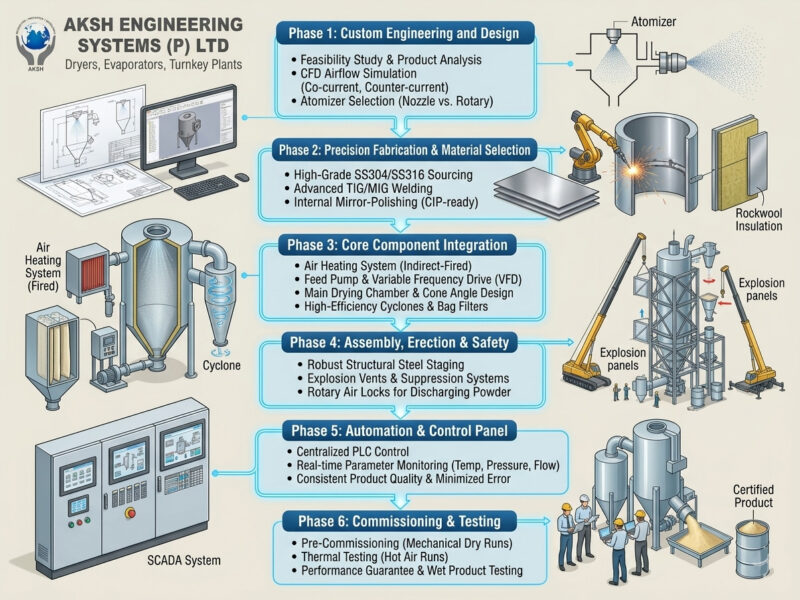
At AKSH Engineering Systems Pvt. Ltd., based in Ahmedabad, India, we design and manufacture cutting-edge industrial drying solutions. In this technical deep-dive, we explore the critical role of spray drying in lithium battery production, the unique challenges manufacturers face, and the engineering solutions driving the industry forward.
The Role of Spray Drying in Battery Manufacturing
The performance of a lithium-ion battery heavily relies on the quality of its cathode and anode active materials. Common cathode materials—such as Lithium Iron Phosphate (LFP), Nickel Manganese Cobalt (NMC), and advanced solid-state electrolytes—require precise chemical composition and strict physical properties.
Spray drying is uniquely suited for this application because it converts a liquid slurry (containing the battery material precursors) into a highly uniform, free-flowing dry powder in a single, continuous step.
Key Benefits of Spray Drying:
- Controlled Particle Size Distribution (PSD): Ensures uniform electrochemical reactivity across the battery cell.
- Spherical Particle Morphology: Spherical particles pack tighter, maximizing tap density and increasing the battery’s overall energy storage capacity.
- Homogeneous Component Distribution: Guarantees that multi-element precursors (like NMC) are perfectly mixed at the molecular level.
Core Challenges in Spray Drying Lithium Battery Materials
While spray drying offers distinct advantages, processing battery chemicals introduces harsh operating conditions and stringent quality parameters. Standard industrial dryers simply cannot cope with these demands.
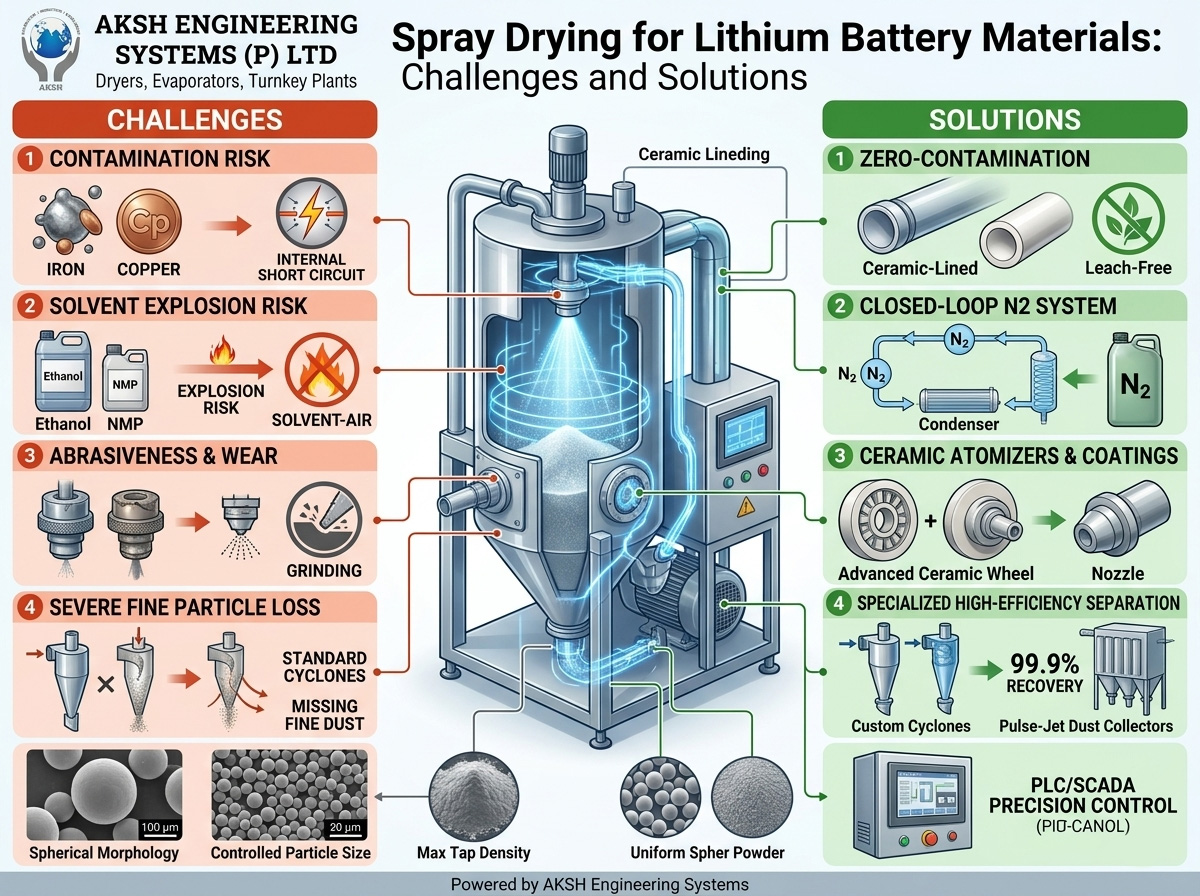
1. Risk of Contamination (Purity and Cross-Contamination)
Battery materials require ultra-high purity levels (often 99.99% or higher). Even microscopic traces of foreign metallic particles (like iron or copper) can cause internal short circuits, leading to catastrophic thermal runaway (battery fires).
2. Handling Organic Solvents (Explosion Risks)
While some precursors are water-based, many advanced formulations utilize volatile organic solvents like Ethanol, Acetone, or N-Methyl-2-pyrrolidone (NMP). Spraying these solvents into a hot air stream creates an immediate risk of explosion.
3. High Abrasiveness and Material Wear
The slurries used for battery materials often feature a high solid content consisting of incredibly abrasive particles. This causes rapid wear and tear on atomizers, nozzles, and internal dryer walls, leading to frequent maintenance shutdowns.
4. Severe Fine Particle Loss
Advanced battery materials often require incredibly fine particle sizes (sub-micron to small micron ranges). Standard cyclone separators struggle to capture these ultra-fine particles, resulting in massive yield losses and product wastage.
Advanced Engineering Solutions by AKSH Engineering Systems
To overcome these roadblocks, AKSH Engineering Systems Pvt. Ltd. has engineered specialized, high-performance spray drying systems tailored specifically for the energy storage sector.
Closed-Loop Nitrogen Systems for Solvent Recovery
To safely process organic solvents, we design and deploy Closed-Loop Spray Drying Systems.
- Inert Atmosphere: The system replaces atmospheric oxygen with an inert gas—typically Nitrogen (N2). By keeping oxygen levels well below the Limited Oxygen Concentration (LOC), the risk of explosion is entirely eliminated.
- Condenser Recovery: The evaporated organic solvents are condensed, collected, and recycled back into the production cycle, drastically reducing operational costs and environmental footprint.
Zero-Contamination Material Selection
To guarantee the absolute purity required for battery-grade materials, AKSH utilizes specialized contact materials:
- Advanced Metallurgy & Coatings: All product-contact surfaces are constructed from premium Stainless Steel (e.g., SS316L) or lined with specialized ceramic coatings (like Silicon Carbide or Alumina) to eliminate the risk of metallic iron contamination.
- Ceramic Atomizer Wheels: Our rotary atomizers feature heavy-duty ceramic components designed to withstand highly abrasive slurries without degrading or leaching impurities into the product.
Specialized High-Efficiency Separation Systems
To prevent the loss of expensive active materials, our dryers utilize a two-stage separation mechanism:
- High-Efficiency Cyclones: Custom-engineered to maximize the capture of primary spherical particles.
- Sanitary Bag Filters / Pulse-Jet Dust Collectors: Fitted with specialized, anti-static membrane filters that capture ultra-fine particles, ensuring a product recovery rate of up to 99.9%.
Intelligent Automation and Precision Control
Battery chemistry is highly sensitive to temperature fluctuations. A slight variance can lead to phase transformation or uneven drying. Our systems feature advanced PLC/SCADA-based automation that meticulously regulates:
- Inlet and outlet air temperatures.
- Slurry feed rates via precision metering pumps.
- Atomizer RPM or nozzle pressure to maintain absolute consistency across batches.
Partner with India’s Premier Engineering Experts
As India accelerates its domestic battery manufacturing and EV supply chain, choosing the right technology partner is vital.
At AKSH Engineering Systems Pvt. Ltd., we combine years of thermal engineering expertise with modern processing innovations. Headquartered in Ahmedabad, we build robust, custom-tailored industrial drying systems that empower manufacturers to scale production, lower operation costs, and achieve impeccable product quality.
Whether you are scaling up a pilot plant for LFP cathode materials or setting up a large-scale commercial line for solid-state electrolytes, AKSH has the engineering prowess to deliver.
Let’s Engineer the Future of Energy Together
Optimizing your drying process is the fastest way to improve battery yields. Visit our website at www.akshengineering.com to explore our product lineup, or reach out to our engineering team in Ahmedabad today to discuss your project requirements.