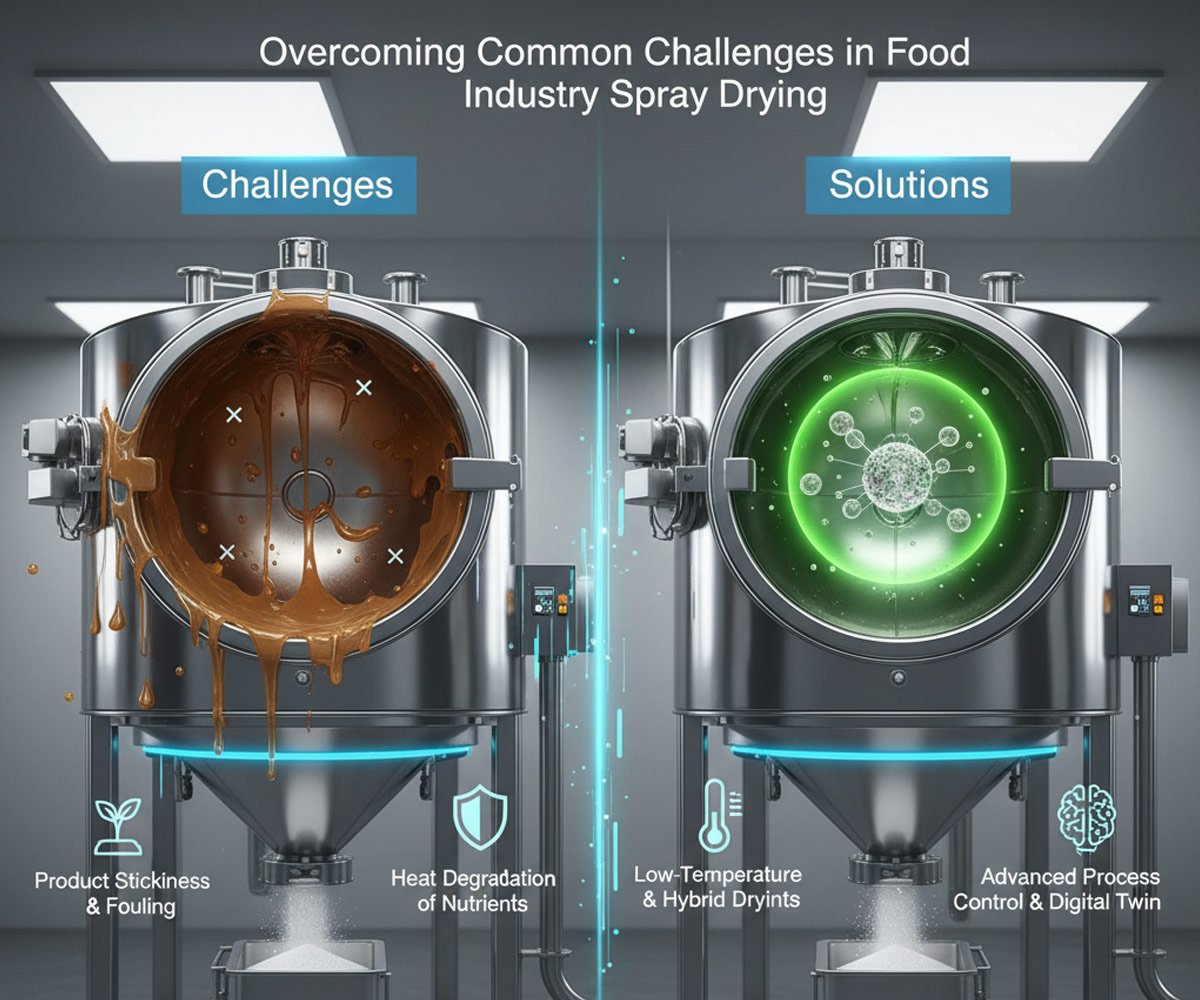
Spray drying is a powerful technique, but like any complex industrial process, it comes with its own set of challenges, especially in the diverse and often sensitive food industry. Successfully overcoming these challenges is crucial for efficient production, consistent quality, and optimal shelf life.
Here are some common challenges encountered in food industry spray drying and effective strategies to solve them:
5 Common Challenges & Solutions in Food Industry Spray Drying
1. Challenge: Product Stickiness and Fouling
- Problem: High sugar or fat content in food products (e.g., fruit juices, dairy concentrates) can make the powder sticky, causing it to adhere to the drying chamber walls and nozzles. This leads to reduced yield, difficult cleaning, and potential product degradation due to prolonged heat exposure.
- Solution Strategies:
- Optimize Drying Conditions: Reduce inlet air temperature and increase outlet air temperature. Use higher airflow rates.
- Add Drying Aids/Carrier Agents: Incorporate non-hygroscopic (non-moisture-absorbing) materials like maltodextrin, gum arabic, or starches into the feed solution. These form a protective matrix around the sticky components.
- Chamber Cooling/Scraping: Introduce cool air jets to the chamber walls or use mechanical scrapers to prevent build-up.
- Nozzle Design: Use specialized nozzles that minimize surface contact or have anti-stick coatings.
2. Challenge: Degradation of Heat-Sensitive Ingredients
- Problem: Many valuable food components (e.g., vitamins, probiotics, certain flavors, enzymes) are sensitive to high temperatures, leading to nutrient loss, off-flavors, or reduced efficacy.
- Solution Strategies:
- Low-Temperature Spray Drying: Reduce inlet air temperature, potentially increasing drying time or requiring higher airflow.
- Spray Freeze Drying (SFD) or Hybrid Drying: For extremely sensitive products, combine spray atomization with freeze-drying for ultra-low temperature processing.
- Microencapsulation: Encapsulate sensitive ingredients within a protective carrier matrix (e.g., proteins, polysaccharides) to shield them from heat during the brief drying period.
- Optimize Residence Time: Design the dryer to ensure the shortest possible residence time for particles in the hot zone.
3. Challenge: Achieving Desired Particle Properties (Size, Density, Flowability, Solubility)
- Problem: Inconsistent or undesirable particle size, low bulk density, poor flowability, or slow dissolution can impact product quality, packaging, and consumer experience.
- Solution Strategies:
- Feed Concentration & Viscosity: Control the total solids content and viscosity of the feed solution. Higher solids content generally leads to larger particles.
- Atomization Control: Adjust atomizer speed (for rotary atomizers) or air pressure (for nozzle atomizers) to control droplet size, which directly influences final particle size.
- Airflow Dynamics: Optimize air inlet and outlet patterns in the chamber to control particle residence time and drying trajectory, affecting particle density and morphology.
- Agglomeration (Post-Drying): For improved solubility and flowability, powders can be further processed through re-wet agglomeration or fluidized bed granulation.
4. Challenge: Low Yield and High Energy Consumption
- Problem: Product loss to chamber walls, inefficient drying, and high energy requirements can negatively impact profitability and sustainability.
- Solution Strategies:
- Dryer Design & Geometry: Optimize chamber dimensions and cyclone design to minimize wall losses and maximize powder collection.
- Advanced Control Systems (Industry 4.0/Digital Twin): Use real-time monitoring and predictive analytics to optimize drying parameters for maximum yield and energy efficiency (e.g., heat recovery systems, optimizing air-to-feed ratio).
- Energy Recovery Systems: Install heat exchangers to recover heat from the exhaust air, preheating the inlet air and significantly reducing energy consumption (often 20-30% savings).
- Feed Concentration: Concentrate the liquid feed as much as possible before spray drying to reduce the amount of water that needs to be evaporated.
5. Challenge: Off-Flavor Development / Volatile Loss
- Problem: Drying can cause the loss of desirable volatile flavor compounds or the formation of undesirable off-flavors due to oxidation or thermal degradation.
- Solution Strategies:
- Microencapsulation: Encapsulating flavors within a protective matrix is highly effective in preventing volatile loss and protecting against oxidation.
- Lower Drying Temperatures: As mentioned above, reduced thermal impact helps preserve delicate flavors.
- Inert Gas Drying (Closed Loop Systems): For highly sensitive flavors, drying in an inert atmosphere (like nitrogen) can prevent oxidation.
- Antioxidant Addition: Incorporate food-grade antioxidants into the feed formulation.
By understanding these common challenges and proactively applying these solution strategies, food manufacturers can leverage spray drying to produce high-quality, consistent, and stable food powders that meet diverse market demands.