
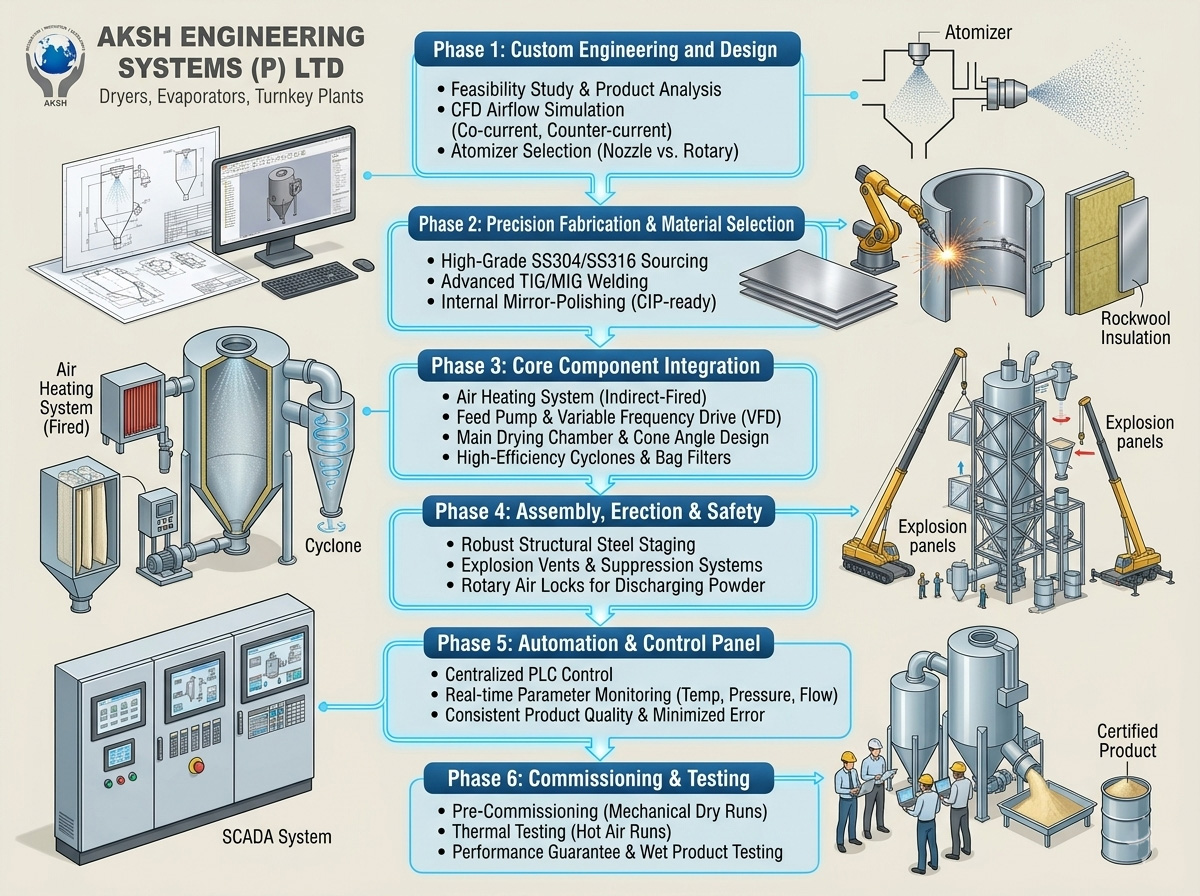
In the modern processing landscape, transforming liquid feeds into high-quality, dry powders efficiently is a cornerstone of success across the food, pharmaceutical, chemical, and dairy industries. Spray drying stands out as the premier technology to achieve this. However, building an efficient, safe, and durable industrial spray dryer requires more than just assembling components—it demands rigorous engineering, precision manufacturing, and flawless execution.
As a premier engineering leader based in Ahmedabad, AKSH Engineering Systems Pvt. Ltd. specializes in delivering turnkey industrial drying solutions. In this comprehensive guide, we walk you through the entire lifecycle of spray dryer construction, from the initial design phase to final commissioning, showcasing how we ensure top-tier performance at every step.
1. Phase 1: Custom Engineering and Design
Every successful spray dryer project begins on the drawing board. Because different materials—whether milk powder, ceramic slurries, or herbal extracts—behave uniquely under thermal stress, a one-size-fits-all approach does not work.
At AKSH Engineering Systems Pvt. Ltd., our engineering process focuses on balancing thermodynamic efficiency with structural integrity.
Material and Fluid Dynamics
The core of spray dryer design lies in understanding the feed characteristics (viscosity, solids content, heat sensitivity) and the desired final powder properties (particle size, bulk density, moisture content). We utilize advanced modeling to determine the optimal drying chamber dimensions, avoiding product deposition on the interior walls.
Selecting the Right Atomizer
The atomizer is the heart of the spray dryer. The choice between a Rotary Disk Atomizer (ideal for high-volume, variable viscosity feeds) and Pressure Nozzles (ideal for narrow particle size distribution and coarse powders) dictates the entire structural layout and height of the drying tower.
Airflow Configuration
Depending on the product’s thermal sensitivity, the system is designed for:
- Co-current Flow: Product and hot air move in the same direction—perfect for heat-sensitive materials.
- Counter-current Flow: Product and air move in opposite directions—ideal for non-heat-sensitive materials requiring high thermal efficiency.
- Mixed Flow: Combining both styles for specific localized particle agglomeration.
2. Phase 2: Raw Material Selection and Precision Fabrication
Once the blueprint is finalized, construction moves to our state-of-the-art fabrication facility in Ahmedabad. Industrial spray dryers operate under high temperatures and, frequently, corrosive environments, making material selection critical.
Premium Material Sourcing
We primarily utilize high-grade Stainless Steel (SS304, SS316, or SS316L) depending on hygiene and corrosion standards. For chemical applications involving abrasive slurries, specialized alloys are employed.
Precision Welding and Finishing
Our skilled fabricators use advanced TIG/MIG welding techniques to ensure flawless joints. In food and pharma applications, the internal surface finish is polished to a mirror or raff finish (typically < 0.8 µm Ra) to prevent product stickiness, eliminate bacterial growth zones, and facilitate easy Clean-In-Place (CIP) cycles.
Insulation and Cladding
To maximize thermal efficiency and prevent heat loss, the entire drying chamber and hot air ducting are heavily insulated with rockwool or mineral wool, enclosed in a neat outer protective cladding of SS304 or aluminum.
3. Phase 3: Core Component Integration
A spray drying system is an ecosystem of interconnected mechanical and thermal components. During the construction phase, these core modules are seamlessly integrated:
| Component Module | Primary Function | AKSH Engineering Design Focus |
| Air Heating System | Generates the thermal energy needed for moisture evaporation. | Can be Direct/Indirect Fired (Gas/Oil) or Steam Radiators tailored to energy availability. |
| Feed Pump System | Delivers the liquid feed to the atomizer at a consistent pressure. | Equipped with Variable Frequency Drives (VFDs) for precise flow rate control. |
| The Drying Chamber | The main vessel where hot air meets the atomized spray. | Engineered with precise cone angles to ensure smooth, gravity-assisted powder discharge. |
| Powder Separation | Separates the dried powder particles from the exhaust air stream. | High-efficiency Cyclones, Bag Filters, or Wet Scrubbers ensuring zero emissions. |
4. Phase 4: Assembly, Erection, and Safety Systems
With all modular components fabricated, the physical assembly takes place on-site or in pre-assembled skid formats.
Structural Support and Layout
Given the vertical height of industrial spray dryers, robust structural steel staging, stairways, and maintenance platforms are engineered to withstand both static weights and dynamic operational vibrations.
Implementing Safety Protocols
Safety is non-negotiable in modern plant operations. Organic powders can create explosive dust environments. At AKSH Engineering Systems Pvt. Ltd., we integrate stringent safety mechanisms directly into the construction:
- Explosion Vents/Venting Panels: Strategically placed panels designed to release pressure safely in case of an accidental dust explosion.
- Deluge Systems: Integrated water nozzles inside the chamber for rapid fire suppression.
- Rotary Air Locks: Installed at the cyclone discharge to maintain a pressure seal while continuously discharging powder.
5. Phase 5: Automation and Control Panel Integration
Modern industrial plants demand absolute precision, which is why the control system is essentially the brain of the spray dryer. We design and assemble centralized PLC (Programmable Logic Controller) and SCADA-based control panels.
This system continuously monitors and self-corrects critical process parameters:
- Inlet and Outlet Air Temperatures
- Feed Pump Speed and Flow Rate
- Chamber Differential Pressure
- Atomizer RPM or Nozzle Pressure
By automating these loops, we ensure consistent powder quality, prevent chamber choking, and significantly minimize human error.
6. Phase 6: Commissioning and Testing
The final transition from a constructed mechanical structure to an active production plant happens during the commissioning phase. This is carried out systematically by our expert commissioning engineers through three distinct stages:
Pre-Commissioning (Dry Runs)
Before introducing any product or heat, all mechanical systems are tested. We check motor rotations, fan balancing, conveyor operations, and verify that there are no air or fluid leaks across the entire loop.
Thermal Commissioning (Hot Air Runs)
The air heaters are ignited, and the system is brought up to its design operating temperatures. This stage checks the thermal expansion of the stainless steel chamber, validates the efficiency of the insulation, and ensures that the control loops respond accurately to temperature fluctuations.
Performance Guarantee Test Runs (Wet Commissioning)
First, water is introduced into the system to verify the atomization pattern and evaporation capacity. Once successful, the actual product feed is introduced. We run the plant at full capacity to verify that the final output meets the exact specifications for moisture content, bulk density, and particle size distribution agreed upon during the design phase.
Why Partner with AKSH Engineering Systems Pvt. Ltd.?
Building an industrial spray dryer is a capital-intensive project that directly impacts your product quality and operational profitability. Based in the industrial hub of Ahmedabad, AKSH Engineering Systems Pvt. Ltd. combines decades of engineering expertise with cutting-edge manufacturing practices to deliver custom, high-performance spray drying plants.
We don’t just supply equipment; we deliver end-to-end solutions tailored to your unique processing needs. From initial feasibility studies and customized thermal design to manufacturing, installation, and rigorous commissioning, our team ensures your project is completed on time and performs beyond expectations.
Partner with us to optimize your production efficiency. Visit our website at www.akshengineering.com or contact our engineering experts today to discuss your upcoming spray drying project requirements.