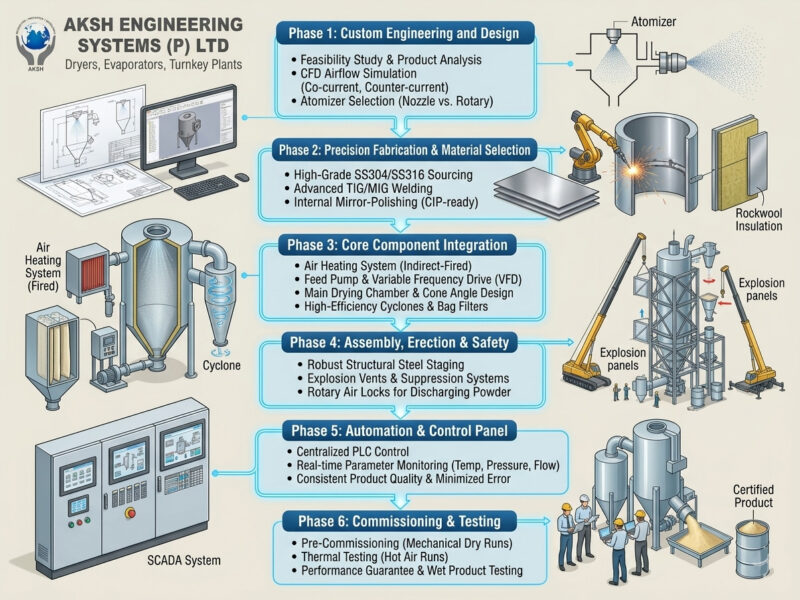
In industrial processing, the choice of construction material isn’t just a technical detail—it is the foundation of product quality, equipment longevity, and operational safety. For industries relying on spray drying technology, this choice holds even greater weight. Spray dryers are subjected to a punishing combination of high temperatures, continuous abrasive airflow, moisture, and chemical exposure.
At AKSH Engineering Systems Pvt. Ltd., based in the industrial hub of Ahmedabad, we design and manufacture high-performance thermal processing equipment that meets stringent global standards. Through our years of engineering excellence, we have seen firsthand how selecting the correct grade of stainless steel directly impacts your bottom line, maintenance cycles, and compliance records.
Whether you are processing dairy products in a hygienic environment or handling aggressive chemicals, this comprehensive guide will help you understand how to choose the right stainless steel grade for your next spray dryer project. Discover more about our engineering capabilities at www.akshengineering.com.
Why Material Selection Matters in Spray Drying
A spray dryer transforms a liquid feed into a dry powder in a matter of seconds. To achieve this, the equipment components—such as the atomizer, air disperser, drying chamber, cyclone, and bag filter—are exposed to severe operational stressors:
- Thermal Stress: Operating temperatures can range from 150°C to well over 300°C depending on the application.
- Corrosion Risk: Liquid feeds can be highly acidic, alkaline, or saline, creating an environment ripe for pitting and crevice corrosion.
- Abrasion and Erosion: High-velocity powder particles continuously scour the internal walls of the drying chamber, cyclones, and ductwork.
- Hygienic Demands: In food, dairy, and pharmaceutical sectors, surfaces must be perfectly smooth to prevent microbial growth and facilitate rigorous Clean-in-Place (CIP) cycles.
Stainless steel is the undisputed material of choice for these systems due to its inherent strength, corrosion resistance, and structural stability under heat. However, “stainless steel” is an umbrella term for a diverse family of alloys, each engineered for distinct operating environments.
Comparing the Key Stainless Steel Grades for Spray Dryers
The most common stainless steel families used in manufacturing industrial spray dryers are Austenitic and Duplex stainless steels. Let us break down the specific grades utilized by AKSH Engineering Systems Pvt. Ltd. to construct robust, application-specific drying systems.
1. SS 304 / 304L: The Industrial Standard
SS 304 is the most widely used austenitic stainless steel, containing approximately 18% chromium and 8% nickel.
- When it is used: It is the go-to choice for non-corrosive or mildly corrosive applications. It is frequently specified for external structural parts, support frames, insulation cladding, and the processing of non-reactive chemicals or standard food items.
- Why the “L” matters: SS 304L is the low-carbon variant. During welding, standard 304 can suffer from carbide precipitation, making the welded joints vulnerable to corrosion. By using 304L, we eliminate this risk, ensuring the structural integrity of large welded components like the main drying chamber cone.
2. SS 316 / 316L: The Superior Corrosion Fighter
When the liquid feed contains chlorides, organic acids, or is being processed under strict hygienic standards, SS 316 becomes essential. The defining feature of SS 316 is the addition of Molybdenum (typically 2% to 3%), which drastically improves its resistance to pitting and crevice corrosion.
- When it is used: It is highly recommended for the food, dairy, infant formula, and pharmaceutical industries. It is also standard for chemical processing lines dealing with moderately aggressive formulations.
- The Hygienic Advantage: SS 316L responds exceptionally well to mechanical polishing and electro-polishing. This allows us to achieve an ultra-smooth internal surface finish (measured in Roughness Average, or Ra), minimizing powder sticking and optimizing CIP efficiency.
3. SS 310 / 310S: The High-Temperature Champion
Standard 304 and 316 grades perform remarkably well under normal operating thermal conditions, but specific high-temperature chemical applications demand something stronger. SS 310 is a high-chromium, high-nickel austenitic steel designed for elevated temperature service.
- When it is used: It is ideal for the hot air generator (HAG) components, air disperser assemblies, and the top inlet zones of the spray dryer where temperatures are at their peak. It resists oxidation at temperatures up to 1035°C under intermittent service..
4. Duplex Stainless Steels (e.g., 2205): The Heavy-Duty Alternative
Duplex stainless steels feature a balanced, two-phase microstructure of both austenite and ferrite. This gives them a dual advantage: exceptional strength and superior resistance to stress corrosion cracking (SCC).
- When it is used: For spray dryers processing highly concentrated saline solutions, brackish materials, or high-chloride chemical slurries where standard 316L would fail due to pitting or stress-induced cracking.
- The Structural Benefit: Because duplex steel is significantly stronger than standard austenitic grades, it allows for thinner chamber walls without sacrificing structural integrity, lowering the overall weight of massive industrial units.
Component-Specific Material Mapping
A high-performance spray dryer is not built out of a single grade of steel. Instead, it is an engineered assembly where different grades are matched to the specific demands of each zone.
| Spray Dryer Component | Primary Stress Factor | Recommended Material Grade |
| Hot Air Generator & Air Disperser | Extreme Heat, Oxidation | SS 310S / SS 304 |
| Atomizer Assembly (Nozzle/Wheel) | High Velocity, Severe Abrasion | Specialty Alloys / Tungsten Carbide inserts housed in SS 316L |
| Main Drying Chamber (Product Contact) | Moisture, Heat, Chemical Action | SS 316L (Hygienic/Chemical) or SS 304L (Standard) |
| Chamber External Cladding | Atmospheric Exposure, Washdowns | SS 304 |
| Cyclones & Ductwork | High-Velocity Particle Abrasion | SS 316L or Duplex 2205 (for abrasive/corrosive powders) |
| Structural Support Frames | Mechanical Load | Carbon Steel (Painted) or SS 304 |
Key Factors to Evaluate When Choosing Your Grade
When collaborating with the engineering team at AKSH Engineering Systems Pvt. Ltd. to design your spray dryer, we guide you through several critical evaluation metrics:
Chemical Composition of the Feed
The pH value, presence of chlorides, and specific chemical compounds in your raw liquid are the primary determinants. Chlorides are notoriously aggressive toward stainless steel, demanding at least an SS 316L or a Duplex grade to avoid premature equipment failure.
Surface Finish Requirements
In the dairy and pharmaceutical sectors, the micro-finish of the steel is just as important as the grade itself. A rough surface allows powder to accumulate, leading to product degradation, burning, or microbial contamination. We provide finishes down to 0.4 μm Ra along with seamless orbital welding to meet sanitary regulations..
Total Cost of Ownership (TCO)
While SS 304L has a lower initial material cost compared to SS 316L or Duplex 2205, opting for a lower grade in an aggressive environment is a costly mistake. Frequent shutdowns for patching, localized corrosion, and premature chamber replacement quickly wipe out any upfront savings. We help you balance capital expenditure (CAPEX) with long-term operational reliability.
Trust AKSH Engineering Systems Pvt. Ltd. for Your Processing Needs
Designing a reliable, highly efficient spray dryer requires an intricate balance of thermal calculations, aerodynamics, and precise metallurgy. Based in Ahmedabad, India’s engineering powerhouse, AKSH Engineering Systems Pvt. Ltd. combines deep domain expertise with cutting-edge manufacturing processes to deliver customized spray drying solutions.
We ensure that every sheet of steel, every weld profile, and every finishing detail matches your exact process parameters. From initial material selection to final commissioning, our focus is on maximizing your yield, minimizing downtime, and ensuring compliance with your industry’s highest standards.
Partner with an expert team that understands the science behind the steel. Visit our website at www.akshengineering.com to explore our product range, read our case studies, or speak with a technical engineer about your custom spray drying requirements today.