In the modern processing landscape, the physical form of a powder is as critical as its chemical composition. “Dusty” powders lead to material loss, cross-contamination, and respiratory hazards. AKSH Engineering Systems specializes in Fluid Bed Drying and Granulation—a process that transforms fine, airborne particles into robust, free-flowing granules. This white paper explores the fluid-dynamic principles that make the fluid bed the gold standard for dust-free powder production.
1. The Anatomy of a “Dusty” Powder
Dust is more than a nuisance; it is an industrial inefficiency. Fine particles (<50 µṃ) exhibit high surface energy, leading to:
- Poor Flowability: Inter-particle friction causes “bridging” in hoppers.
- Segregation: Fines settle at the bottom of packaging, leading to inconsistent dosages.
- Health and Safety Risks: Increased risk of dust explosions and inhalation.
The science of granulation seeks to “enlarge” these particles through controlled agglomeration, a specialty of AKSH industrial systems.
2. The Physics of Fluidization
Fluid bed technology relies on the principle of suspending solid particles in a rising stream of air.
The Three Stages of Fluidization:
- Fixed Bed: Air velocity is low; particles remain stationary.
- Minimum Fluidization (Umf): The upward drag force of the air equals the weight of the particles. The bed begins to “expand.”
- Bubbling Fluidization: The state in which AKSH dryers operate. The air creates a boiling motion, ensuring 100% surface area exposure for rapid heat and mass transfer.
3. Top-Spray Granulation: Building the “Dust-Free” Particle
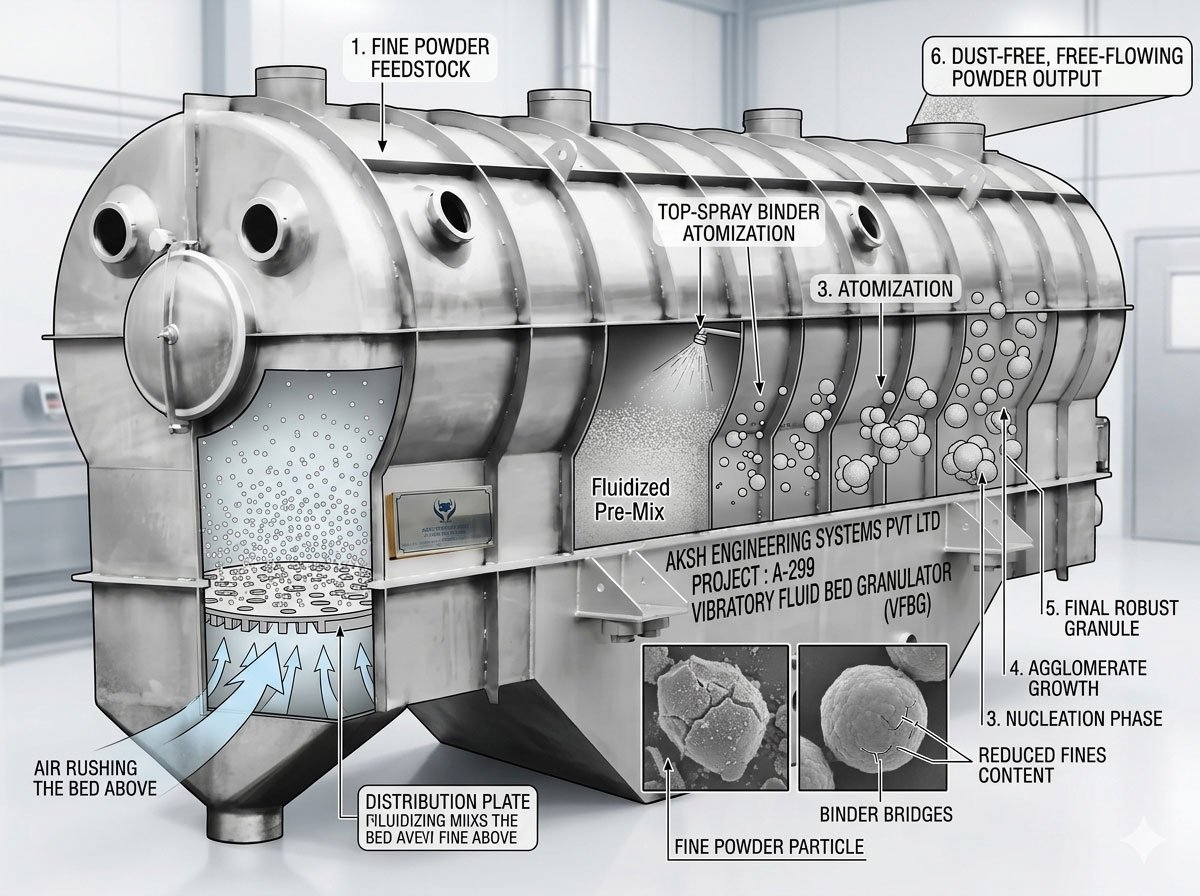
To eliminate dust, we must bind fine particles together. In an AKSH Fluid Bed Granulator, this is achieved through a Top-Spray mechanism.
- Wetting: A liquid binder is atomized and sprayed onto the fluidized powder.
- Nucleation: Liquid bridges form between individual fine particles.
- Growth: As moisture evaporates, the binder hardens, creating a permanent, porous “granule.”
- Attrition Resistance: The turbulent environment of the fluid bed ensures that only the strongest granules survive, while “weak” dust is recaptured and re-granulated.
4. Why Fluid Beds Surpass Other Technologies
| Feature | Tray Drying | Spray Drying | AKSH Fluid Bed |
| Uniformity | Poor (Hot spots) | Excellent | Superior (Constant mixing) |
| Dust Control | None | High fines content | Built-in Agglomeration |
| Porosity | Dense | Hollow/Fragile | Controlled & Robust |
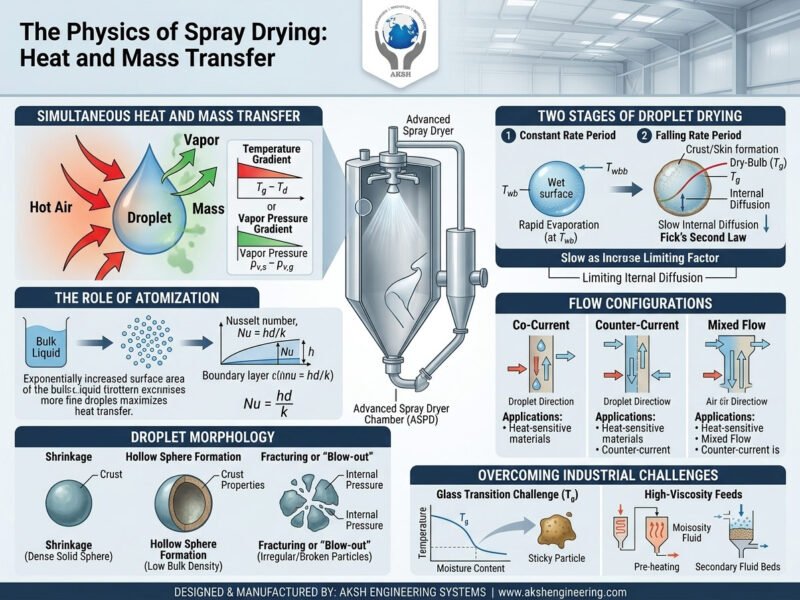
| Thermal Stress | High | Instantaneous | Low & Gentle |
5. Technical Challenges in Granulation
Managing the “Stokes Number” (the ratio of particle momentum to viscous dissipation) is critical. AKSH Engineering focuses on three variables:
- Droplet Size: If binder droplets are too large, the bed “wets out” and collapses.
- Fluidizing Velocity: Must be high enough to suspend granules but low enough to prevent “elutriation” (blowing the product out of the exhaust).
- Dew Point Control: The humidity of the incoming air dictates the rate of bridge hardening.
6. Applications in High-Value Sectors
- Pharmaceuticals: Creating “Instant” granules for tablet compression.
- Agrochemicals: Developing dust-free fertilizers that dissolve predictably in soil.
- Food Science: Engineering “instantized” drink mixes (like cocoa or protein) that sink and dissolve rather than floating on the surface.
7. The AKSH Engineering Advantage
At AKSH Engineering Systems Pvt. Ltd., our Fluid Bed Dryers are engineered for Precision Granulation:
- Advanced Air Distribution: Our “Gillen” plates ensure no “dead zones” where powder can settle and cake.
- Integrated Bag Filters: Automatic pulse-jet cleaning returns fines directly to the granulation zone.
- Wurster Coating Options: For applications requiring functional coatings on the granules.
8. Conclusion
Granulation is the ultimate solution to the “Dust Problem.” By mastering the fluid-dynamic equilibrium within the drying chamber, AKSH Engineering Systems provides manufacturers with powders that aren’t just dry—they are engineered for performance, safety, and flow.