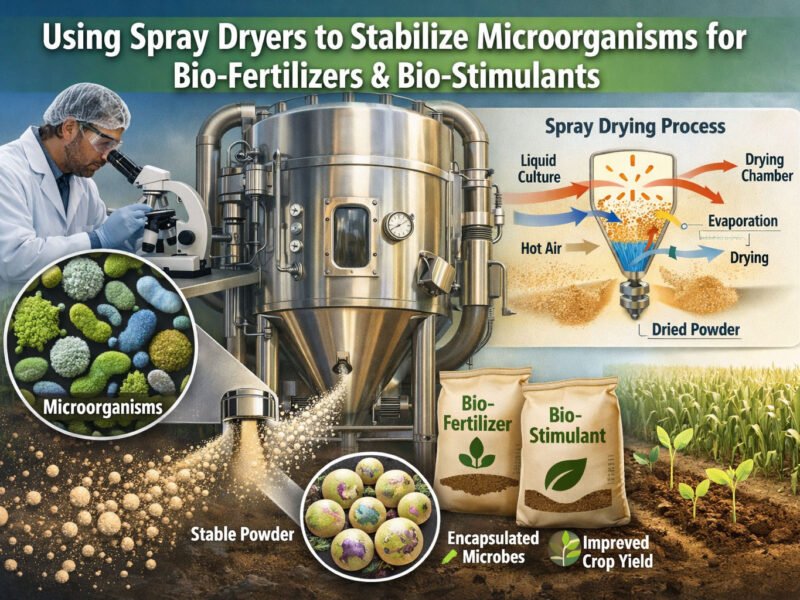

The global shift toward plant-based diets has positioned pea and soy proteins as industry leaders. However, the journey from raw crop to a high-functionality isolate depends heavily on the final dehydration stage. AKSH Engineering Systems specializes in precision spray drying technology, ensuring that the delicate molecular structure of these proteins remains intact while achieving superior solubility and flavor profiles.
1. Introduction: The Plant Protein Revolution
The demand for high-quality protein isolates (containing >90% protein) is driven by the sports nutrition, meat-alternative, and dairy-substitute markets.
- Soy Protein: The gold standard for amino acid profiles.
- Pea Protein: The hypoallergenic, non-GMO rising star.
The challenge lies in the fact that these proteins are highly sensitive to thermal degradation. This is where AKSH Engineering Systems’ specialized spray drying solutions bridge the gap between “commodity grade” and “premium grade.”
2. The Science of Spray Drying in Protein Processing
Spray drying is not just about removing water; it is about engineered particle morphology. The process involves three critical stages:
A. Atomization
The feed (protein slurry) is broken into a fine mist. AKSH utilizes high-pressure nozzles and centrifugal atomizers to control the droplet size distribution, which directly impacts the “instant” solubility of the final powder.
B. Evaporative Cooling
Despite high inlet temperatures, the protein particles stay cool due to the rapid evaporation of moisture. This protects the bioavailability and gelation properties of the pea and soy molecules.
C. Powder Recovery
Using high-efficiency cyclones and bag filters, the fine protein particles are recovered with minimal loss, ensuring high yield for the manufacturer.
3. Optimizing Functional Properties
A high-quality isolate is defined by its functionality. AKSH Engineering’s systems are designed to optimize:
- Solubility: Controlled particle size prevents “clumping” in beverages.
- Emulsification: Maintaining the protein’s ability to bind water and fat—crucial for meat analogues.
- Organoleptic Quality: Reducing “beany” off-flavors through precise thermal residence times.
- Bulk Density: Ensuring the powder fits standardized packaging without settling issues.
4. Technical Challenges: Pea vs. Soy
| Feature | Soy Protein Isolate | Pea Protein Isolate |
| Viscosity | Higher; requires specialized feed pumps. | Lower, but prone to foaming. |
| Thermal Sensitivity | Moderate; sensitive to denaturation. | High; requires lower outlet temperatures. |
| Particle Shape | Typically spherical. | Can be irregular; requires optimized airflow. |
5. Sustainable Engineering by AKSH
Sustainability is no longer optional. Our spray dryers incorporate:
- Heat Recovery Systems: Recirculating exhaust heat to reduce energy consumption by up to 15%.
- CIP (Clean-In-Place) Logic: Minimizing water usage during flavor transitions or batch changes.
- Emission Control: Advanced filtration to ensure zero protein dust escapes into the atmosphere.
6. The AKSH Engineering Advantage
At AKSH Engineering Systems Pvt. Ltd., we don’t believe in “one size fits all.” Our approach includes:
- Pilot Plant Testing: We test your specific slurry to determine the optimal Tinlet and Toutlet parameters.
- Custom Atomizer Design: Tailored to the specific rheology of plant-based slurries.
- Scalability: From 10kg/hr pilot units to multi-ton industrial installations.
7. Conclusion
The role of spray drying is the “make or break” moment in protein isolate production. By partnering with AKSH Engineering Systems, producers ensure that their pea and soy proteins aren’t just dry—they are functional, flavorful, and market-ready.